
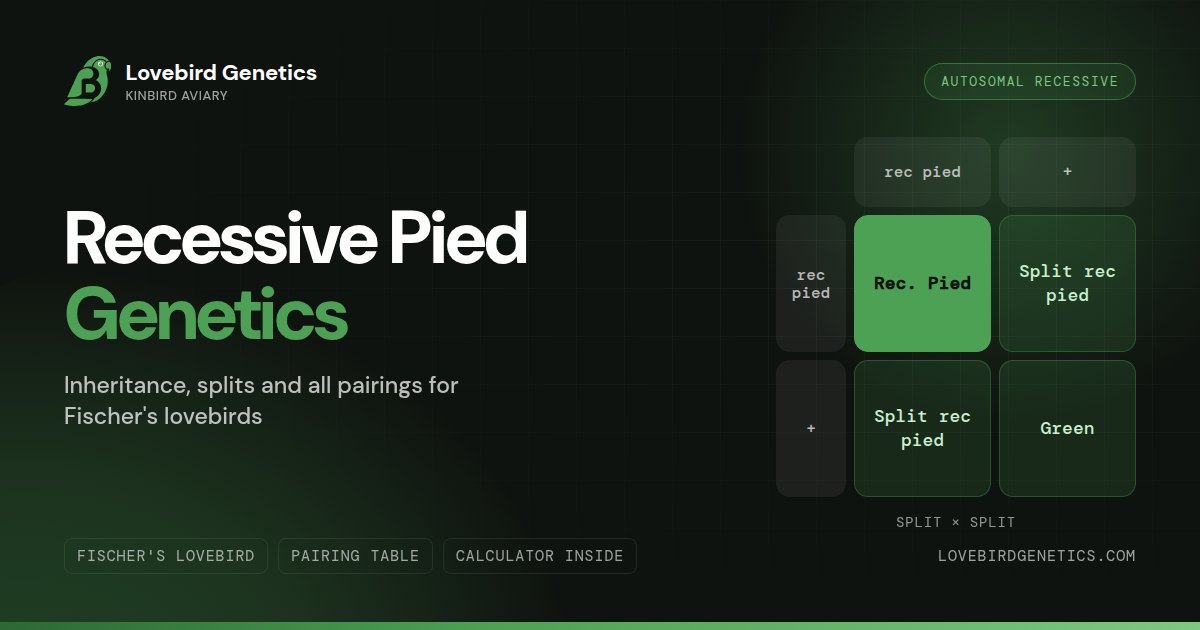
Recessive Pied in Fischer's lovebirds is autosomal recessive. Melanin is absent from irregular patches of feathering, so those patches appear yellow on a green series bird and white on a blue series bird, against normally coloured plumage everywhere else. Two copies are needed for the bird to show it. One copy stays completely hidden, which means a split Recessive Pied looks exactly like a normal bird and both cocks and hens can carry it invisibly. Because the gene is autosomal, reversing a pairing changes nothing. The pattern itself is variable, so two visual Recessive Pied birds can differ a lot in how much clear area they show. The mutation people confuse it with is a different gene entirely: Dominant Pied lovebird genetics works the opposite way, showing with a single copy and having no split form at all. Our calculator models Recessive Pied as trait RecPied with Visual and Split statuses, and Dominant Pied separately.
Pied is not a colour mutation in the ordinary sense. Most mutations change the amount or the type of pigment across the whole bird evenly, which is why a Dilute or a Pastel looks like a lighter version of itself from head to tail. A pied mutation does something different: it prevents melanin from being deposited at all in certain feather-forming areas, while leaving the rest of the plumage untouched. Because the instruction affects where pigment is laid down rather than how much, the same genotype can produce visibly different patterns in different individuals (Van den Abeele, Lovebird Compendium, 2016).
What is a Recessive Pied lovebird?
A Recessive Pied lovebird carries two copies of an autosomal recessive mutation that stops melanin forming in irregular patches. Those clear patches appear yellow on green series birds and white on blue series birds, against normal colouring elsewhere. One copy alone shows nothing.
Every normally coloured Fischer's lovebird lays down eumelanin, the dark pigment that supplies depth and structure in the feather, alongside the psittacine pigments that supply yellow and orange. Where both are present on a green bird, the eye reads green. Take the eumelanin away from a patch of that bird and the underlying psittacine yellow is all that is left in that patch, so it reads yellow. Do the same on a blue series bird, which has no psittacine yellow to begin with, and the patch has nothing left to show at all, so it reads white.
That single mechanism explains everything you see on a pied bird:
- Recessive Pied Green shows yellow patches against green. The contrast is high and the bird is unmistakable in a flight cage.
- Recessive Pied Blue 1 and Recessive Pied Blue 2 show white patches against blue. Again high contrast, and on a well marked bird the clear areas can be striking.
- Recessive Pied Aqua B1, Aqua B2 and Aqua Homo show clear areas that read as a very pale cream or off-white, because the aqua series carries a partial amount of psittacine yellow depending on grade. The more aqua the bird, the whiter the clear patches read.
- Recessive Pied Parblue gives the least contrast of the common combinations, because a parblue bird is already carrying a strong yellow expression across the body, so the clear yellow patches sit closer in tone to the coloured areas.
The beak and the eyes are not part of the pied mechanism. Recessive Pied birds have normal dark eyes at every age, with no red or plum reflection under a torch, which immediately separates a heavily marked pied from any ino-type bird. There is also no viability concern here. A visual Recessive Pied should be as strong and as long lived as any other bird, and a pairing of two visuals carries none of the mortality risk that attaches to recessives such as Bronze Fallow.
Recessive Pied does not dilute the bird, does not soften it and does not change the colour of the areas it leaves alone. A coloured patch on a Recessive Pied Green is exactly as green as a normal green bird, and a clear patch has no melanin at all. There is no in-between. That all-or-nothing quality per feather area is what separates a pied from a dilution mutation, and it is the fastest visual check you can make.
Where the clear areas land is not fixed. Some birds carry most of it across the nape, some on the flights and the shoulder, some in a broad band across the abdomen. Two visual Recessive Pied siblings from the same nest, carrying exactly the same two alleles, can look substantially different. That variability is normal, and covered further down this page.
How does Recessive Pied inherit in lovebirds?
Recessive Pied is autosomal recessive. A bird needs two copies to show the pattern and one copy to be split for it. Both cocks and hens can be split, and reversing a pairing never changes the outcome, which is the opposite of how a sex-linked mutation behaves.
Autosomal means the gene sits on an ordinary chromosome rather than a sex chromosome. In birds, cocks are ZZ and hens are ZW, so a sex-linked mutation such as Opaline or Cinnamon sits on the Z and hens can never be split for it. Recessive Pied is not on the Z. It is on an autosome, and both sexes carry two copies of every autosome, so both sexes have the same three possible states.
- Visual Recessive Pied. Two Recessive Pied alleles. The bird shows pied markings. It can only ever pass a Recessive Pied allele to its chicks, which makes it the most useful bird in any pied breeding plan.
- Split for Recessive Pied. One Recessive Pied allele and one normal allele. The bird looks completely normal, and passes Recessive Pied to half its chicks on average.
- Pure normal. No Recessive Pied allele at all. Cannot contribute the mutation to any chick.
The second state is where nearly every planning error in a pied line begins. A split Recessive Pied is completely invisible: no faint clear feather in the wing, no pale toenail, no smudge across the nape. If a bird is described as split for Recessive Pied, that rests entirely on its parentage or on a test pairing, never on a photograph. The guide on what a split lovebird is works through the concept from the ground up.
The other consequence of autosomal inheritance is a helpful one: reversing the pairing changes nothing. A Recessive Pied cock over a normal hen produces exactly the same clutch as a normal cock over a Recessive Pied hen, so every table on this page is direction-independent. With Opaline or Cinnamon the reversal produces a completely different result and in one direction the chicks even auto-sex, as the guide on sex-linked mutations in lovebirds explains.
We treat every incoming pied bird as an unknown until the paperwork says otherwise. A pied bird from a market tells you it has pied markings and nothing else. It does not tell you whether those markings come from two recessive copies or one dominant copy. The record card gets three separate lines: what the bird shows, what the previous keeper claimed, and what we have confirmed from a pairing. Merging those three is how a line quietly goes wrong.
What is the difference between Recessive Pied and Dominant Pied?
They are different genes at different loci. Recessive Pied is autosomal recessive, needs two copies, and hides completely in a split. Dominant Pied is autosomal dominant, shows with a single copy, and has no split form at all. They do not substitute for each other.
This is the section that matters most, because it is where the majority of pied confusion in the hobby lives. Fischer's lovebirds have two independent pied systems, and both produce clear patches of feathering that a photograph cannot tell apart. Everything else about them is opposite.
Recessive Pied needs two copies. One copy does nothing visible. The mutation can therefore travel through a line for generations without a single pied bird appearing, hiding in split after split, until two carriers happen to be paired and a pied chick arrives apparently out of nowhere. Breeders who have never bought a pied bird sometimes produce one, and the explanation is always the same: two of their birds were splits.
Dominant Pied needs one copy. A single dominant allele already produces visible pied markings, which means there is no such thing as a split Dominant Pied. The mutation cannot hide. If a bird carries it, the bird shows it. That makes a Dominant Pied line far easier to track, and it is why the two mutations demand completely different breeding strategies. The full breakdown, including single factor and double factor behaviour, is in the Dominant Pied guide.
Because they are separate genes at separate loci, they are inherited independently. A bird can carry both, and a visual Dominant Pied that is also split for Recessive Pied looks exactly like one that carries nothing extra. Pairing a Recessive Pied to a Dominant Pied does not combine the two into a stronger pied. Each gene simply follows its own rules in each chick, and the pairing table further down works through what comes out.
You cannot identify the pied system from appearance. A bird showing pied markings is either carrying two Recessive Pied copies or at least one Dominant Pied copy, and no amount of studying the pattern separates those two possibilities reliably. Only pedigree or a test pairing settles it. For a pied bird with no verified parentage the honest entry on the card is "pied, system unknown", and the first thing to plan is the pairing that resolves it.
The practical test is straightforward. Pair the unknown pied bird to a plain normal bird with no pied ancestry at all and look at the clutch:
- If roughly half the chicks show pied markings, the parent was a single factor Dominant Pied. A dominant allele passes to half the chicks and shows in every chick that receives it.
- If every chick shows pied markings, the parent was a double factor Dominant Pied, since it can only pass a dominant allele.
- If no chick shows pied markings at all, the parent was a visual Recessive Pied. Every chick received one recessive copy from it and one normal copy from the other parent, so the whole clutch is split and none of them show anything. This is the clearest single result in the entire pied question.
One clutch answers it. That is why we run the test pairing before building any long-term plan around a pied bird of unknown origin, and why this article and the Dominant Pied guide are written as a pair. The two mutations share a name and nothing else.
| Recessive Pied | Dominant Pied | |
|---|---|---|
| Inheritance mode | Autosomal recessive | Autosomal dominant |
| Gene and locus | Its own locus | A different locus, inherited independently |
| Copies needed to show | Two | One |
| Is there a split form? | Yes, and it is completely invisible | No, a carrier always shows |
| Can it hide in a line? | Yes, indefinitely | No, never |
| Can hens carry it hidden? | Yes, exactly as cocks can | No split form exists for either sex |
| Does reversing the pairing matter? | No | No |
| Calculator statuses | Visual, Split | SF, DF |
| Calculator trait id | RecPied | DomPied |
| Full guide | This page | Dominant Pied lovebird genetics |
Two separate genes producing a superficially similar pattern. They do not substitute for each other and they do not combine into a single stronger pied.
One note on terminology, because it comes up constantly in breeder groups. The word "pied" on its own is not a genetic statement. It describes an appearance shared by at least three genetic situations in Agapornis fischeri: Recessive Pied, Dominant Pied, and the multi factorial mottle discussed near the end of this page. Treat it on a leg-ring card as a description to verify, not a genotype to plan around.
Recessive Pied pairing outcomes, cock × hen
Six pairings cover almost every Recessive Pied decision. Because Recessive Pied is autosomal, every outcome below applies equally to cocks and hens, and swapping the cock and the hen changes nothing at all. That is the opposite of a sex-linked mutation, where the direction of the cross decides the result.
Read every table as a percentage per chick, not a guarantee per clutch. A twenty five percent outcome means each individual chick has a one in four chance of being that type, so a clutch of four can easily contain no visual Recessive Pied at all, or four of them. Over a season the numbers settle towards the expectation, but a single nest never has to obey it.
Recessive Pied cock × Recessive Pied hen
One hundred percent visual Recessive Pied chicks, in both sexes. Each parent carries two Recessive Pied alleles and can pass nothing else, so every chick receives one from each side and shows the pattern. There are no splits and no normals in this nest, and nothing needs testing afterwards.
| Offspring | Percentage | Sex | Notes |
|---|---|---|---|
| Visual Recessive Pied | 100% | Cocks and hens | Two Recessive Pied alleles. Breeds true. Pattern amount still varies chick to chick |
Every chick is a visual, but the amount of clear feathering each one carries is not predictable from the parents.
→ Run this pairing in the calculatorRecessive Pied cock × normal hen
One hundred percent normal-looking chicks, every one of them split for Recessive Pied, in both sexes. The visual parent passes a Recessive Pied allele to every chick, the normal parent passes a normal allele, and the normal allele masks the pied entirely. No pied-marked chick can appear here.
| Offspring | Percentage | Sex | Notes |
|---|---|---|---|
| Normal / Recessive Pied (split) | 100% | Cocks and hens | Looks completely normal. Guaranteed to carry one Recessive Pied allele. Identical result if reversed |
This is the most useful pairing in the whole set, because it produces guaranteed splits that need no testing later.
→ Run this pairing in the calculatorSplit Recessive Pied cock × split Recessive Pied hen
Twenty five percent visual Recessive Pied, fifty percent split, twenty five percent genetically pure normal, evenly across both sexes. This is the standard autosomal recessive ratio. The catch is that the split and pure normal chicks are visually identical, so three quarters of the nest cannot be sorted by eye.
| Offspring | Percentage | Sex | Notes |
|---|---|---|---|
| Visual Recessive Pied | 25% | Cocks and hens | The only chicks in this nest you can identify by looking at them |
| Normal / Recessive Pied (split) | 50% | Cocks and hens | Indistinguishable from the pure normal chicks without a test pairing |
| Pure normal | 25% | Cocks and hens | No Recessive Pied allele at all. Carries nothing forward |
Any normal-looking chick from this nest has a two in three chance of being split, which is a probability, not a status. Record it as such.
→ Run this pairing in the calculatorRecessive Pied cock × split Recessive Pied hen
Fifty percent visual Recessive Pied and fifty percent split, in both sexes. No pure normal chick is possible, because the visual parent contributes a Recessive Pied allele to every chick. Every bird out of this nest carries the mutation whether it shows it or not.
| Offspring | Percentage | Sex | Notes |
|---|---|---|---|
| Visual Recessive Pied | 50% | Cocks and hens | Two Recessive Pied alleles |
| Normal / Recessive Pied (split) | 50% | Cocks and hens | Guaranteed split, no test pairing needed, because the visual parent can only give Recessive Pied |
Nothing in this nest is ambiguous. Every chick is either a visual or a certain split, which is why this pairing beats split by split every time.
→ Run this pairing in the calculatorSplit Recessive Pied cock × normal hen
Fifty percent split and fifty percent genetically pure normal, in both sexes, and not one visual Recessive Pied chick. The split parent passes a Recessive Pied allele to about half the clutch, the normal parent passes a normal allele to all of them, so no chick can ever receive two Recessive Pied alleles. Every chick in this nest looks completely normal and half of them are hiding the gene.
| Offspring | Percentage | Sex | Notes |
|---|---|---|---|
| Normal / Recessive Pied (split) | 50% | Cocks and hens | Carries one Recessive Pied allele. Looks identical to the pure normal chicks |
| Pure normal | 50% | Cocks and hens | No Recessive Pied allele at all. Carries nothing forward |
| Visual Recessive Pied | 0% | Neither sex | Impossible here. The normal parent can only contribute a normal allele |
This is the pairing that quietly loses a line. Nothing in the nest is identifiable by eye, and each normal-looking chick is only a fifty percent possible split, so record it as a possibility and test it later.
→ Run this pairing in the calculatorRecessive Pied cock × Dominant Pied hen
No visual Recessive Pied chicks at all. These are different genes, so the chicks inherit each one independently. Every chick receives one Recessive Pied allele from the visual parent and is therefore split for it, hidden. Separately, a single factor Dominant Pied parent passes its dominant allele to about half the clutch, so roughly fifty percent show Dominant Pied markings.
| Offspring | Percentage | Sex | Notes |
|---|---|---|---|
| Dominant Pied, split Recessive Pied | 50% | Cocks and hens | Shows pied markings from the dominant gene only. Also carries one hidden Recessive Pied allele |
| Normal-looking, split Recessive Pied | 50% | Cocks and hens | Did not receive the dominant allele. Looks like a plain bird, carries one hidden Recessive Pied allele |
| Visual Recessive Pied | 0% | Neither sex | Impossible here. The Dominant Pied parent contributes a normal allele at the Recessive Pied locus |
Every chick in this nest is split for Recessive Pied, whether it looks pied or not. If the Dominant Pied parent is double factor instead, one hundred percent of the chicks show Dominant Pied and one hundred percent are still split for Recessive Pied. See the Dominant Pied guide for the single factor and double factor detail.
→ Run this pairing in the calculatorEvery pairing above gives the identical result when you swap the cock and the hen. A Recessive Pied cock over a normal hen and a normal cock over a Recessive Pied hen both give one hundred percent hidden splits. That is the practical signature of an autosomal gene. With Opaline or Cinnamon, reversing the pairing changes the answer completely and in one direction the chicks even sex themselves in the nest.
Run your own Recessive Pied pairing in seconds
Recessive Pied and Dominant Pied modelled separately, across every base colourHow do you find hidden Recessive Pied splits in your aviary?
Test pair the suspect bird to a visual Recessive Pied. If it is split, roughly half the chicks show pied markings. If it is pure normal, none do. A single pied chick proves the split immediately, while a run of normal chicks only makes it progressively less likely.
Because a split shows nothing, the only way to confirm one is to breed it, and the test pairing that works is the suspect bird to a visual. A visual Recessive Pied contributes a Recessive Pied allele to every chick, so whatever the unknown parent contributes decides the chick's appearance directly:
- If the unknown bird is split, it passes Recessive Pied to half its chicks, and those chicks are visual. The other half are hidden splits. Expected outcome: about fifty percent pied-marked chicks.
- If the unknown bird is pure normal, every chick is a hidden split and not one shows pied. Expected outcome: zero pied-marked chicks, no matter how many you raise.
That asymmetry is the important part. One pied chick settles the question permanently. A run of normal chicks never proves the negative, it only shrinks the probability. Each normal chick halves the remaining chance that the bird was split, so five in a row leave roughly a three percent chance and eight leave well under one percent. At some point you accept the result, but you should know you accepted a probability rather than a proof.
| Normal-looking chicks in a row | Chance the parent is still a split | What to record |
|---|---|---|
| 1 | 50% | Nothing proved yet |
| 2 | 25% | Still an open question |
| 3 | 12.5% | Leaning towards pure normal |
| 4 | 6.3% | Probably not split |
| 5 | 3.1% | Working assumption: not split |
| 6 or more | <2% | Treat as pure normal, note the basis |
A single pied chick at any point ends the test and proves the split. The table only applies while every chick has looked normal.
Two shortcuts save a great deal of this work, and both are about paperwork rather than breeding.
Use guaranteed splits wherever possible. Any chick from a visual Recessive Pied paired to anything at all is guaranteed to carry one Recessive Pied allele, and needs no testing ever. If you are building a pied line from scratch, start with a visual and produce your splits deliberately.
Separate "confirmed" from "possible" on the card. A normal-looking chick from a split by split pairing is a possible split with a two in three probability, not a split. The calculator makes the same distinction rather than folding the two together, which is one reason the pairing outcomes hub repays reading alongside this page.
The worst mistake we have made with any recessive was not a breeding mistake, it was a filing mistake. A bird recorded as "split pied" turned out, once we traced the ring numbers, to have come out of a split by split nest, which made it a possible split at best. Two seasons were planned around a bird with a one in three chance of carrying nothing. Now every card carries the certainty alongside the status: confirmed by parentage, confirmed by test pairing, or possible only.
Why is the pied pattern different on every bird?
Because the gene controls where pigment is switched off, not how much. The Recessive Pied gene sets up the possibility of clear areas, but the exact placement and extent varies between individuals. Two visual Recessive Pied birds can therefore look quite different from each other.
This surprises breeders coming from mutations like Dilute or Pastel, where the same genotype gives a very consistent look. Pied does not behave that way. A clutch of visual Recessive Pied siblings, all carrying exactly the same two alleles, can contain one bird with a small clear patch on the nape, one with clear flights and a clear abdomen, and one that is more than half clear.
The practical consequences need stating plainly:
- The amount of clear area is not a genetic status. A lightly marked visual Recessive Pied carries exactly the same two alleles as a heavily marked one. It is not "half pied", it is not "split pied", and it breeds identically.
- A calculator cannot predict pattern. Our engine, and every honest engine, predicts whether a chick will be a visual, a split or a normal. It does not predict how much clear feathering a visual chick will carry.
- Selection shifts the average slowly. Breeders who consistently pair their most evenly marked visuals together tend to raise the average quality of marking over several generations. That is selection on background genetics, not on the pied gene itself.
- A very lightly marked bird can be missed. If the clear area is a single feather under the wing, a visual can be catalogued as a normal, which is an argument for checking chicks properly at first full feathering.
A heavily marked visual Recessive Pied and a lightly marked visual Recessive Pied are genetically identical at the pied locus. Neither one is "more pied" in a way that passes on directly, and pairing two heavily marked birds does not guarantee heavily marked chicks. If you see a bird described as a "high pied split" or a "25 percent pied", treat those as descriptions of appearance, not as genetic categories. The gene has exactly three states in any bird: two copies, one copy, or none.
The same variability is why pied birds are difficult to identify from photographs. Two images of the same genotype can look like different mutations, and one Recessive Pied next to one Dominant Pied can look almost identical. That is exactly why Dominant Pied lovebird genetics has to be settled by breeding behaviour rather than by eye.
What about Mottle or progressive pied?
Mottle is a separate thing. Ornitho-Genetics VZW lists mottle in MutaBase as autosomal multi factorial, and its defining feature is that the clear area increases with every moult. Because several genes influence it, no calculator can give fixed percentages, so ours does not model it.
Mottle, often called progressive pied, is the third pattern filed under "pied" in the hobby, and it behaves unlike either of the other two. A mottled bird may carry almost no clear feathering as a youngster and become progressively more marked as it moults through successive years. The change is gradual and continues over several moults, which is where the word progressive comes from.
The genetics behind that behaviour are why it sits outside the calculator. Ornitho-Genetics VZW records mottle in its MutaBase entry for mottle as autosomal multi factorial, meaning the trait is influenced by more than one gene rather than by a single locus with clean dominant or recessive behaviour. That has three consequences for a breeder:
- There is no fixed percentage. A single-gene recessive gives clean twenty five, fifty and one hundred percent outcomes. A multi factorial trait does not, because the result depends on how many contributing genes each chick inherits.
- There is no clean split. "Split mottle" does not map onto a multi factorial trait the way it maps onto Recessive Pied, where the two-allele model is exact.
- The phenotype changes with age. Any assessment of a mottled bird is a snapshot, so a record made at six months is not a description of the adult.
Because of all three, our calculator does not model mottle, and we would treat any calculator offering confident mottle percentages with suspicion. Recessive Pied, by contrast, is a clean single-gene autosomal recessive, which is exactly why it can be modelled precisely and why every table on this page is exact.
Recessive Pied: one gene, autosomal recessive, two copies to show, invisible splits exist, modelled by the calculator. Dominant Pied: a different gene, autosomal dominant, one copy shows, no splits exist, also modelled. Mottle: autosomal multi factorial per Ornitho-Genetics VZW, clear area increases with each moult, no fixed percentages possible, not modelled. Three names, three genetic systems, one shared appearance.
If you are working through the full mutation landscape rather than just the pied group, the Fischer's lovebird mutations hub lists every documented mutation alongside its inheritance mode, which is the fastest way to see where the pied genes sit relative to everything else in the species.
How does the calculator handle Recessive Pied?
As a true autosomal recessive with two statuses. Recessive Pied is trait id RecPied with Visual and Split options for either parent. Dominant Pied is a separate trait, DomPied, with SF and DF options, so the two pied systems never get merged into one.
Keeping the two pied genes separate in the engine sounds obvious and is exactly what several tools get wrong. A calculator offering a single "Pied" trait cannot produce correct answers, because the two genes give opposite results from identical-looking parents. Our Lovebird Genetics Calculator models them independently, so a Recessive Pied paired to a Dominant Pied returns the outcome shown in the table earlier on this page rather than a merged approximation.
What that means when you use it:
- Recessive Pied appears under Autosomal Recessive, with Visual and Split statuses for either parent, exactly like Dilute, Pale Fallow and Dun Fallow.
- Dominant Pied appears under Dominant, with SF and DF statuses rather than Visual and Split, because a dominant mutation has no split form. Selecting DF returns one hundred percent pied-marked chicks.
- Both can be selected on the same bird, because they occupy separate loci and are inherited independently.
- Results separate confirmed splits from possible splits, so you can copy a result into a record card without turning a probability into a claim.
- Pattern amount is never predicted. The engine gives the genotype and the visual category, not how much clear feathering a chick will show.
If the interface is new to you, the step-by-step walkthrough covers entering each parent and reading the results panel. For the underlying concepts, lovebird colour genetics explains eumelanin, psittacine pigment and the four inheritance modes, and the complete lovebird genetics guide ties every mutation group together. For pied specifically, this article and the Dominant Pied guide are designed to be read together, because almost every real pied question in an aviary is a question about which of the two genes is present.
The reference material behind all of this is public. Ornitho-Genetics VZW maintains MutaBase, the database recording the inheritance classification of each named mutation across parrot species, and publishes its research through ogvzw.org. The base reference for everything on this page is Dirk Van den Abeele's Lovebird Compendium (2016).
References
- Van den Abeele, D. (2016). Lovebird Compendium. Ornitho-Media. ISBN 978-90-822990-0-3. (Base reference: pattern mutations, melanin deposition, autosomal recessive and autosomal dominant inheritance in Agapornis.)
- Ornitho-Genetics VZW. MutaBase mutation database. Accessed 2026. (Inheritance classification of the recessive and dominant pied mutations.)
- Ornitho-Genetics VZW. MutaBase entry: Mottle. Accessed 2026. (Mottle classified as autosomal multi factorial, clear area increasing with each moult.)
- Ornitho-Genetics VZW. Research and publications of the MUTAVI Research & Advice Group.
- KinBird Aviary engine notes (2026). RecPied and DomPied implementation in the Lovebird Genetics Calculator, verified against the Compendium's inheritance model.
Frequently asked questions
What is a Recessive Pied lovebird?
A Recessive Pied lovebird is a Fischer's lovebird carrying two copies of an autosomal recessive mutation that switches melanin off in irregular patches. Wherever melanin is missing the feather loses its dark component, so those patches read yellow on a green series bird and white on a blue series bird, while the rest of the bird keeps normal colour. The clear areas have no fixed position or size, which is why two visual Recessive Pied birds from the same nest can look quite different. Because the mutation is autosomal, both sexes can carry it hidden as a split.
Is Recessive Pied in lovebirds sex-linked or autosomal recessive?
Recessive Pied is autosomal recessive. It sits on an ordinary chromosome rather than the Z sex chromosome, so a bird needs two copies to show the pied pattern and one copy to be split for it. Cocks and hens can both be split, and swapping the cock and the hen changes nothing about the outcome. That is the quickest way to separate it from sex-linked mutations such as Opaline or Cinnamon, where hens can never be split.
What do you get from a Recessive Pied cock x normal hen?
One hundred percent normal-looking chicks, every one of them split for Recessive Pied, in both sexes. The visual parent can only pass a Recessive Pied allele and the normal parent can only pass a normal allele, so the normal allele masks the pied completely. No pied-marked chick can appear in this nest. The same applies if you reverse the pairing, because the gene is autosomal.
What do you get from a split Recessive Pied cock x split Recessive Pied hen?
Twenty five percent visual Recessive Pied, fifty percent split, and twenty five percent genetically pure normal, spread evenly across both sexes. This is the standard autosomal recessive ratio. The difficulty is that the split chicks and the pure normal chicks look identical, so three quarters of the clutch cannot be sorted by eye. Only a test pairing back to a visual Recessive Pied separates them.
What do you get from a Recessive Pied cock x Dominant Pied hen?
No visual Recessive Pied chicks at all. Recessive Pied and Dominant Pied are different genes at different loci, so each chick inherits them independently. Every chick receives one Recessive Pied allele from the visual parent and a normal one from the Dominant Pied parent, so the whole clutch is split for Recessive Pied but none of them show it. Separately, a single factor Dominant Pied parent passes its dominant allele to half the clutch, so about fifty percent show Dominant Pied markings.
What is the difference between Recessive Pied and Dominant Pied?
They are different genes at different loci, inherited in opposite ways. Recessive Pied is autosomal recessive: two copies are needed before the bird shows any pied marking, and a single copy hides completely, so a split looks like an ordinary bird. Dominant Pied is autosomal dominant: a single copy already shows, so there is no split form and it cannot hide in a line. They do not substitute for each other, and pairing the two does not produce a stronger pied. A pied-marked bird is either carrying two recessive copies or at least one dominant copy, and only the pedigree or a test pairing tells you which. The full breakdown is in our Dominant Pied lovebird genetics guide.
Can you tell a split Recessive Pied by looking at it?
No. A single Recessive Pied allele produces no visible marking at all, so a split Recessive Pied looks exactly like a normal bird of the same base colour. Any claim that a bird is split for Recessive Pied rests entirely on its parentage or on a test pairing to a visual Recessive Pied, never on its appearance.
Is Mottle the same as Recessive Pied in lovebirds?
No. Mottle, sometimes called progressive pied, is a separate thing. Ornitho-Genetics VZW lists mottle in its MutaBase database as autosomal multi factorial rather than a single recessive gene, and the defining feature is that the clear area increases with each moult. Because several genes influence how much clear area appears, no calculator can give fixed percentages for mottle, and ours does not model it. Recessive Pied is a single autosomal recessive gene with a pattern set from the first full feathering.