
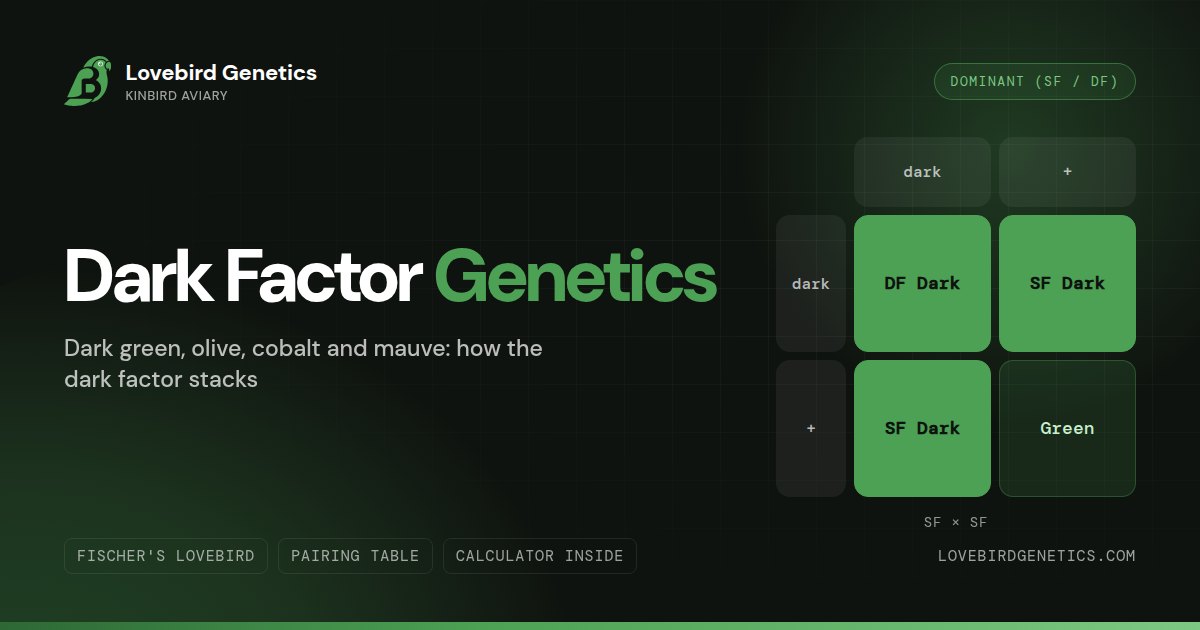
Dark Factor in Fischer's lovebirds is an autosomal incomplete dominant mutation, one copy (SF) deepens body colour; two copies (DF) deepens it further. Dark Factor works on ALL base colours: green-series produces Dark Green (SF) and Olive (DF); blue-series produces Cobalt (SF) and Mauve (DF). It does NOT add extra melanin, it narrows the spongy zone of feather microstructure.
Mechanism: Spongy zone narrowing in feather microstructure, NOT extra eumelanin added
Mode: Autosomal dominant incomplete (codominant), one copy shows, two copies show more
No splits: Every copy of Dark Factor changes the bird's appearance. There is no hidden carrier form.
Six colour forms: Light Green, Dark Green, Olive (green series) · Blue, Cobalt, Mauve (blue series)
Dark Factor is an autosomal incomplete-dominant mutation and cannot be carried as a split. It does not add pigment; it narrows the spongy zone in the feather so the blue interference reads darker, turning green to dark green (single factor) or olive (double factor). It first appeared in Agapornis roseicollis in Australia in 1968. Avoid double-factor to double-factor pairings, as the plumage loosens (Lovebird Compendium, pp. 275 to 283).
What Dark Factor Actually Does, The Spongy Zone
The Dark Factor in lovebirds is an autosomal incomplete-dominant modifier that makes a colour read darker, not by adding pigment but by narrowing the feather's structure. One factor (SF) gives dark green or cobalt, two factors (DF) give olive or mauve. It cannot be carried as a hidden split.
The colour of a lovebird's body feather is produced by two systems working together. The first is pigment: eumelanin (the dark melanin in the feather barbules) and psittacofulvins (the yellow-red pigments unique to parrots). The second is feather microstructure: a layer of sponge-like cells called the spongy zone (or medullary layer) that scatters short-wavelength light, producing the structural blue-green colour you see even before pigment is applied on top.
Dark Factor does not touch the pigment system. It has no effect on how much eumelanin or psittacofulvin a bird produces. Instead, Dark Factor narrows the spongy zone, it physically compresses the light-scattering layer. When the spongy zone is narrower, it scatters shorter wavelengths (shifting the structural colour toward blue and away from green-yellow), which makes the overall plumage appear denser and darker.
This distinction matters enormously for predicting combinations. Because Dark Factor works on feather structure, not pigment, it interacts with every pigment mutation (Blue, Opaline, Cinnamon, Dilute, etc.) in predictable, additive ways without altering those mutations' own effects.
Dark Factor does NOT add extra eumelanin. It does not increase melanin production in any way. The darkening effect is purely structural, a narrower spongy zone shifts the optical output of the feather. Understanding this prevents a chain of wrong predictions: e.g. "Dark Factor on a Cinnamon should grey it out", wrong, because Dark Factor does not interact with the TRP1 gene that Cinnamon affects.
SF vs DF: The Six Colour Forms
Single Factor (SF) means one copy of Dark Factor (Dark Green or Cobalt); Double Factor (DF) means two copies (Olive or Mauve). Because Dark Factor is autosomal incomplete dominant, every copy shows, so the bird's colour reports its genotype directly: no copies, one copy, or two copies map to three visually distinct forms. There is no hidden carrier, which is why Dark Factor can never be split (Van den Abeele, Lovebird Compendium, 2016).
Because Dark Factor is an incompletely dominant mutation, each copy adds an incremental effect. Zero copies = normal. One copy (SF = Single Factor) = a darker bird. Two copies (DF = Double Factor, the homozygous form) = an even darker bird. This creates a three-tier progression within both the green and blue series.
Light Green
The normal wild-type colouring. No Dark Factor present. Bright, vivid green with full orange-red face mask.
0 copies of DFDark Green
One copy of Dark Factor on a green background. Visibly darker and more saturated than Light Green. Face mask colour unchanged.
SF · 1 copy of DFOlive
Two copies of Dark Factor on a green background. Substantially darker, often described as olive-khaki or dull yellow-green. Most extreme green-series form.
DF · 2 copies of DFBlue
The standard Blue mutation with no Dark Factor. White face, clear cobalt-to-blue-green body. Base of the blue series.
0 copies of DFCobalt
One copy of Dark Factor on a Blue background. The spongy zone narrowing deepens the blue considerably, richer and darker than standard Blue. Highly prized in show birds.
SF · 1 copy of DFMauve
Two copies of Dark Factor on a Blue background. The deepest, darkest blue form, often described as mauve or purple-grey. Striking but harder to breed to standard.
DF · 2 copies of DFInheritance, Why No Splits Exist
This is the point where many breeders get confused, especially if they are used to working with recessive mutations like Blue or Pale Fallow where a bird can look normal while secretly carrying a gene copy.
Dark Factor does not work that way. It is dominant, meaning it always has a phenotypic effect when present. Unlike a fully dominant mutation (where one copy looks the same as two copies), Dark Factor is incompletely dominant: each copy incrementally darkens the bird. The result is that you can always tell from looking at a bird how many copies of Dark Factor it carries:
- Normal Light Green or standard Blue = zero copies. No Dark Factor at all.
- Dark Green or Cobalt = exactly one copy. SF Dark Factor.
- Olive or Mauve = exactly two copies. DF Dark Factor (homozygous).
There is no "split for Dark Factor." A bird either shows it or does not carry it. This makes Dark Factor one of the most transparent mutations in the hobby, you can read the gene dose directly from the bird's colour.
With a fully dominant mutation (like some Pieds), one copy and two copies look identical, so you cannot tell homozygous from heterozygous by eye. With a fully recessive mutation (like Blue), zero copies and one copy look identical, so splits are invisible. Dark Factor sits in the middle: each copy has an additive effect, giving three visually distinct forms (Light, SF, DF) that map directly to zero, one, or two gene copies.
Core Pairings
A Double Factor bird crossed with a bird carrying no Dark Factor gives 100% Single Factor offspring, because the DF parent contributes a Dark Factor copy to every chick and the no-dark parent contributes none. This is the cleanest way to fix one even dose across a whole clutch. Avoid DF x DF as a routine cross: doubling the factor can coincide with looser, poorer-quality plumage, so most breeders hold at the single-factor level (Van den Abeele, Lovebird Compendium, 2016).
| 1.0 Dark Green (SF DF)0.1 Dark Green (SF DF) | ||
|---|---|---|
| Offspring | Chance | Note |
| Light Green (no DF) | 25% | Zero copies, normal wild-type green |
| Dark Green (SF DF) | 50% | One copy, same as parents |
| Olive (DF DF) | 25% | Two copies, darkest green-series form |
| 1.0 Dark Green (SF DF)0.1 Light Green (no DF) | ||
|---|---|---|
| Offspring | Chance | Note |
| Dark Green (SF DF) | 50% | One copy, same phenotype as DF parent |
| Light Green (no DF) | 50% | Zero copies, no Dark Factor inherited |
| 1.0 Olive (DF DF)0.1 Light Green (no DF) | ||
|---|---|---|
| Offspring | Chance | Note |
| Dark Green (SF DF) | 100% | Every chick gets one DF copy from the Olive parent, all show SF Dark Factor |
Calculate the rest of your pairing
Dark Factor is tracked on paper; the calculator handles Blue, Opaline, Cinnamon and moreDark Factor + Blue: The Colour Ladder
Dark Factor and the Blue mutation are on completely separate gene loci and combine independently. This means a bird can carry any combination of Blue and Dark Factor doses. The result is a clean two-dimensional colour ladder with six distinct named forms, three in the green series (varying by DF dose), three in the blue series (also varying by DF dose).
Green series, Dark Factor dose
Blue series, Dark Factor dose
| Colour name | Base mutation | Dark Factor dose | Appearance |
|---|---|---|---|
| Light Green | None (wild-type) | 0 copies | Vivid bright green, orange-red face |
| Dark Green | None (wild-type) | 1 copy (SF) | Noticeably darker, more saturated green |
| Olive | None (wild-type) | 2 copies (DF) | Olive-khaki, dull yellow-green, darkest green form |
| Blue | Blue (B1 or B2) | 0 copies | White face, clear blue-green body |
| Cobalt | Blue (B1 or B2) | 1 copy (SF) | White face, rich deep cobalt-blue body |
| Mauve | Blue (B1 or B2) | 2 copies (DF) | White face, very dark mauve-blue or purple-grey body |
The show bird combination: SF Violet Dark Blue (Cobalt-Violet)
When Violet is added to the equation, the ideal show bird combination is widely considered to be Single Factor Violet + Single Factor Dark Factor on a Blue background, commonly written as SF Violet Dark Blue or Cobalt-Violet. The Violet mutation in the presence of SF Dark Factor on Blue produces the richest, most saturated violet-blue expression. DF Dark Factor (Mauve-Violet) tends to appear too dark and muddied, while standard Blue-Violet (no DF) lacks the depth of the cobalt base. SF Violet on SF Dark Blue (Cobalt) hits the ideal balance. See the Violet lovebird genetics guide for the complete breakdown of how Violet inheritance interacts with Dark Factor across base colour combinations.
Note also that the Violet mutation in Fischer's lovebirds is an autosomal incomplete dominant, exactly like Dark Factor, which means it also produces three phenotypes (no Violet, SF Violet, DF Violet) that are visually distinct. The visual assessment of a bird's Violet + Dark Factor status requires comparing body colour in standard lighting conditions. Advanced breeders often maintain written records of each bird's Dark Factor and Violet genotype rather than relying solely on visual assessment, particularly for DF birds where the phenotype can appear similar to deeply coloured SF combinations under poor lighting.
Why is Cobalt the most sought-after Dark Factor form among breeders?
Cobalt (SF Dark Factor on a Blue base) is the form most breeders work toward because it delivers the richest visual depth from a single, easy-to-read gene dose. It is widely kept across South Asian exhibition circles, yet remarkably approachable to produce.
Dark Factor's transparency is what makes it attractive to work with. Because the mutation is incompletely dominant in Agapornis fischeri, you read gene dose directly off the bird: a Cobalt always carries exactly one copy, a Mauve always carries two. There are no hidden splits to chase and no test pairings to run, so a breeder can plan a Cobalt line with full confidence from the very first season. That predictability is precisely what selectors look for when they want consistent, repeatable colour rather than a lucky one-off chick.
What separates a good Cobalt from an ordinary one is the quality of the underlying Blue base and the evenness of the structural deepening. Experienced breeders select for a clean, unbroken white face mask, a deep and uniform body tone without patchiness, and good feather condition that lets the spongy-zone effect show at its best. The single-factor dose matters here: SF Cobalt holds the ideal balance, while DF Mauve often reads too dark and muddied for the show bench, which is why selectors usually pair to keep one copy rather than two.
The widely-pursued target is SF Violet Cobalt, which stacks one Violet copy onto the SF Cobalt base for maximum saturation. Producing it cleanly takes a few generations of selecting parents that combine a strong Blue base, a single Dark Factor copy, and a single Violet copy, then culling toward the birds that hold all three doses at their visual peak. Van den Abeele's Lovebird Compendium (2016) documents the structural mechanism that makes this combination so striking, and the demand for it reflects how hard that balance is to lock in consistently.
Common Mistakes and Misconceptions
Dark Factor works on feather microstructure (spongy zone narrowing), not on melanin production. It has no effect on eumelanin quantity. Thinking it adds melanin leads to wrong predictions when combining with Cinnamon (which reduces eumelanin) or Dilute (which affects macromelanosomes).
There are no splits for Dark Factor. Zero copies = Light Green or Blue (no effect). One copy always produces Dark Green or Cobalt. If a bird looks like a normal Light Green or Blue, it carries zero Dark Factor, not one hidden copy. Incomplete dominance makes every copy visible.
Pairing two SF Dark Factor birds produces 25% Light Green, 50% Dark Green, and 25% Olive. Breeders are often surprised to get Olive chicks from two Dark Green parents, or to get Light Green chicks that appear to "revert." Both outcomes are expected from basic Mendelian ratios for an incompletely dominant trait.
All three produce greenish-yellow or olive-toned birds, but the mechanisms and health implications are completely different. Olive is two copies of Dark Factor, healthy, structurally normal birds with excellent vitality. Dun Fallow and Pale Fallow are separate autosomal recessive fallow mutations at their own df and pf loci, and both show bright red eyes. Bronze Fallow (also TYR-related) carries extremely high mortality when homozygous. Olive birds have normal dark brown eyes and normal foot colour. If in doubt, look at the eyes. See the Pale Fallow vs Dun Fallow guide for how to separate these mutations.
Dark Factor Inheritance, How to Predict Offspring
Because Dark Factor is incompletely dominant with three observable phenotypes, predicting offspring is straightforward once you know the gene dose of each parent. Unlike autosomal recessive mutations where you need to know split status (often invisible), Dark Factor genotype is always readable from phenotype.
Normal × SF Dark (one copy)
A normal (zero copies) paired with a Single Factor Dark bird: 50% offspring will be SF Dark, 50% will be normal. No DF birds possible from this cross, DF requires two copies, which can only occur when both parents contribute a Dark Factor allele.
SF × SF, the classic three-way split
Two SF Dark birds paired together produce the classic 1:2:1 ratio of incomplete dominance: 25% normal (zero copies), 50% SF Dark (one copy), 25% DF (two copies). This is the most common Dark Factor pairing in most aviaries since SF birds are the most frequently held Dark Factor form. The 25% Light Green and 25% Olive from two Dark Green parents surprises many breeders who expect all offspring to be Dark Green.
SF × DF, skewing toward darker offspring
SF paired with DF: 50% SF offspring, 50% DF offspring. No normal birds from this cross, the DF parent contributes a Dark Factor copy to every offspring, and the SF parent contributes either one or none. The result is all birds carry at least one Dark Factor copy.
DF × DF, all offspring are DF
Two DF birds paired together: 100% DF offspring. Every offspring receives one Dark Factor allele from each parent, producing only double factor birds. This is the "lock-in" pairing for DF production, useful if you are specifically breeding for DF Cobalt or DF Mauve.
Normal × DF, all offspring are SF
A normal (zero copies) paired with a DF (two copies): 100% SF offspring. The DF parent contributes a Dark Factor allele to every chick; the normal parent contributes none. Every offspring receives exactly one copy, the SF phenotype. This pairing is useful for quickly introducing Dark Factor at a controlled SF level without risking producing any DF birds.
Because Dark Factor genotype is always visible, test pairings are not required to confirm genotype. Simple visual inspection of a bird, provided you have experience distinguishing the three phenotypes, is sufficient to plan breeding outcomes. This makes Dark Factor one of the easiest mutations to work with from a genetics management standpoint.
Dark Factor on All Base Colours, The Full Colour Matrix
Dark Factor works by narrowing the spongy zone of the feather, shifting the structural colour darker. It adds no eumelanin and no psittacofulvin, so it deepens every eumelanin-bearing base colour without altering the underlying mutation. That is why it stacks predictably on Green, Blue, Aqua, and Opaline alike, and why the orange-red or white face mask stays unchanged at every dose (Van den Abeele, Lovebird Compendium, 2016).
Dark Factor's structural mechanism, spongy zone narrowing, means it modifies the optical output of feather structure independently of any pigment. This makes it a broad colour modifier: it deepens and enriches the phenotype on every base that still carries eumelanin, and the effect is not limited to green and blue series birds. There is one clear exception. On Ino-type birds (Lutino, Albino and DEC), the eumelanin has been removed altogether, so there is no dark pigment for the narrowed spongy zone to work against and Dark Factor has little or no visible effect.
Green Series with Dark Factor
The standard three-tier progression: Light Green (zero copies), Dark Green SF (one copy), Olive DF (two copies). The darkening is most visible on the body and wing coverts. The face mask colour is unchanged by Dark Factor, the orange-red face of a Fischer's lovebird remains orange-red regardless of Dark Factor dose. The back and rump feathers show the most pronounced darkening in Dark Green birds, and experienced breeders use the rump as the primary visual assessment point for distinguishing SF from Light Green at fledging.
Blue Series with Dark Factor
On a Blue base (either B1 or B2 allele), Dark Factor produces: standard Blue (zero copies), Cobalt SF (one copy), Mauve DF (two copies). The white face mask characteristic of Fischer's Blue mutations is retained unchanged at all Dark Factor doses, Dark Factor affects body structural colour only. The Cobalt phenotype (Blue SF) is generally considered the most aesthetically attractive Blue series Fischer's lovebird and is widely kept across South Asian exhibition circles. See the Blue lovebird genetics guide for the full Blue mutation breakdown.
Aqua Series with Dark Factor
On an Aqua (B1/B1 homozygous) base, Dark Factor deepens the characteristic turquoise: Aqua Homo (zero copies) produces the standard saturated turquoise; Aqua Homo SF (one copy) shows a noticeably deeper teal; Aqua Homo DF (two copies) produces a slate-turquoise. The Aqua SF bird is sometimes described as an "Aqua Cobalt equivalent" in breeder shorthand, the structural deepening from Dark Factor acts on the turquoise base in the same way it acts on the blue base. See the Aqua lovebird genetics guide for the B1/B2/Homo distinction that underlies this combination.
Opaline with Dark Factor
Opaline (sex-linked recessive) redistributes psittacofulvin expression across the feather tracts. When Dark Factor is added to an Opaline bird, the structural colour deepening from spongy zone narrowing acts on both the plumage redistribution areas and the body areas simultaneously. Opaline Dark Green and Opaline Cobalt are both widely recognised combinations, the Dark Factor deepening enhances the richness of the Opaline plumage redistribution. See the Opaline genetics guide for the sex-linked inheritance rules that determine whether Opaline can be combined with any given pairing.
Dark Factor as a universal modifier
The key principle: Dark Factor deepens the colour in every base colour combination because it operates at the structural level, independently of psittacofulvins (yellow/orange pigment) and independently of melanin (dark pigment). A Cinnamon Cobalt (Cinnamon reduces TRP1 melanin, Blue removes psittacofulvins, Dark Factor narrows spongy zone) is a structurally distinct bird from a standard Cobalt, the Cinnamon's reduced melanin combines with Dark Factor's structural deepening for a unique visual effect. The calculator models the Cinnamon and Blue components. Dark Factor dose must be tracked on paper.
History and Origin of Dark Factor in Fischer's Lovebirds
Dark Factor in Agapornis fischeri is an autosomal incomplete dominant mutation documented in Van den Abeele's Lovebird Compendium (2016). The incomplete dominant expression, producing three phenotypes from two alleles, makes it behaviourally similar to the Dark Factor in budgerigars (Melopsittacus undulatus), where the equivalent mutation produces Light Green, Dark Green, and Olive in the green series. The parallel extends to the blue series: budgerigars show Sky Blue, Cobalt, and Mauve in exactly the same pattern as Fischer's lovebirds with Dark Factor on a Blue base.
Dark Factor did not arise in Fischer's lovebirds themselves. The Compendium records it appearing naturally in Agapornis roseicollis first (Australia, 1968, the first dark factor in the genus), later in A. taranta in the 1990s and in A. personatus in the late 1980s, and it reached A. fischeri, A. lilianae and A. nigrigenis by transmutation from personatus (Van den Abeele, Lovebird Compendium, pp. 275 to 283). The genetic mechanism was understood through breeding records well before molecular confirmation became available. The spongy zone narrowing mechanism, documented by Van den Abeele as the correct physical explanation for the darkening effect, corrected the earlier misunderstanding that Dark Factor added extra eumelanin.
Across South Asia, the Cobalt phenotype (Blue SF Dark Factor) is the most widely kept Dark Factor variant, with established breeding lines in Bangladesh, Pakistan, and India. The Cobalt phenotype's popularity reflects both its aesthetic quality and its relative ease of production, SF Cobalt birds can be produced from any Blue × Dark Factor cross, making them more accessible than complex multi-mutation combinations. The Violet Cobalt combination (SF Violet + SF Cobalt on a Blue base) is the established show bird target in Fischer's lovebird exhibitions across South Asia and Southeast Asia.
For related content, see our Blue lovebird genetics guide, the Aqua lovebird genetics guide, and the Violet lovebird genetics guide. Dark Factor itself is tracked on paper using the tables on this page, while the calculator handles the base colour and the other mutations in the pairing.
References
- Van den Abeele, D. (2016). Lovebird Compendium. Ornitho-Media. ISBN 978-90-822990-0-3.
- Wikipedia contributors. Lovebird. Wikipedia, The Free Encyclopedia. Accessed 2026.
- BirdLife International. Agapornis fischeri, Fischer's Lovebird. BirdLife Species Factsheet. Accessed 2026.
Dark Factor pairing outcomes, cock × hen
Breeders usually describe a pairing as cock × hen. Below is every common Dark Factor pairing written that way, with the exact percentages Mendelian incomplete dominance produces.
What do you get from a single factor Dark Factor cock x normal hen?
Half the chicks show Dark Factor as single factor and half are completely normal. Dark Factor is dominant, so there is no split form: a bird either shows it or does not carry it.
| Chicks | Outcome |
|---|---|
| All chicks | 50% SF Dark Factor, 50% normal |
What do you get from a single factor Dark Factor cock x single factor Dark Factor hen?
One quarter of the chicks are double factor Dark Factor, half are single factor and one quarter are normal. Double factor birds show the effect more strongly.
| Chicks | Outcome |
|---|---|
| All chicks | 25% DF Dark Factor, 50% SF Dark Factor, 25% normal |
What do you get from a double factor Dark Factor cock x normal hen?
Every chick is a single factor Dark Factor. A double factor parent passes one copy to every chick, so no normal chicks are possible.
| Chicks | Outcome |
|---|---|
| All chicks | 100% SF Dark Factor |
Dark Factor is not currently modelled in the lovebird genetics calculator, so the dark factor dose (SF or DF) has to be tracked on paper using the tables above. The calculator handles the base colour and any other mutations carried by the same pair.