
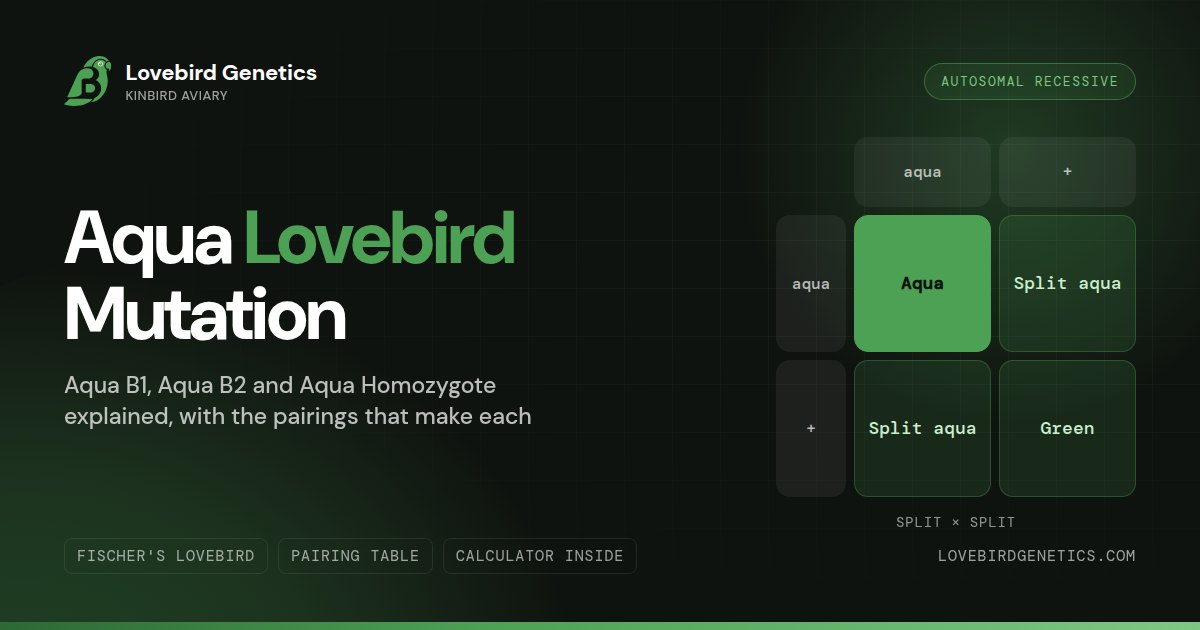
The Aqua mutation in Fischer's lovebirds produces a turquoise body colour by partially reducing psittacofulvin expression. Aqua is the bl aq allele of the blue (bl) locus, one of four alleles there alongside bl1 (Blue 1), bl2 (Blue 2) and bl tq (Turquoise), and a bird carries at most two of them. Aqua Homo (bl aq / bl aq) is autosomal recessive and is visually the most striking form, deeper and more saturated turquoise. Aqua B1 (bl aq // bl1) and Aqua B2 (bl aq // bl2) are co-dominant compounds, not plain recessives, which is why they are visible on a single aqua allele. Aqua combines powerfully with Opaline and Pale Fallow for top-tier, in-demand birds.
What is the Aqua mutation?
The aqua mutation in lovebirds is an allele of the blue (bl) locus that partially reduces psittacine pigment by about 50 percent, turning the normal green body a turquoise, sea-green "aquamarine" shade, and softening the orange face mask to light pink. It has three visual forms: Aqua Homo (bl aq / bl aq), which is autosomal recessive, plus Aqua B1 (bl aq // bl1) and Aqua B2 (bl aq // bl2), which are co-dominant compounds with the blue-series alleles.
Aqua is an allele at the blue (bl) locus, not a gene of its own, and it is recessive to wild-type Green. That locus carries four alleles, bl1 (Blue 1), bl2 (Blue 2), bl aq (Aqua) and bl tq (Turquoise). Aqua combines co-dominantly with bl1 and bl2 rather than masking them, which is exactly why Aqua B1, Aqua B2 and Aqua Homo each present a visibly different turquoise. Two Aqua alleles are needed for a visual bird (Van den Abeele, Lovebird Compendium, 2016).
Aqua is a mutation that partially modifies the expression of the colour pigment pathway in Agapornis fischeri, producing a turquoise or sea-green body colour instead of normal green. The result is a bird that sits visually between a normal green and a full blue, a clear turquoise that catches light differently from either.
Aqua is distinct from the Blue alleles at the same locus (which eliminate psittacine pigment and produce a pure blue bird). Aqua birds retain part of the psittacine pigment, producing the characteristic teal-turquoise tone. The orange face mask fades toward light pink for the same reason.
Aqua Homo (bl aq / bl aq) is autosomal recessive, both males and females can be carriers, and two aqua alleles are needed for the fully recessive visual. Aqua B1 (bl aq // bl1) and Aqua B2 (bl aq // bl2) are co-dominant compounds, two different blue-locus alleles that co-express instead of one masking the other, which is why a single aqua allele is visible when the allele opposite it is bl1 or bl2 rather than wild-type green.
Dirk Van den Abeele documents Aqua as an autosomal recessive allele of the blue (bl) locus that partially reduces psittacine pigment by roughly 50 percent across the whole plumage, giving the "aquamarine" colour between green and blue, with the red mask fading to light pink. It was first reported in the Netherlands in 1963 (Lovebird Compendium, pp. 298 to 303).
How the aqua mutation works, in plain terms
A normal green lovebird gets its colour from two things layered together: a structural blue produced inside the feather, and a yellow pigment (psittacine) sitting over it. Blue light passing through a yellow filter reads as green (Dyck, 1971).
- The Blue mutation removes all of the yellow pigment. With the yellow filter gone, only the structural blue is left, so the bird is pure blue.
- The Aqua mutation removes only about half the yellow pigment (roughly a 50 percent psittacine reduction). The bird lands between green and blue, the turquoise "aquamarine" colour, and the orange-red mask fades toward pink for the same reason (Van den Abeele, Lovebird Compendium, pp. 298 to 303).
That is why aqua is called a partial blue, or a PPR mutation (Partial Psittacine Reduction). It is not a different pigment, it is the same green machinery with the yellow turned down halfway.
Seagreen and AquaTurquoise: aqua combined with turquoise
Turquoise is a second partial-blue allele on the same locus, but it cuts psittacine harder, around 90 percent on the body. Pair aqua with turquoise and you get a bird historically listed as "seagreen" (or apple-green in peach-faced). It is not a separate mutation, it is two blue-locus alleles paired as a compound, correctly written bl aq // bl tq (Van den Abeele, Ornitho-Genetics VZW, 2014).
Some Fischer's birds described as aqua lose the tint and drift back toward green after their first moult. Van den Abeele recorded these as modifications, not true aqua. A genuine aqua keeps its colour for life, and its beak stays pale; a bird whose colour reverts, often with a redder beak, was likely never a true aqua. Ask to see the parents and, ideally, adult photos before you take a bird in.
The three Aqua types
Aqua (bl aq), blue type 1 (bl1), blue type 2 (bl2) and turquoise (bl tq) are all alleles of one gene, the blue (bl) locus, and a bird carries at most two of them. Which two it carries determines which Aqua type it is. Throughout this article a single slash means a split (Green / Aqua) and a double slash means an allelic compound, two different alleles of the same gene that both express (bl aq // bl1):
Aqua B1
The bl aq // bl1 compound: one aqua allele opposite blue type 1. Light-to-mid turquoise. Most common form of Aqua in the hobby.
Standard Aqua demandAqua B2
The bl aq // bl2 compound: one aqua allele opposite blue type 2. Similar turquoise to B1, visually comparable in most birds, slightly different tone.
Standard Aqua demandAqua Homo
Two copies of the aqua allele (bl aq / bl aq). Deeper, richer, more saturated turquoise. Also passes Aqua to every offspring.
In much stronger demand than B1/B2Gene dosage matters. A bird homozygous for Aqua (two copies of the same allele) expresses the mutation more strongly than a heterozygous bird (one copy). Aqua Homo birds show a deeper, more saturated turquoise that is immediately visible to the trained eye. Beyond the visual, Homo birds pass the Aqua gene to every offspring, a significant breeding advantage.
Splits and carriers
An Aqua Homo carries two Aqua alleles, so it passes Aqua to 100% of its offspring. Every chick is at minimum a confirmed Aqua carrier, and the bird never throws a pure non-carrier normal. This is the breeding advantage that sets a true Homo apart from a single-allele Aqua B1, which passes Aqua to only half its chicks (Van den Abeele, Lovebird Compendium, 2016).
Aqua is recessive to wild-type green, so it can be carried hidden in the green series. A green bird carrying a single aqua allele looks completely normal, green with no turquoise visible. The aqua allele is there but needs a second blue-locus mutant allele before anything shows.
A green carrier is written as Green / Aqua. There is no such bird as "Green / Aqua B1", because B1 names the second allele at the same locus, and a green bird already carries wild-type green there. Green carriers are sought-after breeding stock because, when paired with another Aqua carrier or an Aqua visual, they produce Aqua offspring.
To confirm split status: test pair with a visual Aqua. If any turquoise offspring appear, the bird is confirmed to carry the allele. DNA testing is also available for earlier confirmation.
Core Aqua pairings
These are the most important pairings for Aqua production. The calculator handles all combinations, including multi-trait pairings that include Opaline, Pale Fallow, or other mutations alongside Aqua.
| 1.0 Aqua B1 Opaline0.1 Aqua B1 Opaline | ||
|---|---|---|
| Offspring | Chance | Note |
| Aqua Homo Opaline | 25% | Deepest colour, most sought-after, guaranteed Aqua producer |
| Aqua B1 Opaline | 50% | |
| Blue 1 Opaline | 25% | Two Blue 1 alleles, a visual blue bird, neither parent carries green so no pure normal is possible |
This is the most common route to producing Homo. 1 in 4 offspring will be Homo on average. Cannot distinguish Homo from B1 visually without breeding records or DNA test, though experienced breeders often identify the deeper colour at fledging.
Try this pairing →| 1.0 Aqua Homo Opaline0.1 Aqua B1 Opaline | ||
|---|---|---|
| Offspring | Chance | Note |
| Aqua Homo Opaline | 50% | Half the nest will be Homo, highly efficient Homo production |
| Aqua B1 Opaline | 50% | |
Once you have a Homo, this pairing doubles your Homo output per clutch. No normal offspring, all birds carry Aqua.
Try this pairing →| 1.0 Green Opaline / Aqua (split)0.1 Green Opaline / Aqua (split) | ||
|---|---|---|
| Offspring | Chance | Note |
| Aqua Homo Opaline | 25% | Two Aqua splits each pass Aqua, so a quarter are visual Aqua Homo |
| Green Opaline / Aqua (split or pure) | 75% | Green-looking, most carry Aqua but cannot be told apart by eye, test pair to confirm |
Approximate percentages from two heterozygous splits. Use the calculator for precise values with your specific parent genotypes.
Try this pairing →| 1.0 Aqua Homo Opaline0.1 Green Opaline (pure) | ||
|---|---|---|
| Offspring | Chance | Note |
| Green Opaline / Aqua (confirmed splits) | 100% | All offspring are confirmed Aqua carriers, no pure normals, no visuals |
Use this to introduce Homo genetics into a new line. Every offspring is a guaranteed carrier.
Try this pairing →| 1.0 Aqua B2 Opaline0.1 Aqua B2 Opaline | ||
|---|---|---|
| Offspring | Chance | Note |
| Aqua Homo Opaline | 25% | Same sought-after as B1 Homo, deepest turquoise, guaranteed Aqua producer every clutch |
| Aqua B2 Opaline | 50% | |
| Blue 2 Opaline | 25% | Two Blue 2 alleles, a visual blue bird, not green |
Identical ratios to the B1×B1 pairing. B1 and B2 alleles are symmetric, both produce Homo at 25% from two same-allele visuals.
Try this pairing →| 1.0 Aqua B1 Opaline0.1 Aqua B2 Opaline | ||
|---|---|---|
| Offspring | Chance | Note |
| Aqua Homo Opaline | 25% | Both parents carry Aqua, so a quarter inherit two Aqua alleles, identical to Homo from a B1 × B1 pairing |
| Aqua B1 Opaline | 25% | |
| Aqua B2 Opaline | 25% | |
| Parblue (B1B2) Opaline | 25% | One Blue 1 and one Blue 2 allele combined |
Note: B1 and B2 are both Aqua-series alleles, so each parent still passes the Aqua allele to half its chicks. A quarter of the nest inherit two Aqua alleles and are visual Aqua Homo, exactly the same as Homo produced from a B1 × B1 pairing. The remaining birds are Aqua B1, Aqua B2, and one Parblue (B1B2) carrying a Blue 1 and a Blue 2 allele. Confirmed against the lovebirdgenetics.com calculator engine.
Try this pairing →| 1.0 Aqua Homo Opaline0.1 Aqua Homo Opaline (same allele) | ||
|---|---|---|
| Offspring | Chance | Note |
| Aqua Homo Opaline | 100% | Every single offspring is Homo, the most productive Aqua pairing possible |
This is the ideal end-state for an established Aqua Homo line. Every chick in every clutch will be Homo, no visuals, no splits, no normals. Achievable once you have two same-allele Homo birds, which typically takes 2-3 seasons starting from splits.
Try this pairing →| 1.0 Aqua B1 Opaline0.1 Green Opaline (pure) | ||
|---|---|---|
| Offspring | Chance | Note |
| Green Opaline / Aqua or Blue 1 (split) | 100% | Every chick is green-looking and carries one Aqua-series allele, none are visual, none are pure normal |
Used to widen the gene pool or introduce Aqua genetics into an unrelated high-quality line. Every chick is a confirmed carrier, so the whole clutch becomes your split foundation to breed back to an Aqua visual next season.
Try this pairing →Complete Aqua pairing reference table
All key Aqua pairings in one place. These ratios apply symmetrically to both B1 and B2 alleles, substitute B2 for B1 in any same-allele pairing and the percentages are identical. For multi-trait pairings (Aqua + Opaline, Aqua + Pale Fallow, Aqua + Yellow Face), use the genetics calculator.
| Pairing | % Homo | % Visual | % Split | % Green |
|---|---|---|---|---|
| B1 Opaline × B1 Opaline | 25% | 50% | 0% | 25%* |
| B2 Opaline × B2 Opaline | 25% | 50% | 0% | 25%* |
| Homo Opaline × B1 Opaline (same allele) | 50% | 50% | 0% | 0% |
| Homo Opaline × Homo Opaline (same allele) | 100% | 0% | 0% | 0% |
| Homo Opaline × Green Opaline | 0% | 0% | 100% | 0% |
| B1 Opaline × Green Opaline | 0% | 0% | 50% | 50% |
| Green / Aqua × Green / Aqua (split × split) | 25% | 0% | 50% | 25% |
| Aqua B1 × Aqua B2 (bl aq // bl1 × bl aq // bl2) | 25% | 75% | 0% | 0% |
* Neither parent in a visual × visual pairing carries a wild-type green allele, so this final quarter is a visual blue-series bird, Blue 1 (bl1 / bl1) or Blue 2 (bl2 / bl2), not a green bird. In the Aqua B1 × Aqua B2 row the 75% visual splits into 25% Aqua B1, 25% Aqua B2 and 25% Parblue (bl1 // bl2), and Aqua Homo is fully possible because both parents carry the aqua allele (see Pairing 6).
How to select quality Aqua breeding stock
Good Aqua breeding stock is judged on two things at once: confirmed genotype and physical quality. The genotype tells you what a bird can produce, while feather condition, body weight, and eye colour tell you whether it can raise those offspring reliably. A visually stunning Aqua Homo with poor fertility is a weaker founder than a slightly plainer bird that breeds dependably.
Start with genotype, because it is the part you cannot see. The single most useful confirmation for an Aqua bird is whether it is truly Homo (bl aq / bl aq) or only a single-aqua compound, bl aq // bl1 or bl aq // bl2. A confirmed Homo passes Aqua to every chick and never wastes a slot on a pure normal, which is why experienced breeders insist on a documented pedigree or a test pairing rather than relying on body colour alone. The same care applies to the allele sitting opposite the aqua: a bird should be known as Aqua B1 or Aqua B2, never assumed, because that second allele decides whether the quarter of the nest that misses out on aqua comes out as Blue 1, Blue 2 or Parblue (see Pairing 6). Treat any "Aqua" bird of unknown allele pairing and unknown zygosity as a question mark until records or a test cross resolve it.
Once genotype is settled, select on physical quality. Look for tight, well-aligned feathering with no persistent fret marks, a bird of good size and weight for its age, clean nostrils and bright clear eyes, and steady, alert behaviour at the nest. For Aqua specifically, the depth and evenness of the turquoise across the rump and back is the most reliable visual cue separating a strong Homo from a paler single-allele bird in fresh plumage. Avoid founders from tightly inbred single-source lines: years of Aqua x Aqua pairing without outcrossing can quietly erode fertility and chick survival, and that weakness compounds across the generations you are about to build.
Finally, think in terms of pairs rather than individuals. The fastest route to a stable Aqua Homo line is to retain several confirmed B1 splits or visuals from a single strong clutch, so that you can pair like with like and steadily concentrate the allele. Selecting one excellent bird is a start; selecting a matched group is what lets you reach the Homo x Homo end state in two to three seasons.
Sourcing Aqua Lovebirds
Aqua is one of the most widely worked mutations in Fischer's lovebirds across South and Southeast Asia. Knowing where reliable Aqua Homo stock comes from, and how to confirm it, is essential for any breeder working seriously with this mutation.
Sourcing from Indonesia and the Philippines
Indonesia is the world's largest Fischer's lovebird producer and the origin of most widely traded Aqua Homo lines. The Philippines hosts several established Aqua Homo and Aqua Homo Opaline operations. When importing from either country:
- Confirm the allele pairing first, request clarification on Aqua B1, Aqua B2 or Aqua Homo before acquiring the bird. Aqua B1 × Aqua B2 still yields Aqua Homo at 25 percent (see Pairing 6), but the rest of the nest comes out as Aqua B1, Aqua B2 and Parblue rather than as a single predictable type, so records matter.
- Request breeding records, visual confirmation of Homo vs. B1 is unreliable from photos and video. Parent-pair records with clutch outcome data are the minimum standard for any serious acquisition.
- DNA testing, available from specialist avian genetics labs. Definitive: confirms allele type, split status, and sex simultaneously. Strongly recommended for any acquisition where Homo status matters.
- Test pair on arrival, pair the acquired bird with a confirmed Green (no Aqua). A true Homo produces 100% green-looking splits, zero visual Aqua chicks. To separate a Homo from a single-aqua Aqua B1 or Aqua B2, pair instead to a confirmed Aqua Homo: two Homo birds give 100% Aqua Homo, while a single-aqua bird throws lighter Aqua B1 or Aqua B2 chicks alongside the Homo ones.
The safest way to verify Aqua Homo is to see at least one clutch result from the bird paired with a confirmed Green. A genuine Homo produces zero visual Aqua offspring in that cross, all chicks carry the allele as a split but look completely normal green. If you are shown visual Aqua chicks from a "Homo × Green" pairing, the bird is not a Homo paired to a pure Green. Note that a clean nest of green-looking chicks on its own does not prove Homo, because an Aqua B1 or Aqua B2 over pure Green also throws no visuals. To settle it, pair the bird to a confirmed Aqua Homo.
Aqua combined with other mutations
Because Aqua sits at the blue locus while Opaline is sex-linked and Pale Fallow sits on its own autosomal locus, each trait assorts independently. A multi-trait pairing is simply each mutation's own Mendelian ratio multiplied together, which is why combined visuals such as Aqua Homo Pale Fallow only emerge once every contributing locus is homozygous at the same time (Van den Abeele, Lovebird Compendium, 2016).
Aqua's real breeder demand explodes in combination with other mutations. The turquoise base colour interacts with every other mutation, producing birds that are among the most visually striking in the lovebird world:
- Aqua Homo Opaline female, the Opaline redistribution enhances the turquoise, producing a deeply saturated, gradient-rich bird. Among the most sought-after combinations globally.
- Aqua Pale Fallow, the Pale Fallow melanin reduction softens the Aqua turquoise to a pastel teal. A very different look from either mutation alone. Full pairing breakdown: Aqua Homo × Pale Fallow →
- Aqua Yellow Face, Yellow Face on an Aqua base produces a unique warm-toned turquoise, different from standard Aqua.
- Aqua Cinnamon, Cinnamon's warm melanin reduction on the Aqua base creates a distinctive cinnamon-tinted teal.
Combined Aqua mutations follow independent assortment, each mutation's Mendelian ratios apply separately. Model any combination at once in the calculator.
Aqua vs Parblue, they are different
Parblue is the allelic compound bl1 // bl2, a bird carrying blue type 1 on one chromosome and blue type 2 on the other. Aqua is not a different mutation from Parblue, both are combinations at the same blue (bl) locus, they simply use different pairs of alleles from that one allelic series. Because the two combinations sit on the same locus they produce birds with similar turquoise coloration, which causes significant confusion in the trade, especially when birds are imported without documentation.
A bird described as "Aqua" in one country may be the Parblue compound (bl1 // bl2) in another. When importing stock described as Aqua, always request breeding records to confirm which pair of blue-locus alleles the turquoise comes from. Confusing a bl aq // bl1 bird with a bl1 // bl2 bird in a breeding programme produces unpredictable results, because only the first of the two can pass on an aqua allele.
Model every Aqua pairing instantly
B1, B2, Homo, splits, and any combination with Opaline, Pale Fallow, or other traitsThe B1 vs B2 vs Aqua Distinction: Clearing Up the Confusion
Many Fischer's lovebird breeders confuse the terms Aqua, B1, and B2, using them interchangeably when they refer to distinct genetic states. Getting this right matters enormously for breeding strategy and demand.
Aqua B1, the bl aq // bl1 compound
Aqua B1 is a bird carrying the aqua allele on one chromosome and the blue type 1 (bl1) allele on the other, written bl aq // bl1. Both alleles belong to the blue (bl) locus and they co-express rather than one masking the other, which is why a single aqua allele is visible here: the bird reads as a light-to-mid turquoise. That is co-dominant expression at the bl-locus, not a partly penetrant recessive. Reserve the name "Aqua B1" for that visible compound. A bird carrying aqua on one chromosome and the wild-type green allele on the other is not an Aqua B1, it is a green-looking carrier written Green / Aqua.
bl2 and Aqua B2, the second blue-series allele
bl2, blue type 2, is another allele at the same blue (bl) locus. A bird with bl2 / bl2 is a visual Blue 2, and a bird with bl1 / bl1 is a visual Blue 1. Put the aqua allele opposite bl2 and you get Aqua B2 (bl aq // bl2), the second co-dominant turquoise compound. Aqua Homo is neither of these: it is bl aq / bl aq, two copies of the aqua allele, and it is the fully autosomal recessive form. Because every one of these alleles occupies the same position, a bird carries at most two of them.
Parblue, the bl1 // bl2 compound
A bird with one bl1 allele and one bl2 allele (bl1 // bl2) is a Parblue, the turquoise allelic compound. Parblue birds show a distinctive yellowish or cream face mask, and their body turquoise is slightly lighter than Aqua Homo. This yellowish-face feature is what separates Parblue from Aqua Homo and from standard Blue. Note that Parblue carries no aqua allele at all, so it cannot pass one on.
The key rule: alleles are exclusive
A bird cannot carry more than two of the four blue-locus alleles, bl1, bl2, bl aq and bl tq, at once. Each chromosome carries one allele at the locus, so two slots in total, and the two alleles, one from each parent, replace each other at the same position. "Aqua" in the Fischer's hobby usually means bl aq / bl aq Aqua Homo unless otherwise specified. For the full blue-series deep dive, see our Blue lovebird genetics article.
Pairing an Aqua B1 (bl aq // bl1) to an Aqua B2 (bl aq // bl2) does produce Aqua Homo, at the usual 25 percent, because each parent passes its aqua allele to half its chicks. Green offspring are impossible from this pairing, since neither parent carries a wild-type green allele. The nest splits four ways: 25% Aqua Homo (bl aq / bl aq), 25% Aqua B1, 25% Aqua B2 and 25% Parblue (bl1 // bl2). Confirming which compound each parent is still matters, because it decides whether the non-Homo chicks come out as Aqua B1, Aqua B2, Blue 1, Blue 2 or Parblue.
What Aqua Homo Looks Like vs Aqua Split vs Parblue
Visual identification is one of the most frequently asked questions in Aqua breeding. The four phenotypes are distinct but require experience to reliably separate.
Aqua Homo (bl aq / bl aq), the deepest turquoise
The Aqua Homo bird shows a fully saturated teal-green across the entire body. The turquoise produced by two aqua alleles is noticeably richer and deeper than any single-aqua compound. The face mask is not left untouched: the same partial psittacofulvin reduction that turns the body turquoise also fades the orange-red mask toward light pink, which is exactly what the Compendium records. The rump and back feathers are where the deepest colour concentrates, and experienced breeders use the rump colouring as their primary visual diagnostic when assessing Aqua birds at fledging. The body colour is clearly turquoise even to non-experts who have never seen the mutation before.
Green / Aqua, the split that looks completely normal green
A bird that carries one aqua allele and one normal (wild-type) allele looks completely normal green. There is zero visual difference between an Aqua split and a non-carrier normal. This is critical to understand: when you pair an Aqua Homo with a pure Green, every single offspring will be a Green / Aqua split that looks perfectly normal. These birds are confirmed carriers and should never be discarded or passed on as "pure normals." They are the foundation of your next generation of Aqua production. Confirmation requires pedigree records, test pairings, or DNA testing.
Parblue (bl1 // bl2), the yellowish face diagnostic
The Parblue bird (bl1 from one parent, bl2 from the other) shows a turquoise body that is lighter than Aqua Homo. The key diagnostic feature is the face mask: Parblue birds show a yellowish or cream tint on the face, where an Aqua bird's mask fades toward light pink and a normal green Fischer's stays orange-red. That yellow cast is the single most reliable visual separator between Parblue and both Aqua Homo and standard Blue. The body turquoise itself is ambiguous, lighting conditions and individual variation make body colour alone an unreliable diagnostic, but the face mask is consistent.
Green / Aqua one-copy carriers, the "split"
As covered above: completely normal green appearance. The split status can only be confirmed by breeding outcome or DNA test. Never assume a green bird from a known Aqua parent is a non-carrier, it may well be carrying the allele that will produce your next Aqua Homo.
Aqua Homo Breeding Programme, Generation by Generation
Building an established Aqua Homo line takes discipline and record-keeping over multiple seasons. Here is the generation-by-generation roadmap.
Starting with one Aqua Homo male
If you acquire a confirmed Aqua Homo male, pair him with any normal female. The result is 100% Green / Aqua splits in Generation 1, every chick looks normal green but carries the aqua allele. This is not a wasted generation. These confirmed splits are your next season's foundation breeders. Keep all females as confirmed split females, and keep the best split males for back-pairing.
Generation 2: split × split producing Homo
Pair two confirmed Green / Aqua splits together. The offspring ratio is: 25% Aqua Homo visual, 50% Green / Aqua split, 25% normal non-carrier. From a single pair producing 4 to 6 chicks per clutch over 2 to 3 clutches in a season, you should statistically produce 1 to 2 Homo birds in this generation. Band all chicks from these pairings carefully, and do not part with any before confirming Homo vs. split status.
Consolidating: Aqua Homo × Aqua Homo
Once you have a confirmed Homo male and a confirmed Homo female (bl aq / bl aq × bl aq / bl aq), every single offspring from that pair will be Aqua Homo. This is the ideal established line state, 100% sought-after production per clutch, zero splits, zero normals. Getting to this point typically requires 2-3 seasons starting from your first Homo bird.
Introducing a second mutation into the Aqua Homo line
Adding Opaline or Pale Fallow to an Aqua Homo line is a multi-season project. You cannot introduce Opaline simply by pairing an Aqua Homo male with an Opaline female, the Opaline is sex-linked, and the Aqua is autosomal recessive, so the combinations require careful planning. The fastest route is to obtain a male that is Aqua Homo and split Opaline simultaneously (produced by pairing an Aqua Homo male with an Opaline female in a prior generation, then selecting the appropriate male offspring). This takes 2 or more additional seasons beyond establishing the Homo line. See the Aqua Homo × Pale Fallow pairing guide for the popular combination breakdown.
History and Origin of the Aqua Mutation
The aqua mutation first appeared in the early 1960s in the Netherlands, in the peach-faced lovebird (Agapornis roseicollis). The Lovebird Compendium records the first appearance in 1963, with Dutch breeder P. H. Habels of Roosendaal (Van den Abeele, 2016, pp. 298 to 303). It is the oldest of the partial-blue mutations in lovebirds.
Genetically, aqua is an allele of the blue (bl) locus and inherits autosomal recessive. It does not remove psittacine pigment completely the way the Blue mutation does. Instead it reduces it by roughly 50 percent across the whole plumage, producing the "aquamarine" colour between green and blue, with the red or orange mask fading to light pink and yellow areas turning paler. Because the reduction is partial, Van den Abeele classes aqua as a PPR mutation (Partial Psittacine Reduction), the lovebird equivalent of the budgerigar yellow-face.
The name changed over the decades. Before the international naming system, breeders used seagreen, seablue, ivory, pastel and pastel blue for these birds. The community settled on "aqua", short for aquamarine, to end the confusion (Van den Abeele, Ornitho-Genetics VZW, 2014).
- 1927, first blue lovebird (A. personatus), in a shipment from Tanganyika (Tanzania) to England.
- 1963, first aqua, in peach-faced lovebirds, the Netherlands (P. H. Habels).
- 1967 to 1970s, turquoise described and then established in peach-faced lovebirds.
- 2018, blue type 2 confirmed in A. fischeri through controlled test-mating.
- ~50 percent psittacine reduction defines aqua; turquoise reduces around 90 percent on the body.
Aqua in Fischer's lovebirds, the honest position. In A. roseicollis aqua is a confirmed, established mutation. In A. fischeri, aqua-looking phenotypes appear regularly, but Van den Abeele recorded that the early Fischer "aqua" birds behaved as modifications rather than a proven separate mutation, and later test-matings (confirmed 2018) placed the aqua and turquoise phenotypes on that same bl-locus, which carries four alleles: bl1 (Blue 1), bl2 (Blue 2), bl aq (Aqua) and bl tq (Turquoise). For a breeder this means the Fischer aqua, blue 1, blue 2 and parblue birds are all variations on one locus, which is exactly how this calculator models them.
Aqua should not be confused with turquoise, a separate PPR allele on the same locus. Turquoise reached A. roseicollis in the 1970s (first described in Belgium in 1967, originally called "pastel") and reduces psittacine far more, about 90 percent on the body, which is why it often reads almost blue. Yellow Face itself is a different gene, the orange face gene (of), autosomal recessive at its own locus separate from the blue locus, which is why Aqua Yellow Face birds exist. See our Blue, Blue 2 and Parblue genetics guide and the Yellow Face guide for how these genes interact.
Common Mistakes with Aqua Birds
Mislabelling Parblue as "Aqua"
The most common trade error: a Parblue bird (bl1 // bl2) is described as "Aqua" without clarification. Parblue and Aqua Homo are visually distinct, the face mask yellowing of Parblue is the key diagnostic, but breeders and keepers alike sometimes use "Aqua" as a catch-all for any turquoise bird. When you acquire a bird as Aqua Homo, check that the mask has faded toward light pink rather than carrying a yellow or cream cast. A yellow face on a turquoise bird means Parblue or Yellow Face Aqua, not Aqua Homo.
Treating a green split as a non-carrier
After producing Aqua offspring, breeders sometimes pass the green siblings on as "pure normals" without checking their split status. A green bird from a pair that produced any Aqua offspring is either a confirmed split or a non-carrier, and you need test pairings or DNA to know which. Labelling a confirmed or likely split as a non-carrier discards real genetic potential and misleads the next breeder. Always track the splits and record them accurately.
Assuming "Aqua × Aqua = 100% Aqua offspring"
This is only true if both parents are Aqua Homo (bl aq / bl aq). If one parent is a single-aqua Aqua B1 (bl aq // bl1), the pairing is Homo × Aqua B1, which gives 50% Homo and 50% Aqua B1, still excellent, but not 100% Homo. If both parents are Aqua B1, the pairing gives 25% Homo, 50% Aqua B1, 25% Blue 1, a completely different distribution. Always know which of the three Aqua genotypes each parent is before predicting outcomes.
Confusing Aqua with Pale Fallow
Both mutations alter body colour. Pale Fallow produces a greenish or pastel bird with pink-red eyes. An Aqua bird, whether B1 visual or Homo, has completely normal dark brown eyes. If you see altered body colour plus red or pink eyes, you are looking at a fallow mutation, not Aqua. This confusion is common in birds that are double-mutation (Aqua + Pale Fallow), where the combination of both mutations produces an eye colour change alongside the turquoise body. On a single-mutation Aqua bird, eyes are always normal dark brown.
References
- Van den Abeele, D. (2016). Lovebird Compendium. Ornitho-Media. ISBN 978-90-822990-0-3 (Aqua mutation, pp. 298 to 303).
- Van den Abeele, D. (2014). Blue, aqua and turquoise mutations in Lovebirds. Ornitho-Genetics VZW (BVA Magazine). Accessed 2026.
- Dyck, J. (1971). Structure and colour-production of the blue barbs of Agapornis roseicollis and Cotinga maynana. Cell and Tissue Research, 115(1), 17 to 29. doi:10.1007/BF00330211.
- Wikipedia contributors. Lovebird. Wikipedia, The Free Encyclopedia. Accessed 2026.
- BirdLife International. Agapornis fischeri, Fischer's Lovebird. BirdLife Species Factsheet. Accessed 2026.
Identifying Aqua Homo in your nest
Experienced breeders who have worked with both types can often identify Homo offspring at fledging by the deeper, more saturated turquoise colouring, particularly noticeable on the rump and back, and in the blue wing coverts. In fresh plumage, the difference between a B1 visual and a Homo is clear to a trained eye.
If you are less experienced, the safest approach is to band all Aqua offspring separately and test-pair any you cannot confirm visually. Breeding a suspected Homo with a pure normal green gives a whole nest of green-looking confirmed splits and zero visual chicks, because the pure normal parent contributes a wild-type allele to every chick. That result tells you the bird carries aqua, but it does not on its own separate a Homo from an Aqua B1 or Aqua B2, since those also throw no visuals over pure Green. To confirm Homo, pair the bird to a known Aqua Homo: two Homo birds give 100% Aqua Homo, while a single-aqua compound throws lighter Aqua B1 or Aqua B2 chicks in the same nest.
Aqua pairing outcomes, cock × hen
Breeders usually describe a pairing as cock × hen. Below is every common Aqua pairing written that way, with the exact percentages this calculator produces.
Aqua cock × aqua hen
Every chick is a visual Aqua, cocks and hens alike. Because Aqua is autosomal recessive, sex plays no part in the outcome. This holds when both parents are Aqua Homo. If both parents are Aqua B1 instead, the blue locus splits 25% Aqua Homo, 50% Aqua B1 and 25% Blue 1, so a quarter of the clutch is not Aqua at all.
| Chicks | Outcome |
|---|---|
| All chicks | 100% visual Aqua |
Aqua cock × normal hen
No visual chicks appear in this generation. Every chick is a normal-looking bird carrying one hidden copy, written as normal / Aqua.
| Chicks | Outcome |
|---|---|
| All chicks | 100% split (normal / Aqua) |
Split aqua cock × split aqua hen
One quarter of the chicks are visual Aqua. Half are splits and one quarter carry nothing, and the splits and pure normals look identical.
| Chicks | Outcome |
|---|---|
| All chicks | 25% visual Aqua, 50% split, 25% pure normal |
Aqua cock × split aqua hen
Half the chicks are visual Aqua and half are splits, with the same result whichever parent carries the visible mutation.
| Chicks | Outcome |
|---|---|
| All chicks | 50% visual Aqua, 50% split |
Run any of these in the lovebird genetics calculator to see the full offspring list for your own birds.
Frequently asked questions
What is the Aqua mutation in lovebirds?
Aqua is a mutation in Agapornis fischeri that partially reduces psittacofulvin, producing a turquoise sea-green body instead of normal green. Its allele is bl aq, one of four at the blue (bl) locus. The three forms are Aqua B1, Aqua B2 and Aqua Homo.
What is the difference between Aqua B1, B2, and Homo?
All three sit at the blue (bl) locus. Aqua B1 is the co-dominant compound bl aq // bl1 and Aqua B2 is bl aq // bl2. Aqua Homo is bl aq / bl aq, two Aqua alleles, the fully recessive form with the deepest turquoise.
Why is Aqua Homo more sought-after than B1 or B2?
Aqua Homo has two advantages. Gene dosage from two bl aq alleles gives a deeper, more saturated turquoise. It also passes Aqua to every offspring, a guaranteed producer rather than a 50 percent one, which is why breeders chase the Homo form.
How do you produce Aqua Homo lovebirds?
The most reliable path is Aqua B1 × Aqua B1: 25% of offspring will be Homo on average. Once you have a Homo, Homo × Aqua B1 produces 50% Homo per clutch, a much more efficient production rate.
Is Aqua autosomal recessive in Fischer's lovebirds?
Partly. Against wild-type green the bl aq allele behaves autosomal recessive, so both sexes can be splits, and Aqua Homo is the fully recessive visual. Aqua B1 and Aqua B2 pair bl aq with bl1 or bl2 and co-express, so the compounds behave co-dominantly.
Can Aqua B1 × Aqua B2 produce Homo?
Yes. Aqua B1 is bl aq // bl1 and Aqua B2 is bl aq // bl2, so both parents pass bl aq to half their chicks. The nest splits 25% Aqua Homo, 25% Aqua B1, 25% Aqua B2 and 25% Parblue (bl1 // bl2).
How many seasons does it take to establish an Aqua Homo line?
Starting from two Aqua B1 visuals, expect 25% Homo per clutch, so most breeders confirm their first Homo within one season. Homo × Aqua B1 then gives 50% Homo. By season three or four a Homo × Homo pair gives 100% Homo every clutch.
When and where did the aqua mutation first appear?
Aqua first appeared in the early 1960s in the Netherlands, in peach-faced lovebirds (Agapornis roseicollis). The Lovebird Compendium records the first bird in 1963, bred by P. H. Habels of Roosendaal. The name "aqua" is short for aquamarine; older names included seagreen, pastel and ivory.
Is aqua a true mutation in Fischer's lovebirds?
In peach-faced lovebirds aqua is a confirmed mutation. In Fischer's, Van den Abeele first recorded aqua-type birds as modifications, and test matings confirmed in 2018 placed the aqua and turquoise phenotypes on the blue (bl) locus. The calculator models all four blue-locus alleles there.
What is the difference between aqua and turquoise?
Both are partial psittacine reduction alleles of the bl locus, aqua as bl aq and turquoise as bl tq. Aqua cuts the yellow pigment by about 50 percent, turquoise by about 90 percent on the body, so turquoise reads almost blue.
How do you confirm a bird is Aqua Homo rather than B1 or B2 visual?
Visual assessment picks out Homo by its deeper, more saturated turquoise, clearest on rump and wing coverts. A test pairing with a confirmed Aqua Homo gives 100% Aqua Homo chicks only if the tested bird is also Homo. Pedigree records or DNA testing settle uncertain cases.
What does Aqua B1 x Parblue (B1B2) produce?
Aqua B1 x Parblue (B1B2) produces 25% Aqua B1, 25% Aqua B2, 25% Blue 1, 25% Parblue (B1B2). Verified on the lovebirdgenetics.com calculator engine.
What does Aqua B2 x Parblue (B1B2) produce?
Aqua B2 x Parblue (B1B2) produces 25% Aqua B1, 25% Aqua B2, 25% Parblue (B1B2), 25% Blue 2. Verified on the lovebirdgenetics.com calculator engine.
What does Aqua B1 x Blue 1 produce?
Aqua B1 x Blue 1 produces 50% Aqua B1, 50% Blue 1. Verified on the lovebirdgenetics.com calculator engine.
What does Aqua B2 x Blue 1 produce?
Aqua B2 x Blue 1 produces 50% Aqua B1, 50% Parblue (B1B2). Verified on the lovebirdgenetics.com calculator engine.
What does Aqua B1 x Aqua B2 produce?
Aqua B1 x Aqua B2 produces 25% Aqua Homo, 25% Aqua B1, 25% Aqua B2, 25% Parblue (B1B2). Verified on the lovebirdgenetics.com calculator engine.
What does Aqua B2 x Aqua B2 produce?
Aqua B2 x Aqua B2 produces 25% Aqua Homo, 50% Aqua B2, 25% Blue 2. Verified on the lovebirdgenetics.com calculator engine.
What does Aqua Homo x Blue 1 produce?
Aqua Homo x Blue 1 produces 100% Aqua B1. Verified on the lovebirdgenetics.com calculator engine.
What does Aqua Homo x Blue 2 produce?
Aqua Homo x Blue 2 produces 100% Aqua B2. Verified on the lovebirdgenetics.com calculator engine.
What does Aqua Homo x Parblue (B1B2) produce?
Aqua Homo x Parblue (B1B2) produces 50% Aqua B1, 50% Aqua B2. Verified on the lovebirdgenetics.com calculator engine.
What does Aqua Homo x Aqua B1 produce?
Aqua Homo x Aqua B1 produces 50% Aqua Homo, 50% Aqua B1. Verified on the lovebirdgenetics.com calculator engine.
What does Aqua Homo x Aqua B2 produce?
Aqua Homo x Aqua B2 produces 50% Aqua Homo, 50% Aqua B2. Verified on the lovebirdgenetics.com calculator engine.
What does Aqua Homo x Aqua Homo produce?
Aqua Homo x Aqua Homo produces 100% Aqua Homo. Verified on the lovebirdgenetics.com calculator engine.
What does Green (Normal) x Aqua B1 produce?
Green (Normal) x Aqua B1 produces 50% Green / Aqua and 50% Green / Blue 1. Every chick looks green, and each one carries exactly one hidden blue-locus allele, either aqua or bl1, never both. Verified on the lovebirdgenetics.com calculator engine.
What does Green / Blue 1 x Aqua B1 produce?
Green / Blue 1 x Aqua B1 produces 25% Green / Aqua, 25% Green / Blue 1, 25% Aqua B1 and 25% Blue 1. Verified on the lovebirdgenetics.com calculator engine.
What does Green (Normal) x Aqua Homo produce?
Green (Normal) x Aqua Homo produces 100% Green / Aqua (split). Verified on the lovebirdgenetics.com calculator engine.
What does Green (Normal) x Blue 2 produce?
Green (Normal) x Blue 2 produces 100% Green / Blue 2 (split). Verified on the lovebirdgenetics.com calculator engine.
What does Green / Blue 1 x Aqua Homo produce?
Green / Blue 1 x Aqua Homo produces 50% Green / Aqua (split), 50% Aqua B1. Verified on the lovebirdgenetics.com calculator engine.