
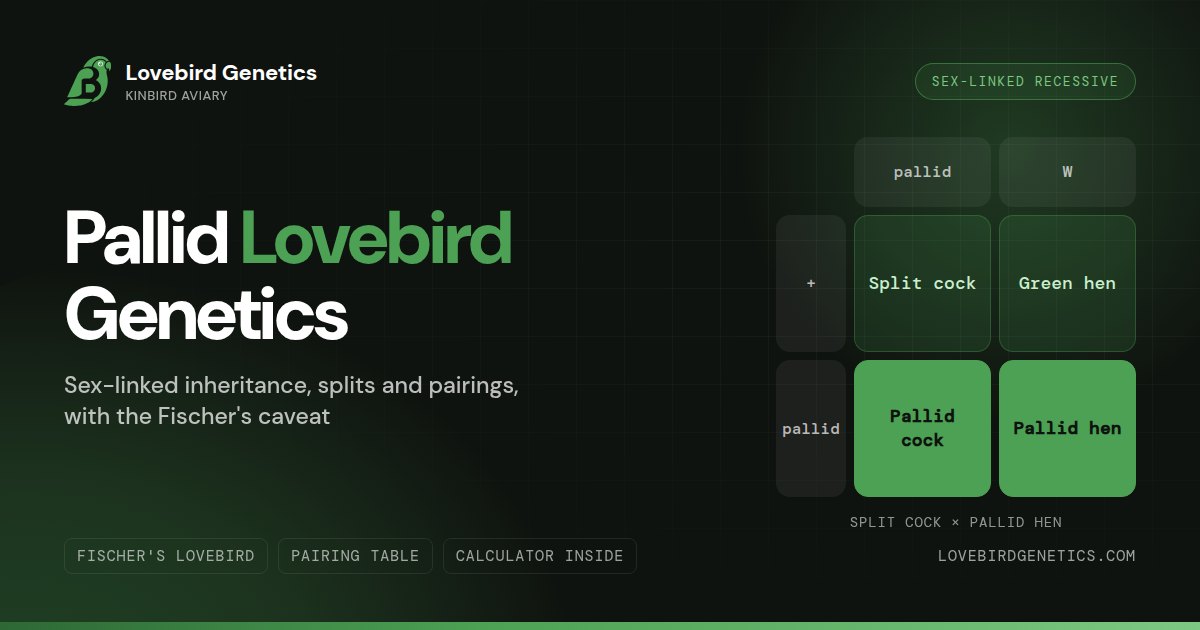
Pallid in Fischer's lovebirds is a sex-linked recessive mutation that partially reduces eumelanin, the dark pigment, giving a paler, softer body colour (a lighter greyish or olive green) with reduced wing markings. The key tell is that Pallid birds keep dark eyes, which separates them from red-eyed Ino and Lutino and from brown-toned Cinnamon. Hens cannot be splits, they are either visual or non-carrier. Genetically Pallid is an allele of the same Z-linked gene that SL ino sits on, and SL ino itself is not established in this species (Van den Abeele, Lovebird Compendium, 2016, pp. 396 to 407).
Pallid is documented as a sex-linked recessive mutation in Agapornis roseicollis, an allele of the same Z-linked gene that SL ino sits on. It partially reduces eumelanin, so the dark pigment is diluted rather than removed, giving a paler, softer body colour with reduced wing markings, yet the eyes stay dark. It was historically misnamed "Isabel" or "Australian cinnamon" before the standardised MUTAVI and BVA name Pallid was adopted (Lovebird Compendium, pp. 396 to 407). For what is and is not established in Agapornis fischeri, read the OGVZW note directly below.
Ornitho-Genetics VZW (Dirk Van den Abeele) records pallid as an original mutation in Agapornis fischeri on its mutation list dated 17 August 2025, meaning it arose in this species rather than being introduced from another. An earlier OGVZW note reported that a pure-bred pallid green Fischer's had not yet been examined; the 2025 list is the newer document and supersedes it on species attribution. Pallid is also recorded as original in Agapornis roseicollis. What is certain is that the Fischer's phenotype is sex-linked, and OGVZW's position is that it is either allelic with pale or a phenotype created in combination with pale. Pale is itself a proven sex-linked mutation in Fischer's, sitting at the same ino locus, but with a smaller reduction of roughly 15 percent of the eumelanin against pallid's roughly 50 percent. In practice that means some birds sold as pallid Fischer's are likely pale, or pale combined with other eumelanin-reducing mutations such as Opaline or Pastel. If you keep these birds, the single most useful thing you can do is pair to pure green and report the results, which is exactly what OGVZW has asked breeders to do. Sources: OGVZW FAQ on pallid Agapornis fischeri and the 2022 update.
Pallid and sex-linked Ino are alleles of the same gene, the ino locus, and that gene sits on the Z chromosome. A cock carries two Z chromosomes, a hen only one. That means a cock can carry two different alleles of this gene at the same time and show the PallidIno compound, while a hen never can: she carries exactly one allele at this locus, so she is either one thing or the other. Pale is the third allele of this same locus, symbol inope, confirmed by Ornitho-Genetics VZW. It competes with pallid and sex-linked ino for that one slot, so PalePallid and PaleIno are cock-only compounds in exactly the same way, and no hen can be pale and pallid at once. What no hen can ever be is split for any sex-linked mutation.
What is the Pallid mutation in lovebirds?
Pallid in lovebirds is a sex-linked recessive mutation that partially reduces eumelanin, the dark pigment. The result is a paler, softer body colour, a lighter greyish or olive green, with reduced wing markings, while the eyes stay dark. Genetically it is an allele of the same Z-linked gene that SL ino sits on, and SL ino itself is not established in this species.
Pallid dilutes eumelanin rather than removing it or re-colouring it. It does not strip the dark pigment away completely the way Ino does, and it does not convert it to brown the way Cinnamon does. Because the reduction is only partial, enough eye pigment develops that the eyes darken within the first days and the adult is dark-eyed. That partial-reduction-plus-dark-eye signature is the whole identity of the mutation, and it is why Pallid is best combined only with non-eumelanin mutations such as Blue, Aqua, Parblue, and Opaline, where its dilution effect layers cleanly (Van den Abeele, Lovebird Compendium, 2016, pp. 396 to 407).
Eumelanin is the pigment responsible for the dark grey and black tones in a Fischer's lovebird, the depth of the body colour and the markings across the wings and back. The Pallid mutation partially reduces how much of this pigment is laid down in the feather. Instead of the full, saturated dark tone of a normal bird, a Pallid bird shows a lighter, softer version of the same colour, and its wing markings are visibly reduced.
What makes Pallid distinct from the other pigment mutations is that the reduction is partial and leaves enough pigment in the eye for it to darken. Ino removes eumelanin so completely that the bird is left with only its psittacine colour and red eyes, and in Agapornis fischeri Ino is autosomal (NSL) recessive, not sex-linked. Pallid stops short of that: enough eumelanin remains for the eyes to darken within the first days and for the body to keep a diluted version of its normal colour rather than losing it entirely. This is why the Lovebird Compendium treats Pallid as an allele of the same Z-linked gene that SL ino sits on, with its own softer expression (Van den Abeele, 2016, pp. 396 to 407).
Because Pallid acts only on eumelanin, it leaves the psittacine pigment, the yellow-to-red mask and body colour, untouched, and it leaves the structural blue-green base intact. This selective action is what lets Pallid combine cleanly with Blue, Aqua, Parblue, and Opaline: each of those works on a different part of the colour system, so stacking them with Pallid layers effects rather than cancelling them out.
In our aviary, and across three years of breeding Fischer's, the single fastest way we teach new keepers to spot a Pallid is the eye check under daylight. Hold the bird so the light falls on the head: a pale bird with dark eyes is a Pallid or a Dilute, never an Ino. Then look at the depth of the markings, Pallid softens and dilutes them evenly, it does not brown them like Cinnamon or erase them like Ino. That two-step check has saved us from mislabelling more birds than any book ever did.
What Pallid looks like in Fischer's lovebirds
The Pallid mutation lightens everything that eumelanin normally darkens. On a normal Fischer's lovebird the body colour is deep and the wing markings are strong and dark. On a Pallid bird the same colour reads as a lighter, softer version of itself, and the markings are noticeably reduced. The change is a dilution of tone, not a change of hue or a loss of colour.
Key visual markers
The most reliable identification feature is the combination of a diluted body colour with dark eyes. On Green-series Pallids the olive green becomes a lighter, softer greyish or olive green, and the dark wing markings fade to a paler, reduced version. On Blue-series or Aqua Pallids the body reads as a paler, washed version of the normal blue or teal. In every case the eyes remain dark. That dark eye is the deciding marker, because it rules out Ino and Lutino, which are red-eyed, immediately.
Pallid's dilution is even and soft rather than patchy. The bird does not look brown, which separates it from Cinnamon, and it does not look bleached to near-yellow with red eyes, which separates it from Ino. It looks like a normal bird whose dark pigment has been turned down a notch or two, with the markings softened to match.
Why the eye colour matters so much
Because a Pallid ends up dark-eyed once the first days have passed, you cannot flag it in the nest by eye colour the way you can with Ino and the Fallows, which stay red-eyed. The practical consequence is that you rely on the diluted feather tone once feathers grow in, plus the sex-linked pairing logic covered below, rather than any early red-eye tell. Pallid chicks do hatch with red eyes, which darken within the first days, so the eye test is reliable from the nest-feather stage onward rather than at hatch (Van den Abeele, Ornitho-Genetics VZW). What separates Pallid from Ino is that an Ino keeps red eyes for life, while a Pallid ends up dark-eyed.
Pale bird with dark eyes and softly diluted (not brown, not erased) markings = Pallid. Pale with red eyes = Ino or Lutino. Pale with warm brown markings = Cinnamon. The eye colour is the first thing to check, the tone of the markings confirms it.
How Pallid inheritance works: why hens can't be splits
Pallid inheritance follows the same rules as Opaline and Cinnamon, the sex-linked recessive mutations in Agapornis fischeri. In birds, sex is determined by Z and W chromosomes, and this is the reverse of mammals:
- Cocks (males): ZZ, two Z chromosomes
- Hens (females): ZW, one Z chromosome and one W chromosome
The Pallid gene sits on the Z chromosome. For a recessive gene to be hidden as a "split", a bird needs two Z chromosomes, one carrying the Pallid allele and one carrying the normal allele, so the normal allele can mask the Pallid one visually. That masking can only happen in cocks, who have two Z chromosomes.
Hens have only one Z chromosome. Whatever Pallid allele is on that single Z is expressed immediately, there is no second Z to hide behind. This is why hens are always either visual Pallid (they show the mutation) or completely normal (they carry no Pallid gene at all). A hen described as "split for Pallid" does not exist and is a labelling error.
Cocks can be: Visual Pallid (ZPalZPal), Split Pallid (ZPalZN, looks normal), or Pure Normal (ZNZN).
Hens can only be: Visual Pallid (ZPalW) or Normal (ZNW). There is no split for hens.
This has real consequences for how you plan pairings, evaluate birds for purchase, and read calculator results. Every Pallid pairing outcome must be interpreted with sex in mind, unlike autosomal recessive mutations where the outcomes are identical for both sexes.
All Pallid pairing outcomes
The five core Pallid pairings below cover every realistic breeding scenario. Each box separates sons and daughters, because the outcomes differ by sex for every pairing. These are the five engine-verified Pallid pairings modelled by the calculator.
| 1.0 Pallid0.1 Normal (Green) | ||
|---|---|---|
| Offspring | Chance | Note |
| ♂Green/Pallid cock (split) | 50% | Looks completely normal, carries one Pallid Z from dad, one Normal Z from mom |
| ♀Pallid hen (visual) | 50% | Inherited dad's Pallid Z, expresses it fully |
Every visual (Pallid) chick is a hen, and every normal-looking chick is a split cock, so this pairing auto-sexes the clutch. It is the best starter pairing for introducing Pallid into a line, because you can read sex straight from the nest box.
Try this pairing →| 1.0 Green/Pallid (split)0.1 Normal (Green) | ||
|---|---|---|
| Offspring | Chance | Note |
| ♂Green cock (normal) | 25% | No Pallid gene at all |
| ♂Green/Pallid cock (split) | 25% | Looks normal, carries one hidden Pallid Z |
| ♀Normal hen | 25% | Inherited dad's Normal Z |
| ♀Pallid hen (visual) | 25% | Inherited dad's Pallid Z, expresses it fully |
Half of all daughters are visual Pallid and half of all sons carry Pallid hidden. The split cock parent looks identical to a pure normal, so this is the pairing that confirms his carrier status when visual Pallid daughters appear.
Try this pairing →| 1.0 Normal (Green)0.1 Pallid | ||
|---|---|---|
| Offspring | Chance | Note |
| ♂Green/Pallid cock (split) | 50% | All sons carry Pallid, inherited from their Pallid mother's Z |
| ♀Normal hen | 50% | Inherited dad's Normal Z, no Pallid gene |
Every son carries Pallid and every daughter is normal. There are no visual Pallid chicks in this generation, but the pairing quietly seeds the Pallid gene into all the sons, ready to be brought out in the next round.
Try this pairing →| 1.0 Green/Pallid (split)0.1 Pallid | ||
|---|---|---|
| Offspring | Chance | Note |
| ♂Green/Pallid cock (split) | 25% | Looks normal but carries one Pallid Z |
| ♂Pallid cock (visual) | 25% | Homozygous, both Z chromosomes carry Pallid |
| ♀Normal hen | 25% | No Pallid gene, inherited dad's Normal Z |
| ♀Pallid hen (visual) | 25% | Inherited dad's Pallid Z, expresses it fully |
This pairing finally produces visual Pallid cocks, the harder sex to produce for a line that does not have them yet. A quarter of the clutch are visual Pallid cocks and another quarter are visual Pallid hens.
Try this pairing →| 1.0 Pallid0.1 Pallid | ||
|---|---|---|
| Offspring | Chance | Note |
| ♂Pallid cock (visual) | 50% | Homozygous ZPalZPal |
| ♀Pallid hen (visual) | 50% | ZPalW, expresses it fully |
100% Pallid offspring regardless of sex, both cocks and hens visual. This is the fastest way to establish a full Pallid line, but it requires two visual parents, and a visual Pallid cock is usually harder to source than a hen.
Try this pairing →The Pallid auto-sexing advantage
Because Pallid sits on the Z chromosome and a hen is ZW with a single Z, she is either visual Pallid or carries nothing at all. A "split Pallid hen" is genetically impossible. This is exactly why a visual Pallid cock paired with a normal hen auto-sexes the clutch: every visual Pallid chick is a daughter, every normal-looking chick is a split son (Van den Abeele, Lovebird Compendium, 2016, pp. 396 to 407).
Pairing 1 above, Pallid cock × Normal hen, is the most practically useful Pallid pairing because it gives you free, reliable sex determination from the nest box. In a nest where both parents are confirmed as above, the rule is absolute:
- Every chick that shows Pallid colouring (diluted, softer body, reduced markings, dark eyes) is a hen.
- Every chick that looks normal (full dark colour and markings) is a split Pallid cock.
There are no exceptions in a correctly confirmed pairing. This works because of the ZW sex determination system: all daughters inherit only the Pallid Z from their father (since he is ZPalZPal), while all sons inherit their father's Pallid Z plus the mother's Normal Z and are therefore split.
For breeders who produce large volumes of chicks and want to track sex without DNA testing or waiting for vent sexing, this pairing is hard to beat. The offspring are also directly useful: split Pallid cocks are valuable breeding birds because they quietly carry the gene, and visual Pallid hens are popular with keepers who want the diluted, dark-eyed look.
Auto-sexing is only reliable when both parents are confirmed: the cock must be a proven visual Pallid, not just "probably Pallid" or a misidentified Dilute, and the hen must be a confirmed normal with a known background. A misidentified parent breaks the sex prediction entirely, and because Pallid is so easily confused with Ino, Cinnamon, and Dilute, confirming the cock's mutation before you rely on the trick matters.
Can Pallid be combined with other mutations?
Yes. Pallid combines with the non-eumelanin mutations, and because it works only on eumelanin, it layers onto them cleanly without cancelling anything out. The mutations it pairs with are Blue, Aqua, Parblue, Opaline, and the dark factors. Because Pallid is sex-linked, planning combination pairings means thinking about sex at every step.
Pallid + Blue and Pallid + Aqua
The Blue and Aqua mutations remove or shift the yellow psittacine pigment, giving a blue or teal body. Adding Pallid dilutes the remaining dark eumelanin, so a Pallid Blue or Pallid Aqua reads as a paler, softer, washed version of the blue or teal, with reduced markings and the characteristic dark eye. Because both Blue and Aqua are autosomal and Pallid is sex-linked, the two systems are planned independently and then combined.
Pallid + Parblue
Parblue keeps a partial yellow tone rather than removing it entirely. Layering Pallid onto a Parblue bird softens the dark pigment while the partial yellow remains, producing a pale, gentle-toned bird with dark eyes. As with Blue and Aqua, Parblue is inherited independently of the sex-linked Pallid, so both systems are set separately in the calculator.
Pallid + Opaline, the sex-linked stack
Both Pallid and Opaline are sex-linked recessive, carried on the Z chromosome, so a single cock can carry both. A Pallid Opaline cock shows Opaline's colour redistribution together with Pallid's diluted, softer feathering, an unusually pale and richly patterned combination. Producing double sex-linked birds takes careful multi-generation planning, and tracking which mutations sit on which Z is essential.
Pallid + dark factors
The dark factors deepen the overall body tone. Combined with Pallid, they push against Pallid's dilution to produce intermediate depths of colour, giving breeders a way to fine-tune how pale or how deep a Pallid bird looks.
The Pallid-Cinnamon crossover
Pallid and Cinnamon are both carried on the Z chromosome. Because of that, a crossover event during the formation of sex cells can place both mutations onto a single Z, producing a combined Pallid-Cinnamon bird that carries the two together as one linked unit. This crossover combination is a genuine possibility precisely because the two mutations share the same chromosome, and it is the one case where two eumelanin-affecting mutations meet in Pallid breeding.
Plan your Pallid pairings
Set Pallid on the correct sex and see exact offspring percentages by sexReading the calculator for Pallid
The Lovebird Genetics Calculator handles Pallid's sex-linked inheritance automatically, but you need to enter the birds correctly. Here is the exact process:
- For cocks: set the Pallid toggle to Visual (if the cock shows Pallid), Split (if he looks normal but is a known carrier), or leave it off (pure Normal with no Pallid gene).
- For hens: set the Pallid toggle to Visual (if she shows Pallid) or leave it off (she is Normal and carries no Pallid gene). The Split option for hens is intentionally unavailable, it does not exist for sex-linked mutations in females.
- Read the results by sex. Unlike autosomal mutations where every row applies to any offspring, Pallid results are split into cock and hen rows. The percentage shown is the probability for that specific sex, not among all offspring combined.
The most common mistake is setting a hen parent to "Split for Pallid", which produces incorrect offspring calculations. If you bought a hen advertised as "split Pallid" it is a mislabelled bird; enter it as either Visual Pallid or Normal in the calculator, depending on its actual appearance.
When combining Pallid with an autosomal mutation like Aqua, set both systems independently. The calculator multiplies the probabilities correctly: if a pairing gives 50% Pallid daughters and 25% Aqua offspring, it will correctly show Aqua Pallid daughters appearing in 12.5% of all offspring (50% × 25% = 12.5%).
How to tell Pallid apart from Ino, Cinnamon and Dilute
Pallid is one of the most misidentified Fischer's mutations because it produces a paler-looking bird, and three other mutations also produce paler-looking birds. Getting them confused has real breeding consequences, because their inheritance patterns are not the same. The single most useful field test is the eye, and the tone of the markings settles the rest.
Dark eyes rule out Ino. Diluted (not brown) markings rule out Cinnamon. Sex-linked inheritance (hens can't be split) rules out Dilute. Pallid is the pale, dark-eyed, evenly-diluted, sex-linked one.
Pallid vs Ino / Lutino
Ino and Lutino remove eumelanin completely, leaving red eyes and only the psittacine colour. In Agapornis fischeri Ino is autosomal (NSL) recessive, a different locus from the Z-linked pale and pallid gene, so the two do not travel together through a breeding programme. Pallid only partially reduces eumelanin, so enough pigment remains for the eyes to darken and for a diluted version of the body colour to survive. The eye colour is the instant separator: red eyes mean Ino or Lutino, dark eyes mean Pallid.
Pallid vs Cinnamon
Cinnamon is also sex-linked recessive, so it shares Pallid's inheritance rules exactly, cocks can be split, hens cannot. The difference is what each does to eumelanin. Cinnamon turns the dark pigment brown, giving warm cinnamon-brown markings. Pallid reduces and dilutes the pigment instead, giving a paler, softer version of the normal colour rather than a brown one. And because both mutations sit on the Z chromosome, a crossover can produce a combined Pallid-Cinnamon bird.
Pallid vs Dilute
Dilute also produces a paler bird with dark eyes, so the eye test alone does not separate it from Pallid. The deciding difference is inheritance: Dilute is autosomal recessive, so both cocks and hens can be splits, while Pallid is sex-linked recessive, so hens can never be split. If a pale, dark-eyed bird comes from a documented line, the pattern of which sex can carry the gene hidden tells you which mutation you are dealing with. This is why pedigree and test pairings matter when separating Pallid from Dilute.
Pallid in combination, full guide
Because Pallid is sex-linked, planning combination pairings means thinking about sex at every step. The combinations below are the ones that follow directly from Pallid acting only on eumelanin, so it stacks cleanly with the non-eumelanin mutations.
Pallid Opaline, the premier sex-linked stack
Both Pallid and Opaline are sex-linked recessive, carried on the Z chromosome, which means a single cock can carry both mutations at once. A cock carrying both on his Z chromosomes passes them to his daughters, producing Pallid Opaline hens that show Opaline's colour redistribution together with Pallid's diluted, softer feathering. A Pallid Opaline cock homozygous for both is especially prized as a breeding bird, because he can reliably pass both mutations to all of his daughters. As with any double sex-linked project, whether the two mutations sit on the same Z or on different Zs changes what a given cock will produce, so careful pedigree tracking is essential.
Pallid Aqua, cool body, softer everything
The Aqua mutation gives the body a pale teal-green or mint colour. Adding Pallid dilutes the dark eumelanin on top of that, softening the markings further and producing an especially pale, gentle-toned bird with dark eyes. Because Aqua is autosomal recessive and Pallid is sex-linked, producing a Pallid Aqua hen requires a Pallid cock (visual or split) combined with Aqua on both sides, planned across the two systems at once.
Pallid Blue and Pallid Parblue
On a Blue-series bird, Pallid softens the dark pigment against the cool blue base, giving a pale, washed blue with reduced markings and dark eyes. On a Parblue bird, where a partial yellow tone remains, Pallid produces a pale, gentle-toned bird that keeps that soft yellow cast. Both Blue and Parblue are inherited independently of the sex-linked Pallid, so each system is set separately and then combined.
Pallid with dark factors
The dark factors deepen the overall body colour, working against Pallid's dilution. Combining them lets a breeder tune the final depth of a Pallid bird, from very pale up to a more moderate, deeper-toned dilution, while keeping the reduced markings and dark eye that define the mutation.
The Pallid-Cinnamon crossover combination
Because Pallid and Cinnamon are both carried on the Z chromosome, a crossover during sex-cell formation can bring both onto a single Z, producing a Pallid-Cinnamon bird. This is the one combination where two eumelanin-affecting mutations occur together in Pallid work, and it is possible only because the two share the same chromosome. Reaching it reliably takes patient, pedigree-tracked breeding, since the crossover has to be captured and then fixed in the line.
How rare is Pallid, and what to look for in breeding stock
As a single mutation, Pallid is straightforward to establish once you have a visual bird. Its scarcity, and the interest that follows, lives mostly in its combinations: Pallid Opaline, Pallid Aqua, and the crossover Pallid-Cinnamon take real generations to build, which is what keeps them sought-after.
The breeding difficulty is not in producing Pallid itself but in steering its sex-linked inheritance toward the combination you want. Because Pallid sits on the Z chromosome, the sex of every chick changes what a pairing can produce. A visual Pallid cock is the genuinely scarce piece in most lines, because the quickest route to Pallid, the auto-sexing Pairing 1, throws all its visual Pallids into the daughters and leaves the sons as splits. Producing visual Pallid cocks takes a Pallid hen paired back to a split or visual cock (Pairing 4 or 5), and stacking a second sex-linked mutation like Opaline onto the same Z compounds the difficulty further.
When selecting Pallid stock, examine the bird in natural daylight and start with the eye: a dark eye confirms you are not looking at an Ino, and an evenly diluted, non-brown body tone confirms you are not looking at a Cinnamon. Favour birds with clean, even dilution and good feather quality over patchy or washed-out examples, because consistent pigment expression carries through into the combination birds. For sex-linked planning, documented parentage matters more than appearance: a split Pallid cock is only useful to your programme if his carrier status is recorded, since he is visually identical to a pure normal. The most useful founders are confirmed visual Pallid hens and well-documented split cocks, ideally ones that already carry a second mutation such as Aqua or Opaline, because they shorten the path to the combination birds.
In our aviary the birds we protect most carefully are the documented split Pallid cocks. They look like ordinary green birds, so without a written record they are indistinguishable from a normal and their value to the line is lost the moment the paperwork is. We ring and log every split cock the season he hatches, and we keep at least one proven visual Pallid cock back each year so we are never forced to rebuild the visual side of the line from daughters alone.
Common mistakes with Pallid
Several recurring errors show up across Fischer's breeding communities when working with Pallid, and almost all of them come from the mutation's resemblance to its look-alikes:
- Calling a Pallid bird "Lutino" or "Ino." Both look pale, but Ino removes eumelanin completely and leaves red eyes, while Pallid only partially reduces it and keeps dark eyes. Check the eye colour first: dark eyes rule Ino out entirely. Mislabelling one as the other misrepresents how the bird will breed, and the two do not inherit the same way, because Ino in Fischer's is autosomal recessive while the pallid phenotype is sex-linked.
- Calling a Pallid bird "Cinnamon." Cinnamon browns the dark pigment; Pallid dilutes it to a paler, softer version of the normal colour without turning it brown. Both are sex-linked, so the breeding rules are the same, but the visual is different, and confusing the two leads to wrongly labelled stock.
- Selling a "split Pallid hen." Genetically impossible. Hens are ZW and cannot carry a Z-linked mutation as a hidden split. A hen is either visual Pallid or normal. If a seller offers a "split Pallid hen," the bird has been mislabelled, buy it as a visual or a normal, or request a DNA test to confirm which applies.
- Entering a hen as "split Pallid" in the calculator. This produces incorrect offspring percentages. For a hen, use Visual Pallid or leave the toggle off; the Split status only exists for cocks.
Why is Pallid sometimes called Isabel? History and naming
Pallid has carried more names than almost any other lovebird mutation. In older aviculture it was variously called "Isabel" and "Australian cinnamon", labels that caused constant confusion. "Australian cinnamon" in particular wrongly implied a link to the Cinnamon mutation, when Pallid does something quite different: it dilutes eumelanin rather than browning it. To end that confusion, the mutation was standardised under the MUTAVI and BVA naming systems as Pallid, which is the correct and current name. Isabel should now be treated as a historical label only.
Pallid is documented in Van den Abeele's Lovebird Compendium (2016), pp. 396 to 407, as a sex-linked recessive mutation in Agapornis roseicollis, an allele of the same Z-linked gene that SL ino sits on. The phenotype in Agapornis fischeri is also sex-linked, and as the OGVZW note above explains OGVZW records it as an original mutation in this species. What is established as sex-linked in Fischer's is Opaline, Cinnamon and Pale, all of which give breeders the practical advantage of automatic sex determination from the nest through the auto-sexing pairing.
The Fischer's lovebird (Agapornis fischeri), as documented by BirdLife International, is native to the interior of Tanzania and was first described scientifically in the late 19th century. Its popularity in aviculture, and the resulting accumulation of colour mutations, has made it one of the most genetically diverse parrot species in captive breeding programmes globally. Pallid is one of the sex-linked mutations in that diversity, and getting its name and its identity right, dark-eyed and diluted, not Ino and not Cinnamon, is the first step to working with it well.
For the complete context on sex-linked mutation inheritance in Fischer's lovebirds, including how Pallid compares to Opaline and Cinnamon, see the sex-linked mutations overview guide.
References
- Van den Abeele, D. (2016). Lovebird Compendium. Ornitho-Media. ISBN 978-90-822990-0-3. (Pallid: pp. 396 to 407.)
- Wikipedia contributors. Lovebird. Wikipedia, The Free Encyclopedia. Accessed 2026.
- BirdLife International. Agapornis fischeri, Fischer's Lovebird. BirdLife Species Factsheet. Accessed 2026.
Pallid pairing outcomes, cock × hen
Breeders usually describe a pairing as cock × hen. Below is every common Pallid pairing written that way, with the exact percentages this calculator produces.
What do you get from a Pallid cock x normal hen?
Every son is a normal-looking split Pallid cock and every daughter is a visual Pallid hen. This is the classic auto-sexing pairing: you can sex the chicks by colour alone, with no DNA test.
| Chicks | Outcome |
|---|---|
| Sons | 100% normal / split Pallid |
| Daughters | 100% visual Pallid |
What do you get from a normal cock x Pallid hen?
Every son is a split Pallid cock and every daughter is a normal hen. No visual Pallid chicks are produced in this direction, which is why the sex of the Pallid parent decides everything.
| Chicks | Outcome |
|---|---|
| Sons | 100% normal / split Pallid |
| Daughters | 100% normal |
What do you get from a split Pallid cock x normal hen?
Half the daughters come out visual Pallid. Sons are split or normal in equal share and look identical, so only a test pairing or pedigree tells them apart.
| Chicks | Outcome |
|---|---|
| Sons | 50% split Pallid, 50% normal |
| Daughters | 50% visual Pallid, 50% normal |
What do you get from a split Pallid cock x Pallid hen?
This pairing produces visual Pallid in both sexes. Half the sons are visual Pallid and half are split, while half the daughters are visual Pallid.
| Chicks | Outcome |
|---|---|
| Sons | 50% visual Pallid, 50% split Pallid |
| Daughters | 50% visual Pallid, 50% normal |
What do you get from a Pallid cock x Pallid hen?
Every chick of both sexes is a visual Pallid. Nothing is hidden and no splits are produced, which makes this the fastest way to fix the mutation in a line.
| Chicks | Outcome |
|---|---|
| Sons | 100% visual Pallid |
| Daughters | 100% visual Pallid |
Run any of these in the lovebird genetics calculator to see the full offspring list for your own birds.
Frequently asked questions
Is Pallid confirmed in Fischer's lovebirds?
Yes. Ornitho-Genetics VZW (Dirk Van den Abeele) records pallid as an original mutation in Agapornis fischeri on its mutation list dated 17 August 2025, meaning it arose in this species. An earlier OGVZW note reported that a pure-bred pallid green Fischer's had not been examined; the 2025 list is the newer document and supersedes it on species attribution. Pallid is also recorded as original in Agapornis roseicollis. The phenotype seen in Fischer's is certainly sex-linked, and OGVZW's position is that it is either allelic with pale or a phenotype created in combination with pale. Pale itself is a proven sex-linked mutation in Fischer's with a smaller eumelanin reduction of roughly 15 percent against pallid's roughly 50 percent, so some birds sold as pallid are likely pale, or pale combined with other eumelanin-reducing mutations. Breeders can help by pairing to pure green and reporting results.
Is the Pallid mutation sex-linked in lovebirds?
Yes, pallid in Agapornis fischeri is sex-linked and behaves as a sex-linked recessive on the Z chromosome, and OGVZW records it as an original mutation in this species on its list dated 17 August 2025. Because it is sex-linked, cocks (ZZ) can be visual Pallid or split carriers that look completely normal, while hens (ZW) have only a single Z and so are either visual Pallid or completely normal with no Pallid gene. A hen cannot be split for Pallid. Genetically Pallid is an allele of the same Z-linked gene that SL ino sits on, and SL ino itself is not established in this species. It is cross-checked against Dirk Van den Abeele's Lovebird Compendium (2016), pp. 396 to 407. This sex-linked inheritance is the single most important thing to understand before planning any Pallid pairing, because every outcome is read differently by sex.
Do Pallid lovebirds have red eyes?
Only briefly. Pallid chicks hatch with red eyes that darken within the first few days, and an adult Pallid is dark-eyed. That is the separator from Ino and Lutino, which remove eumelanin completely and keep red eyes for life. So if you are looking at a grown bird, dark eyes plus a softly diluted body colour points to Pallid, while red eyes point to Ino.
What is the difference between Pallid and Cinnamon?
Both Pallid and Cinnamon are sex-linked recessive mutations carried on the Z chromosome, so both follow the same inheritance rules: cocks can be split, hens cannot. The difference is what each does to eumelanin. Cinnamon turns the dark eumelanin brown, giving warm cinnamon-brown flights and markings. Pallid partially reduces and dilutes the eumelanin instead, giving a paler, softer greyish or olive green with reduced markings, and it keeps dark eyes. Because Pallid and Cinnamon are both on the Z chromosome, a crossover event can place both on a single Z, producing a combined Pallid-Cinnamon bird. So the two are distinct in appearance but genetically neighbours on the same chromosome.
Can a female lovebird be split for Pallid?
No. Pallid is sex-linked recessive, carried on the Z chromosome. Female lovebirds are ZW, meaning they carry only one Z chromosome. Whatever Pallid allele sits on that single Z is expressed immediately, so a hen is either visual Pallid (she shows it) or completely normal (she carries no Pallid gene at all). There is no second Z for a recessive gene to hide behind, so a hen cannot be a split. Only cocks (ZZ) can be split for Pallid, carrying one Pallid Z hidden behind one normal Z. A bird advertised as a split Pallid hen is a labelling error, and it should be entered into a genetics calculator as either visual Pallid or normal.
What does Pallid × Pallid produce?
A Pallid cock paired with a Pallid hen produces 100% Pallid offspring, with both cocks and hens visual. The cock is ZPalZPal and the hen is ZPalW, so every son inherits a Pallid Z from each parent and every daughter inherits the father's Pallid Z, leaving no room for a normal or split outcome. This is the fastest way to establish a pure Pallid line once you have a visual bird of each sex, though a visual Pallid cock is usually the harder of the two to source, because the quickest routes to Pallid, the auto-sexing pairings, put all their visual Pallids into the daughters.
Is Pallid the same as Isabel?
Isabel is an old and unreliable name for what is now standardised as Pallid. In older aviculture the mutation was variously called Isabel or Australian cinnamon, names that caused constant confusion because they suggested a link to the Cinnamon mutation that does not describe what Pallid actually does. The standardised MUTAVI and BVA name is Pallid, and Dirk Van den Abeele's Lovebird Compendium (2016), pp. 396 to 407, documents it as a sex-linked recessive allele of the same Z-linked gene that SL ino sits on. So Isabel and Pallid refer to the same mutation, but Pallid is the correct, current name and Isabel should be treated as a historical label only.
What do you get from a Pallid cock x normal hen?
Every son is a normal-looking split Pallid cock and every daughter is a visual Pallid hen. This is the classic auto-sexing pairing: you can sex the chicks by colour alone, with no DNA test. Sons: 100% normal / split Pallid; Daughters: 100% visual Pallid.
What do you get from a normal cock x Pallid hen?
Every son is a split Pallid cock and every daughter is a normal hen. No visual Pallid chicks are produced in this direction, which is why the sex of the Pallid parent decides everything. Sons: 100% normal / split Pallid; Daughters: 100% normal.
What do you get from a split Pallid cock x normal hen?
Half the daughters come out visual Pallid. Sons are split or normal in equal share and look identical, so only a test pairing or pedigree tells them apart. Sons: 50% split Pallid, 50% normal; Daughters: 50% visual Pallid, 50% normal.