
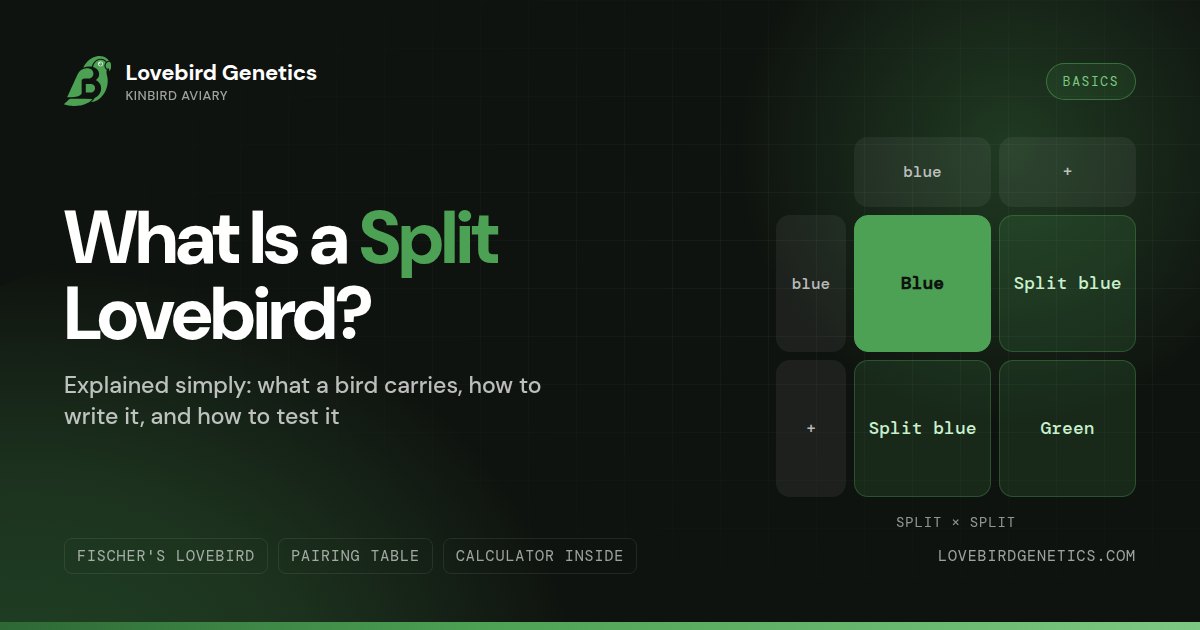
A split lovebird carries a hidden recessive mutation gene on one chromosome but expresses it on neither feather nor eye. The only way to confirm a split is through pedigree records, DNA testing, or test pairings. Understanding splits is the foundation of all Fischer's lovebird genetics planning.
What "split" actually means
A split lovebird is a bird that carries one hidden copy of a recessive mutation without showing it. It looks completely normal but can pass the gene to its chicks. Written as normal/mutation (for example Green / Blue), splits are how recessive colours are carried and reappear when two carriers are paired.
A split lovebird carries one copy of a recessive mutation gene but does not show that mutation visually. The bird looks completely normal. The hidden gene is there, it just needs a second copy to be expressed.
In genetics, this is called being heterozygous for a recessive allele. The bird has one working copy of the normal gene and one mutated copy. The normal gene "wins" visually, so the bird looks normal, but the mutated copy is passed to roughly half of all offspring.
A recessive mutation requires two copies to be visible. One copy = split (hidden carrier). Two copies = visual (the mutation shows).
Split is written with a forward slash. Examples:
- Normal / Aqua, looks green, carries one Aqua gene
- Green / Pale Fallow, looks normal green, carries one Pale Fallow gene
- Blue 1 / Ino, looks Blue 1, carries one Ino gene
Everything before the slash is what the bird looks like. Everything after the slash is what it secretly carries.
Which mutations can produce splits
A split carries one hidden copy of a recessive gene and looks identical to a non-carrier. Only autosomal recessive mutations produce splits. Dominant mutations have no hidden carriers, and hens cannot be split for sex-linked mutations because they hold only one Z chromosome (Van den Abeele, Lovebird Compendium, 2016).
Only autosomal recessive (AR) mutations work this way. In Fischer's lovebirds, these include: Aqua, Blue, Pale Fallow, Dun Fallow, Bronze Fallow, Ino (Lutino/Albino), Dilute, Recessive Pied and Yellow Face. Red Factor is handled as autosomal recessive in the calculator as a modelling choice rather than a settled fact.
For these mutations, any bird, male or female, can be a split carrier.
One important qualification: Blue, Aqua and Parblue are all alleles of a single gene, the blue locus, and a bird carries at most two of them. Only Aqua Homo (two Aqua alleles) behaves as a plain autosomal recessive with a normal split form. Aqua B1 (one Aqua allele with Blue 1) and Aqua B2 (one Aqua allele with Blue 2) are co-dominant compounds, not splits, so there is no such bird as a "split Aqua B1". A green bird carrying one hidden Aqua allele is written Green / Aqua. See Aqua lovebird genetics.
How autosomal recessive inheritance works
Each bird inherits two copies of every autosomal gene, one from the father, one from the mother. For an AR mutation to be visible, both copies must carry the mutation. If only one copy carries the mutation and the other is normal, the normal gene "wins", the bird looks wild-type but secretly carries the mutant allele as a split.
The classic example is Aqua. When two split-Aqua birds are paired together, the offspring follow Mendel's 1:2:1 ratio:
- 25% receive two normal alleles, pure normal (no Aqua gene at all)
- 50% receive one normal + one Aqua allele, split carriers, look green
- 25% receive two Aqua alleles, visual Aqua, the mutation is expressed
This ratio holds across all autosomal recessive mutations in Fischer's lovebirds. The same 25/50/25 pattern applies to Pale Fallow, Dun Fallow, Dilute, and Yellow Face when two splits are paired. The Lovebird Genetics Calculator applies this ratio automatically for every AR mutation in the system.
How sex-linked splits work differently
Fischer's lovebirds have four sex-linked recessive mutations recorded by OGVZW: Opaline, Cinnamon, Pale and Pallid. All of them are carried on the Z chromosome. Because females have only one Z chromosome (ZW genotype), they cannot be splits, they either show the mutation or they don't. Only males (ZZ) can carry these mutations as splits.
A male split for Opaline carries one Z chromosome with the Opaline allele and one Z chromosome with the normal allele. The normal allele masks the Opaline, so he looks completely normal. When he breeds, he passes his Opaline Z to half of his daughters, and because a daughter has only one Z, any daughter who receives it shows Opaline immediately. This is the mechanism behind the famous Opaline auto-sexing pairing. See the full guide: Sex-linked mutations in lovebirds →
The difference between a carrier and a split
In aviculture, the terms "split," "carrier," and "heterozygous" all mean the same thing: a bird that carries one copy of a recessive mutation gene without expressing it visually. The difference is purely terminological. "Split" is the traditional aviculture term. "Carrier" is used more broadly in genetics contexts. "Heterozygous" is the formal genetic term. When you see a bird described as "Normal / Aqua," that is a heterozygous carrier, a split bird.
The slash notation comes from the way geneticists write allele pairs. The allele that is expressed (or the base colour) goes first; the hidden allele goes second: Green / Aqua reads as "the bird is phenotypically green, but genotypically it carries one Aqua allele."
Dominant mutations: no splits exist
Dominant mutations, Euwing, Misty, Dominant Pied and Slaty (autosomal) and Greywing (sex-linked), do not have splits. Every bird carrying the gene shows it. Instead of split/visual, these mutations have Single Factor (SF) and Double Factor (DF), one copy versus two copies. Euwing, Misty and Greywing are incomplete dominants, so a DF bird looks visibly different from an SF bird. Dominant Pied and Slaty are plain dominants, so SF and DF are not reliably separable by eye and zygosity comes from the breeding record. There are no hidden carriers for any of them.
What splits produce in the nest
This is where splits become powerful for planning. The three most important pairing types:
| 1.0 Normal / Aqua0.1 Normal / Aqua | ||
|---|---|---|
| Offspring | Chance | Note |
| Visual Aqua Homo | 25% | Homozygous, shows the mutation fully |
| Normal / Aqua (split) | 50% | Carrier, looks normal but passes the gene |
| Normal (pure) | 25% | No Aqua gene at all |
Note: you cannot distinguish splits from pure normals by looking, they appear identical.
Try this pairing →| 1.0 Normal / Aqua0.1 Visual Aqua Homo | ||
|---|---|---|
| Offspring | Chance | Note |
| Visual Aqua Homo | 50% | |
| Normal / Aqua (split) | 50% | |
| 1.0 Visual Aqua Homo0.1 Normal (pure) | ||
|---|---|---|
| Offspring | Chance | Note |
| Normal / Aqua (split) | 100% | All offspring are carriers, none show Aqua visually |
This is how breeders "bank" a rare mutation into their flock when they have only one visual bird.
Try this pairing →Double splits: carrying two mutations at once
A bird can be split for more than one autosomal recessive mutation simultaneously. A bird listed as Normal / Aqua / Pale Fallow carries hidden copies of both mutations, and passes each gene independently to its offspring. These double splits are among the most strategically important birds in a serious breeding program, because a single bird can introduce two rare mutations into a flock in the same season.
Double splits arise naturally when you cross two lines carrying different mutations. For example: pair a Visual Aqua Homo male with a Visual Pale Fallow female and all offspring will be double splits, Normal / Aqua / Pale Fallow, that look completely plain green but secretly carry both genes.
| 1.0 Normal / Aqua / Pale Fallow0.1 Normal / Aqua / Pale Fallow | ||
|---|---|---|
| Offspring | Chance | Note |
| Normal (various split combos) | ~56.25% | Includes pure normals, single Aqua splits, single PF splits, and double splits, all look identical |
| Visual Aqua Homo (pure or split Pale Fallow) | ~18.75% | Cannot distinguish visually, test pair or DNA to check for hidden PF gene |
| Visual Pale Fallow (pure or split Aqua) | ~18.75% | |
| Visual Aqua Homo Pale Fallow | ~6.25% | Compound visual, both mutations fully expressed simultaneously, the most sought-after outcome |
Each mutation segregates independently (Mendel's independent assortment). Compound visuals (both mutations visible) appear in roughly 1 in 16 offspring on average.
Try this pairing →A double split looks completely normal but can produce compound visuals, birds expressing two rare mutations simultaneously, in a single breeding season. Aqua Pale Fallow and Aqua Dun Fallow are the most prized compound forms in Fischer's lovebirds. The only way to produce them consistently is through verified double-split breeding lines.
Step-by-step: reading splits in the calculator
The Lovebird Genetics Calculator handles splits automatically, once you know how to enter them correctly. Each parent card starts with a base colour, and every additional trait is added as its own row with a status selector set to Visual or Split. Here is a precise walkthrough:
- Set the base colour first (Green, Blue 1, Blue 2, Aqua, etc.). This defines what the bird looks like visually, independent of what it carries.
- For each mutation the bird carries, press Add Mutation to create a row for it, then set that row's status selector to Split. If the bird actually shows the mutation visually, set the row to Visual instead. Leave a mutation out entirely if the bird does not carry it.
- For sex-linked mutations (Opaline, Cinnamon, Pale) remember that hens cannot be split. On the hen card a sex-linked row offers Visual only, and the Split option does not appear. Only the cock card offers Split for sex-linked traits.
- Repeat for the second parent. There is no Calculate button to press: the offspring breakdown appears below the parent cards as soon as both have a base colour, and it updates live with every change you make.
- Read the offspring rows. Each shows: the phenotype (what the bird looks like), the split genotype (what it secretly carries), the sex where sex-linked mutations are involved, and the percentage probability.
The most common entry error is treating "unknown" as "no gene." If a bird's parents were both splits for Aqua, the bird itself may be split, enter it as Split until DNA testing or test pairings prove otherwise. Assuming a bird is clear when its parentage is unverified can make your breeding projections significantly wrong and cause you to miss sought-after offspring categories.
When a parent's split status is uncertain, run the calculation twice: once with Split and once with Visual/Off. Compare the two result sets. If the difference in target offspring percentages is large, that uncertainty is one to resolve with a DNA test before committing the bird to a full breeding season.
Plan your split pairings instantly
Set parents to Split or Visual and see every offspring category with percentagesAre splits sought-after?
Yes, especially for the scarcer mutations. A bird that is split for Aqua can do something a pure normal cannot: paired correctly, it produces visual offspring. A double split, for example a bird carrying hidden Aqua and Pale Fallow alleles at once, opens up combinations a plain normal bird can never reach.
The calculator shows you exactly what percentage of each offspring category you can expect from any split pairing, which helps you judge whether a bird is the right bird for your goals before you commit it to a pair.
How to confirm a split, three methods
Because a split looks exactly like a non-carrier, you can never confirm one by eye. The only certain proof is a documented pedigree from a known visual parent, a test pairing that produces visual offspring, or a DNA test. Anything short of these is an assumption, not a confirmation (Van den Abeele, Lovebird Compendium, 2016).
Because a split bird is visually indistinguishable from a pure normal, breeders have three tools for confirming split status. Each has different effort, timelines, and certainty levels.
Method 1: Pedigree records
The simplest and fastest confirmation method, if your records are good. If one parent is a known visual for an AR mutation, then every offspring from that parent that does not show the mutation is a guaranteed split. This is because a visual parent (homozygous) must pass one copy of the mutant allele to every chick. A green chick from a Visual Aqua father and a normal mother carries exactly one Aqua allele, a confirmed split, no test required.
Pedigree confirmation only works when the parentage is known with certainty, when you bred the bird yourself or received it with verified breeding records. For imported birds or birds from unknown aviaries, pedigree confirmation is not reliable.
Minimum records needed for pedigree-based split confirmation: parent ring numbers, mutation status of each parent, date of pairing, date of hatch. See the aviary management section below for more on record-keeping.
Method 2: DNA testing
Avian genetics laboratories can analyse feather pulp or blood samples and directly read the genotype at specific mutation loci. DNA testing definitively confirms split status for any AR mutation, no breeding required, no waiting for offspring. It is the most certain way to confirm a difficult split before passing the bird to another breeder.
DNA testing is increasingly available across South Asia and Southeast Asia through specialist avian labs. Turnaround varies by lab and the number of mutations being tested simultaneously, testing a bird for five or six mutations at once is usually more efficient than five separate single-mutation tests. For birds described as double splits, a DNA certificate removes any doubt about the bird's genetics for whoever takes them on next.
Method 3: Test pairings
The traditional method for confirming split status: breed the suspected split with a confirmed visual bird of the same AR mutation. From a split × visual pairing, you expect 50% visual offspring per chick on average. If any chick shows the mutation visually, the parent is confirmed as a split carrier.
The sex-linked test is different. To test whether a cock is split for Opaline, Cinnamon or Pale, pair him to a normal hen and watch the daughters: a split cock gives 50% visual daughters, a clean cock gives none, and sons never show it from this pairing. Pairing him to a visual hen is the faster test, because a split cock then gives 50% visual sons and 50% visual daughters while a clean cock gives no visual chicks at all. The hen herself is never in question: a hen shows a sex-linked mutation or does not carry it.
The limitation is statistical certainty. A true split can still produce zero visuals across an entire clutch by chance. A clutch of four chicks gives roughly a 6.25% probability of producing no visuals even if the parent is a true split (0.5^4 = 0.0625). Across two full clutches, that drops to ~0.4%, and across three clutches to ~0.02%. Three clean clutches with no visuals is strong evidence the bird is not split, but only DNA testing eliminates the uncertainty entirely.
The possible split, written //, and how the calculator uses it
A bird you suspect carries a mutation but have not proven is a possible split, written with a double slash: Green // Dun Fallow. A single slash, Green / Dun Fallow, is a confirmed split. The double slash says the status cannot be told by eye and a test breeding is still owed. In the calculator this is the // Split option: / Split is a confirmed split, // Split is a possible split. The same notation appears in offspring lists, where a chick from a split × split pairing that looks normal is written // because it may or may not carry the gene.
The calculator takes a possible split as a parent setting. Choose // Split instead of / Split and it produces two complete nests, one for if split and one for if not split, never an average. The two nests are the test breeding written out in advance: the first shows what a visual chick would prove, the second shows what you will see if the bird is clean.
Two rules decide the test. One visual chick confirms the split with certainty, because a clean parent cannot produce that chick. Clear chicks only lower the odds, they never reach zero. Starting from an even chance either way, the chance the bird is still split after a run of clear chicks is:
| Clear chicks | Split × visual (50% show if split) | Split × split (25% show if split) |
|---|---|---|
| 3 | 11% | 30% |
| 5 | 3% | 19% |
| 10 | under 1% | 5% |
| 15 | under 1% | 1% |
The pairing partner decides how fast the test runs. A visual partner halves the doubt each chick. A confirmed split partner takes roughly twice as many chicks. A partner that carries nothing cannot test the bird at all, because no chick can show the mutation whichever way the possible split falls, and the calculator says so when you set that pairing.
Never assume a bird is "pure normal" just because it has produced no visual offspring yet. A split bird paired with another split will only produce visuals 25% of the time, so it can take several clutches before any appear.
Sex-linked mutations, why females cannot be splits
Hens are ZW and carry a single Z, so for Opaline, Cinnamon, and Pale a hen is either visual or non-carrier, never a hidden split. Any bird described as a "split Opaline hen" is a bird that cannot exist (Van den Abeele, Lovebird Compendium, 2016).
This is one of the most commonly misunderstood points in Fischer's lovebird genetics, and it has real consequences. Anyone describing a "split Opaline female" either does not understand sex-linked genetics or is misdescribing the bird. Here is why such a bird cannot exist.
Female Fischer's lovebirds are ZW, they have one Z chromosome and one W chromosome. The W chromosome is gene-poor and does not carry copies of the mutation loci that sit on the Z. This means every female has exactly one copy of the Z-linked gene for mutations like Opaline, Cinnamon, and Pale.
For a recessive mutation to be hidden (i.e., for a bird to be a "split"), the bird needs two alleles at the relevant gene locus, one mutant copy and one dominant normal copy. The normal copy masks the mutant. In males (ZZ), this is possible: one Z can carry the Opaline allele, the other Z carries the normal allele. The bird looks normal but passes Opaline to half his offspring.
In females (ZW), there is only one Z. If that single Z carries the Opaline allele, there is no second Z with a normal allele to mask it. The female shows Opaline visually. If her Z carries the normal allele, she simply does not have the Opaline gene at all. There is no intermediate state. A female cannot be a split for Opaline, Cinnamon, or Pale.
Any bird advertised as a "split Opaline female," "split Cinnamon female," or "split Pale female" is a genetically impossible bird. Treat it as a signal that whoever wrote the description does not understand Fischer's lovebird genetics, and question the accuracy of every other claim made about that stock.
For the complete chromosome mechanics, pairing outcomes, and auto-sexing applications of sex-linked mutations, see: Sex-Linked Mutations in Fischer's Lovebirds →
For Opaline-specific pairing outcomes and combination birds, see: Opaline Lovebird Genetics: The Complete Guide →
Practical split management in a breeding aviary
Knowing which birds are splits is only useful if you can reliably track that information across breeding seasons, between pairs, and as birds move on to other breeders. Many experienced breeders lose track of split status once their flock grows beyond 20 to 30 birds. A systematic approach prevents waste and protects the integrity of your split lines.
Banding and tagging splits
Every bird whose split status is confirmed, whether by pedigree, DNA test, or test pairing, should be physically distinguished from birds of unknown split status. The most reliable method is colour-coded closed leg bands applied at the time of banding (typically 8-12 days after hatch). Assign one colour to confirmed splits for each mutation class: for example, green bands for Aqua splits, blue bands for Pale Fallow splits, and so on. Use a double-band (two rings on one leg) for confirmed double splits.
When a split bird leaves your aviary, the band colour is the first authentication marker: the next keeper can see immediately that the bird was documented in the breeding record rather than casually labelled a split on the day it moved.
Split record-keeping minimum requirements
Every bird in a serious split-breeding programme should have a record that includes: closed leg band number, date of hatch, cage or pair number of the parents, ring numbers of both parents, confirmed mutation status of each parent, and the split status determination method (pedigree, DNA, or test pairing). When space is limited, a simple spreadsheet or notebook with one row per bird is sufficient. Digital records are preferable because they can be searched quickly when another breeder asks about parentage.
At minimum, record every bird that is either: (a) confirmed split by pedigree from a known visual parent, (b) DNA-tested, or (c) confirmed by test pairing. Birds of unknown status should be labelled "unknown", not "normal", to prevent them from being accidentally treated as pure normals in future pairings.
The generation ladder concept
Think of split lines as a ladder. At the top rung: a visual bird, fully expressed. One rung down: a confirmed split (one generation away from producing visuals when paired with another split or a visual). Two rungs down: a bird of unknown status that may be split based on its pedigree but has not been confirmed. Three rungs down: a bird that is probably not split but cannot be ruled out.
The further down the ladder a bird sits, the less weight its split status claims carry. A bird two generations removed from a confirmed visual parent that has never been test-paired or DNA-tested cannot reliably be described as a confirmed split. The only safe way to move a bird up the ladder is test pairing or DNA testing. Pedigree alone only validates the first generation of confirmed splits.
How Do Splits Shape a Breeding Plan?
Splits are the hidden scaffolding of every serious breeding plan. They let you carry a rare mutation forward invisibly, combine two recessive traits in a single line, and time when visual birds appear. Reading splits correctly is what separates a planned programme from random pairing.
The first thing splits give you is patience as a strategy. When you own only one visual bird of a rare autosomal recessive mutation, pairing it to a normal "banks" the gene into a flush of splits that all look plain but carry the trait. You lose a season of visuals, but you gain a wider base of carriers to build from. A breeder who understands this does not panic when the first nest of a banking pairing shows no visuals, that outcome was the plan all along, and the calculator will have shown it in advance.
The second thing splits give you is the ability to stack mutations. Two rare recessive traits cannot both appear in one bird unless both parents carry both genes. Double splits, birds carrying two hidden recessives at once, are the bridge to compound visuals like Aqua Pale Fallow. You reach them by crossing two single-mutation lines, holding the resulting double splits, and pairing them in the following season. Mapping this two-step path on paper before you bring in any birds prevents the common error of acquiring two visuals that can never produce the combination you actually want.
The third thing splits control is timing. A split × visual pairing delivers 50% visuals per clutch, so you may see results in the first nest. A split × split pairing delivers only 25%, so the same goal may take a full extra season. Knowing which ratio your pairing produces lets you decide whether a season's wait is acceptable or whether you should source a visual partner instead. This is where running the pairing in the calculator before committing the pair pays off: you set realistic expectations, allocate nest space sensibly, and avoid abandoning a sound pairing just because chance withheld visuals in the first clutch.
In short, splits are not a lesser version of a visual bird. They are the planning instrument that makes deliberate, multi-season breeding possible at all.
Common mistakes with splits
These errors come up in aviaries all across South Asia, regardless of the breeder's experience level. Understanding them protects you whichever side of a bird transfer you are on.
Accepting a "split Opaline female"
Genetically impossible, as explained above. A female Fischer's lovebird cannot be split for any sex-linked recessive mutation (Opaline, Cinnamon, Pale). If someone uses this description, it means either they do not understand the genetics or they are mislabelling a split male. In either case, do not accept a split claim for this bird without a DNA certificate confirming the actual genotype.
Assuming all normal-looking chicks from split × split are splits
This is the most common statistical error new breeders make. From a split × split pairing, 75% of chicks look normal, but only two-thirds of those normal-looking chicks (i.e., 50% of the total clutch) are actually splits. The remaining one-third of normal-looking chicks (25% of the total) are pure normals with no gene at all. You cannot distinguish splits from pure normals visually. If you label all normal-looking offspring as splits and pass them on as such, you will over-represent the split frequency by 33%, and your reputation suffers when those birds produce no visuals for the next breeder.
Pairing two "suspected" splits without verification
Two birds of unverified split status, perhaps obtained from different breeders who both "claimed" them as splits, should not be trusted as a split × split pairing until at least one is confirmed. If neither is a true split, you will produce a full season of pure normal offspring and wonder why no visuals appeared. Always confirm at least one parent's split status by pedigree or DNA before committing to a split × split programme for a rare or hard-to-source mutation.
Expecting quick results from split × split pairings
A split × split pairing gives only 25% visuals per clutch. A four-egg clutch has roughly a 32% chance of producing zero visual offspring in any single nest. Breeders who expect visuals in the first clutch and give up when none appear may be abandoning a correct split pairing prematurely. Allow at least two full clutches before drawing conclusions. If after three clutches with no visuals, investigate the parents' actual split status rather than assuming the pairing failed.
History and origin of the split concept in lovebird aviculture
The formal use of the word "split" to describe recessive gene carriers in aviculture developed alongside the first deliberate mutation breeding programmes in the mid-twentieth century. As Fischer's lovebirds began showing the first documented mutation forms, early Blue and Lutino birds appearing in European and South African aviaries from the 1970s onward, breeders recognised that mutation genes could be hidden in normal-looking birds and re-appeared in the following generation.
The slash notation (Green / Aqua) was popularised in European aviculture magazines and breeding records from the 1980s as a shorthand for heterozygous carriers. Dirk Van den Abeele's Lovebird Compendium (2016) standardised the notation and provided the first comprehensive genetic framework for all Fischer's mutations, distinguishing clearly between autosomal recessive, sex-linked recessive, and autosomal dominant mutations.
In Asia, where Fischer's lovebird breeding expanded rapidly from the early 2000s through Indonesia, the Philippines, and then across South Asia, the split concept was adopted alongside the spread of rare mutations. As Indonesian and Philippine breeders developed Aqua, Pale Fallow, and Opaline lines, confirmed split status became central to how breeding stock was described as it reached Bangladesh, Pakistan, and India.
Today, DNA testing has become an important tool for confirming split status in scarce breeding lines, replacing the multi-season test pairing approach where a season lost to a failed test pairing is a setback no serious breeder wants to repeat.
References
- Van den Abeele, D. (2016). Lovebird Compendium. Ornitho-Media. ISBN 978-90-822990-0-3.
- Wikipedia contributors. Lovebird. Wikipedia, The Free Encyclopedia. Accessed 2026.
- BirdLife International. Agapornis fischeri, Fischer's Lovebird. BirdLife Species Factsheet. Accessed 2026.
Frequently asked questions
What is a possible split lovebird and how is it written?
A possible split is a bird suspected of carrying a recessive mutation but not yet proven, written with a double slash such as Green // Dun Fallow. A single slash marks a confirmed split. A test breeding settles it: one visual chick confirms the split, while clear chicks only lower the odds. From an even starting chance, five clear chicks from a split by visual pairing leaves about 3% chance the bird is still split, and five from a split by split pairing leaves about 19%.
What does "split" mean in lovebirds?
A split lovebird carries one copy of an autosomal recessive mutation gene but looks completely normal visually. The bird passes the mutation to roughly half its offspring. Split is written as a forward slash, e.g. "Normal / Aqua" or "Green / Pale Fallow".
Can female lovebirds be split for Opaline?
No. Opaline in Fischer's lovebirds is sex-linked recessive, carried on the Z chromosome. Females have only one Z chromosome (ZW), so they either show Opaline visually or do not carry it at all. Only males (ZZ) can be split for Opaline, Cinnamon, and Pale.
What offspring does split × split produce?
Two split birds for the same AR mutation produce on average: 25% Visual, 50% Split, and 25% Normal (no gene). The visual offspring express the mutation fully.
How do you confirm if a lovebird is split?
You cannot tell by looking, a split bird is visually identical to a normal. For an autosomal recessive mutation you confirm with a test pairing: breed the bird to a visual, and if visuals appear among the offspring the parent is split. For a sex-linked mutation, pair the suspected split cock to a normal hen and watch the daughters instead. DNA testing settles either case.
Do dominant mutations have splits?
No. Dominant mutations like Euwing, Greywing, and Misty do not have splits. Every bird carrying the gene shows it visually, as Single Factor or Double Factor. There are no hidden carriers for dominant mutations.
Can a lovebird be split for more than one mutation at the same time?
Yes. A bird can carry splits for multiple autosomal recessive mutations simultaneously, for example, Normal / Aqua / Pale Fallow. Each mutation is inherited independently. When two double splits are paired, they can produce offspring that express both mutations visually at the same time, called compound visuals. These are the most sought-after birds in advanced breeding programs.
What is the most sought-after split to own in Fischer's lovebirds?
Splits for the scarcer autosomal recessive mutations are the ones breeders ask about most. A Normal / Aqua split can produce Aqua Homo visual offspring, one of the most admired colour forms, in a single pairing step. Double splits combining Aqua with Pale Fallow or Dun Fallow are the most strategically useful of all, because they can produce compound visuals that are hard to reach any other way.
How many clutches does it take to confirm a split by test pairing?
There is no guaranteed minimum. Each clutch from a split × visual pairing gives roughly 50% visuals on average, but a true split can still produce no visuals across several clutches by chance alone. Statistically, three or four clean clutches with no visuals reduces the probability of the bird being split significantly, but does not eliminate it. DNA testing is the only definitive method.
Is a split lovebird as healthy as a normal?
For the vast majority of mutations, yes, splits are just as healthy as pure normals. The notable exception is Bronze Fallow: visual Bronze Fallows (homozygous for the gene) suffer very high juvenile mortality rates, so split Bronze Fallow birds are actually preferred over visuals for breeding. In all other common Fischer's mutations, split status has no impact on health, size, or lifespan.
If I add a split to my aviary, when will I see visual offspring?
It depends entirely on the pairing. A split × visual pairing gives 50% visuals per clutch, you may see them in the very first nest. A split × split pairing gives only 25% visuals, expect to wait one to two seasons before the first visual appears by chance. Running the calculator before you pair helps you set realistic expectations for how many seasons a split bird will take to produce the outcomes you want.