
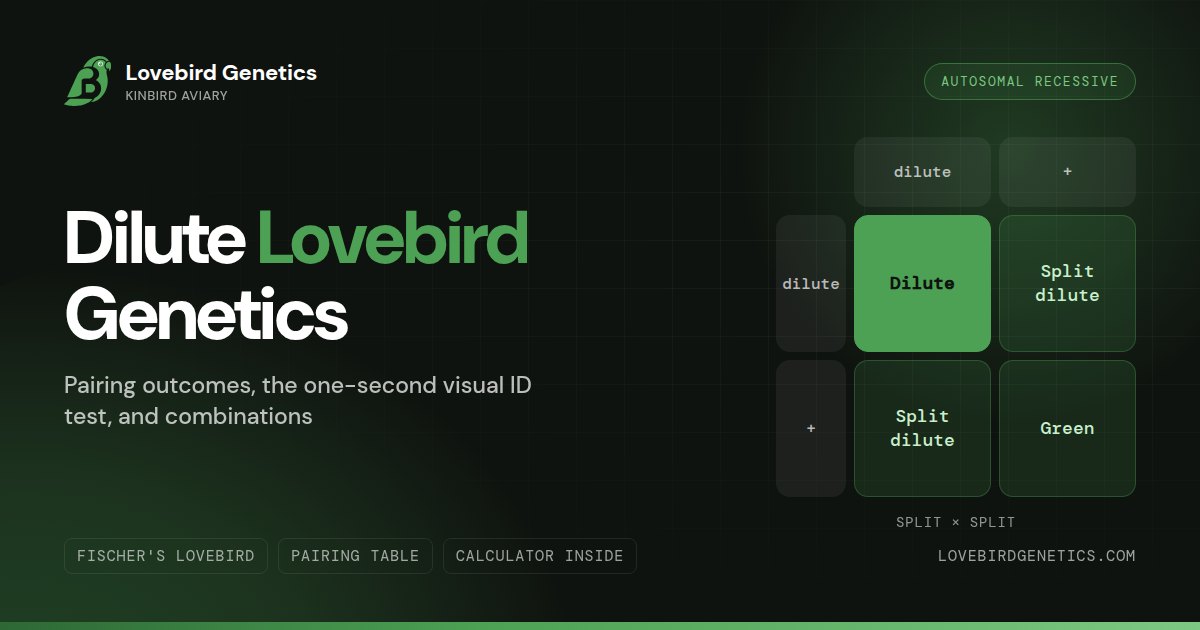
Dilute in Fischer's lovebirds is an autosomal recessive mutation that reduces melanin deposition through abnormally large melanosomes (macromelanosomes), producing generally paler, more washed-out plumage. Unlike Cinnamon (which changes melanin type) or Pale Fallow (which reduces eumelanin by roughly 90 to 95 percent), Dilute reduces melanin concentration per feather barb through organelle size increase. Eye colour and foot colour remain normal, this is the definitive diagnostic separating Dilute from all Fallow mutations.
Dilute is autosomal recessive. Tyrosinase and black pigment are normal, but the pigment granules clump into giant macromelanosomes up to 500 times normal size, which pales the plumage while leaving eyes and feet normal wild-type colour. It was first recorded in Agapornis roseicollis in Japan in 1954 (Masaru Iwata; some sources give 1967), per Van den Abeele, Lovebird Compendium, pp. 461–462. Dilute reached A. fischeri by transmutation. In peach-faced lines some Dilute hens can be infertile, so pair to unrelated wild-type stock (Lovebird Compendium, pp. 460 to 471).
How Dilute Works, Macromelanosomes Explained
The Dilute mutation in lovebirds is autosomal recessive. The pigment is all there but the granules clump into giant oversized clusters, so the bird looks pale and washed-out with grey flights, while the eyes and feet stay normal. That normal eye colour is the key to telling Dilute from a fallow.
Dilute is autosomal recessive and forms oversized, clumped melanin granules (macromelanosomes) that deliver less pigment per feather. The eumelanin itself stays chemically normal, so a Dilute bird is simply a paler version of its base colour rather than a different hue. Both sexes can carry it as a hidden split, and two copies are needed for a visual bird (Van den Abeele, Lovebird Compendium, 2016).
In a normal Fischer's lovebird, melanin is packaged in melanosomes, small organelles produced within feather-producing cells called melanocytes. During feather growth, these melanosomes transfer melanin granules into feather keratinocytes (the cells that actually form feather barbs and barbules). The size, shape, and density of melanosomes determines how efficiently melanin is deposited into the growing feather structure. Normal melanosomes are relatively small, ellipsoidal, and densely packed, they transfer melanin efficiently, producing deeply saturated, richly pigmented feather barbs.
The Dilute mutation disrupts melanosome development at the organelle-formation stage. Instead of forming normal-sized ellipsoidal melanosomes, Dilute melanocytes produce abnormally large, irregular melanosomes, these are called macromelanosomes. The oversized organelles are structurally inefficient: they transfer melanin to feather keratinocytes at a lower rate per unit area, and they cannot pack as densely into the feather barb space. The net result is significantly reduced melanin deposition per feather barb, the bird's plumage appears "diluted" or "washed out" because each feather barb contains less melanin than a Normal bird would show.
Critically, the type of melanin produced is unchanged. Dilute birds still produce the same normal black-grey eumelanin as a wild-type Fischer's lovebird, there is no chemical modification to the melanin molecule itself, unlike in Cinnamon (where TRP1 shifts melanin from black-grey to warm brown). The macromelanosomes contain normal eumelanin; they simply deliver less of it per feather area. This distinction is the molecular basis of the most important diagnostic feature of Dilute: the eyes remain completely normal dark brown. Eye melanocytes function via a separate pigment pathway from feather melanocytes, and the macromelanosome defect in Dilute does not significantly affect iris pigmentation. This is documented in Van den Abeele's Lovebird Compendium (2016) as the defining mechanical distinction between Dilute and the Fallow mutations.
The macromelanosomes in Dilute are also distinct from the mechanism of Pale Fallow, which reduces eumelanin synthesis itself by roughly 90 to 95 percent (a production problem rather than a delivery problem). And they are distinct from Dun Fallow, which uses a different eumelanin pathway variant. Dilute, Pale Fallow, and Dun Fallow all produce paler Fischer's lovebirds, but the cellular reason is different in each case, and the practical diagnostic (eye colour) is immediate and reliable.
What Dilute looks like in Fischer's lovebirds
A Dilute Fischer's lovebird looks like a "faded" or "washed-out" version of whatever base colour it is. The body plumage loses saturation and depth, it becomes paler, while the overall hue stays correct. This is the key: a Dilute Green bird is still clearly green, just softer and less intense. It has not turned yellow, teal, or blue. The colour is diluted, not replaced.
Green Series Dilute
The most common form. A Normal Green Fischer's has a rich, saturated yellow-green body. A Dilute Green is a noticeably paler yellow-green, sometimes described as "lime green" or "pale yellow-green." The orange-red mask retains full pigmentation because psittacine pigment (which produces the mask colour) is unaffected by the Dilute gene. Only the body colour, which is produced by a combination of psittacine and melanin, appears diluted. The dark green shoulders, rump, and back lightens to a softer medium green.
Blue Series Dilute
Dilute Blue 1 and Dilute Blue 2 birds are very pale, almost whitish-blue in their lightest expression. The blue hue is intact but so reduced in intensity that the bird looks almost pastel or silvery. The mask, which in Blue Series birds is white or whitish, remains largely unchanged. Dilute B1 and Dilute B2 are difficult to distinguish from each other visually, the Dilute gene masks the subtle differences between the two Blue mutations.
Aqua Dilute
Combining Dilute with Aqua (autosomal recessive) produces one of the most delicate colour forms in the Fischer's spectrum. Aqua itself produces a soft teal or mint-green, already paler than Normal Green. Adding Dilute softens this further into an extremely light, almost ghostly pale mint-green. Dilute Aqua birds are subtle, calm-coloured birds that photograph beautifully and stand out precisely because of their restraint.
The critical identifier: eye colour
The single most important feature for identifying Dilute is what it does not change: the eyes remain completely normal dark brown. This separates Dilute from every Fallow mutation instantly. Pale Fallow birds have red or wine-red eyes. Dun Fallow birds have bright red eyes on a darker laurel-green body. Dark burgundy eyes belong to Bronze Fallow, a separate mutation. Bronze Fallow birds also show altered eye pigmentation. Dilute birds have normal, dark eyes, just like a wild-type or Normal Fischer's lovebird. If a pale bird has red eyes, it is a Fallow, not a Dilute.
Look at the eyes. Normal dark brown eyes + pale body colour = Dilute. Red or altered eye colour + pale body colour = one of the Fallow mutations (Pale, Dun, or Bronze). This test works reliably even in dim lighting and does not require any equipment.
Dilute vs Pale Fallow vs Dun Fallow
A Dilute keeps wild-type colour everywhere the mutation does not reach: the eyes stay dark brown, and the feet and beak stay their normal colour. This is the single test that separates Dilute from Pale Fallow, which shows red eyes. If a pale bird has red or wine-red eyes, it is a Fallow, not a Dilute (Van den Abeele, Lovebird Compendium, 2016).
Three mutations all produce paler Fischer's lovebirds, but they are genetically distinct, affect different pigment systems, and have different visual markers. This table summarises the key differences:
| Feature | Dilute | Pale Fallow | Dun Fallow |
|---|---|---|---|
| Inheritance | Autosomal recessive | Autosomal recessive | Autosomal recessive |
| Eye colour | Normal dark brown | Red / wine-red | Bright red |
| Beak / feet | Normal pigmentation | Lighter, flesh-toned | Slightly lighter |
| Cellular mechanism | Macromelanosomes (enlarged granules) | Strong eumelanin reduction, roughly 90 to 95 percent, ruby eyes | Near-complete eye reduction, slight feather reduction |
| Splits possible | Both sexes | Both sexes | Both sexes |
| Relative availability | Uncommon | Uncommon | Uncommon |
The genetic mechanism behind Dilute is distinct from both Fallow types. The Dilute gene causes melanosomes (the organelles where melanin is produced and stored) to form much larger than normal, these are called macromelanosomes. Because each macromelanosome occupies more space, fewer can pack into the same area of a feather barb. The total melanin concentration per unit of feather drops, making the bird appear pale. Crucially, the melanin itself is chemically normal, the same colour, the same type, just less of it per square area of feather.
The genetics of Dilute: autosomal recessive
Dilute is a straightforward autosomal recessive (AR) mutation. Unlike Cinnamon, Opaline, or Pallid, which are sex-linked and follow different rules for males and females, Dilute has no sex component. The gene sits on an autosome, which means:
- Both males and females can be Visual Dilute (showing the mutation).
- Both males and females can be split Dilute (hiding the mutation).
- Pairing outcomes are identical regardless of which sex is which parent.
A bird needs two copies of the Dilute gene to show the mutation visually. One copy makes the bird a split, it looks completely normal but passes the gene to roughly half its offspring. Two copies make the bird a visual Dilute, the full mutation is expressed.
This is the same inheritance model as Aqua, Pale Fallow, Dun Fallow, Yellow Face, and Ino (Lutino/Albino). If you already understand how splits work for those mutations, Dilute follows the exact same rules. See the full explanation: What is a Split Lovebird? →
One copy = Split (looks normal, carries the gene). Two copies = Visual Dilute (pale body, dark eyes). Zero copies = Pure Normal. Both sexes follow identical rules.
All Dilute pairing outcomes
The four core Dilute pairings below cover every scenario. Because Dilute is AR, the percentages apply equally to male and female offspring, no sex-specific columns needed.
| 1.0 Visual Dilute0.1 Normal (pure) | ||
|---|---|---|
| Offspring | Chance | Note |
| Split Dilute | 100% | All offspring look completely normal, no visual Dilute chicks. Every chick carries one hidden Dilute gene. |
This is how breeders "bank" the Dilute gene into a new line when they have only one visual bird. No visual Dilute offspring appear, but all chicks are splits for future use.
Try this pairing →| 1.0 Normal / Dilute (split)0.1 Normal / Dilute (split) | ||
|---|---|---|
| Offspring | Chance | Note |
| Visual Dilute | 25% | Homozygous, two Dilute gene copies. Pale body, normal dark eyes. |
| Split Dilute | 50% | One Dilute gene copy. Looks completely normal but carries the mutation hidden. |
| Pure Normal | 25% | No Dilute gene. Cannot be distinguished from splits by appearance alone. |
The standard 1:2:1 AR ratio. Visual Dilutes and pure Normals look different; splits and pure Normals look identical.
Try this pairing →| 1.0 Visual Dilute0.1 Normal / Dilute (split) | ||
|---|---|---|
| Offspring | Chance | Note |
| Visual Dilute | 50% | Shows the mutation fully, pale body, normal dark eyes |
| Split Dilute | 50% | Looks normal but carries one hidden Dilute gene |
Half of all offspring are visual Dilutes in every clutch, the most efficient pairing for consistent Dilute production.
Try this pairing →| 1.0 Visual Dilute0.1 Visual Dilute | ||
|---|---|---|
| Offspring | Chance | Note |
| Visual Dilute | 100% | All offspring are homozygous Dilute, no splits, no pure Normals produced in this pairing |
Once both parents are visual, 100% of offspring are Dilute. Used when a full Dilute line is established.
Try this pairing →Building a Dilute line from scratch
If you are starting with no Dilute birds and want to introduce the mutation, the typical season-by-season progression is:
- Season 1: Acquire a Visual Dilute bird (one is sufficient). Pair it with your best Normal bird. All offspring are split Dilute, they look normal but carry the gene. Keep several split offspring from this nest.
- Season 2: Pair split × split (two of the Season 1 offspring). From this pairing, 25% of offspring will be visual Dilute. With a typical clutch of 4-6 chicks, you may see a visual in the first nest, or you may need two or three clutches. Average expectation: one visual per two clutches.
- Season 3 onwards: Once you have a visual from Season 2, pair it with a Split from Season 1 (Visual × Split = 50% visuals per clutch). From this point, Dilute production is efficient and predictable.
The key bottleneck is Season 2, where 25% odds mean patience is required. Running two or three split × split pairs simultaneously in Season 2 dramatically increases your chances of seeing your first visual Dilute that season.
A split Dilute bird is visually indistinguishable from a pure Normal. If you buy birds described as "split Dilute" without verified parentage records, you cannot confirm the split status just by looking. Always ask for the breeding record or consider DNA testing before relying on a bird's claimed split status.
Dilute combined with other mutations
Because Dilute is autosomal recessive, it combines freely with any other mutation, including other AR mutations, sex-linked mutations, and dominant mutations. The combinations below are the most practically relevant.
Dilute Opaline
Opaline is sex-linked recessive; Dilute is autosomal recessive. A Dilute Opaline bird carries both mutations and expresses both simultaneously, the Opaline redistribution of psittacine pigment creates richer, more saturated colour on a bird that is simultaneously made pale by Dilute. The two mutations partially counteract each other visually: Opaline enriches and redistributes colour while Dilute softens it. The result is a subtly warm, richly feathered but softly coloured bird. Dilute Opaline is sometimes described as a "pastel Opaline" in the trade.
Because Opaline is sex-linked, producing Dilute Opaline females is more complex and requires an Opaline or Opaline-split male combined with Dilute splits on both sides. Cinnamon will not substitute here: Cinnamon and Opaline are different Z-linked genes. Use the calculator to plan the exact cross, multi-system pairings with both sex-linked and AR mutations require careful step-by-step planning.
Dilute Aqua
Both Dilute and Aqua are autosomal recessive, so combining them is conceptually straightforward, both parents need to be splits or visuals for each mutation. A Dilute Aqua bird expresses both mutations: the Aqua colour shift (from full green to teal/mint-green) is further softened and lightened by the Dilute gene. The result is an extremely pale, soft mint or aqua-white bird, lighter than either mutation produces alone. Dilute Aqua is one of the most elegant Fischer's colour forms and is increasingly sought after in markets that prize unusual, muted coloration.
The path to producing Dilute Aqua: acquire splits for both mutations, pair two double splits, and wait for the 6.25% compound visual rate. Alternatively, one parent can be Visual Aqua / split Dilute paired with a Visual Dilute / split Aqua parent, this produces compound visuals in 25% of offspring.
Dilute Pale Fallow
This is one of the rarest Fischer's compound forms. Both mutations reduce melanin by different mechanisms, Dilute through macromelanosomes, Pale Fallow through a strong eumelanin reduction of roughly 90 to 95 percent, and combining them creates an extremely pale bird with red eyes and an almost washed-out appearance. The practical challenge is that Pale Fallow birds are already uncommon, double splits for both mutations are difficult to identify and verify, and the compound visual has a very pale, delicate appearance that is not universally prized. Where established breeding lines exist, Dilute Pale Fallow is in strong demand due to its rarity.
Dilute Yellow Face
Yellow Face is the orange face gene, symbol of. It is autosomal recessive on its own locus, separate from the blue locus that carries Blue and Aqua, and it turns the orange-red mask yellow rather than reducing psittacine across the body. Dilute sits at its own dil locus, so the two never compete for the same slot and combine freely. The combination reads best on a green-series bird, where Yellow Face turns the orange-red mask clean yellow and Dilute softens the body behind it. On a full Blue bird there is little psittacine left to reduce, so Yellow Face is largely masked there and the bird mostly reads as a pale Blue Dilute.
Plan your Dilute pairings instantly
Set both parents to Split or Visual for Dilute and see all offspring categoriesReading the calculator for Dilute
Because Dilute is AR, entering it in the Lovebird Genetics Calculator is the same as any other AR mutation. Here is the exact process:
- Set the base colour (Green, Blue 1, Blue 2, Aqua, etc.) for each parent first.
- For the Dilute toggle on each parent: set to Visual if the bird shows Dilute, Split if the bird is a confirmed carrier, or leave it off if the bird is a pure Normal with no Dilute gene.
- The same rules apply to both sexes. Unlike sex-linked mutations, there is no "females can't be splits" rule for Dilute. Male and female Dilute toggles work identically.
- Read the offspring breakdown. The result shows Visual, Split, and Pure Normal percentages. If additional mutations are set, the compound visual percentages multiply accordingly.
One subtlety: the calculator cannot distinguish between splits and pure Normals in the result display, both look the same to the breeder. When the result shows "50% split Dilute, 25% pure Normal," those 75% of chicks that look normal will require either test pairings or DNA testing to confirm which is which.
Dilute vs Other "Light" Mutations, The Complete Comparison
Many Fischer's lovebird mutations produce lighter-looking birds. Breeders need to distinguish them precisely, both for accurate popular labelling and for correct pairing calculations. The following H3 subsections give the quick diagnostic for each pairwise comparison.
Dilute vs Pale Fallow
This is the most common confusion pair. Both Dilute and Pale Fallow are autosomal recessive mutations that produce paler Fischer's lovebirds. The diagnostic is immediate and definitive: eye colour. Dilute birds have completely normal dark brown eyes. Pale Fallow birds have pink-red or wine-red eyes, the visible sign of the same strong eumelanin reduction reaching the iris. Check the eyes under natural light, the distinction is unambiguous even in suboptimal lighting. Beak and feet also differ: Pale Fallow birds have lighter, more flesh-toned beaks and feet. Dilute birds have normal-coloured beaks and feet matching a standard Fischer's lovebird.
Dilute vs Dun Fallow
Dun Fallow is also autosomal recessive and also produces paler plumage. Like Pale Fallow, Dun Fallow alters eye pigmentation, Dun Fallow birds have bright red eyes, the same signal as Pale Fallow, so the body colour rather than the eye separates them, but distinctly different from the normal dark brown of Dilute. If the bird has any reddish tinge to the iris, it is a Fallow mutation (either Pale or Dun), not a Dilute. Normal dark brown eyes = Dilute.
Dilute vs Cinnamon
Both Dilute and Cinnamon produce lighter-looking Fischer's lovebirds with normal dark brown eyes, which is why they are frequently confused. The distinguishing features: (1) Wing bar colour: Dilute birds have pale grey wing bars, the same grey as a Normal bird, just lighter. Cinnamon birds have warm brown wing bars, a distinctly different hue with red-brown undertones. (2) Inheritance type: Dilute is autosomal recessive (both sexes can be splits). Cinnamon is sex-linked recessive (females cannot be splits). If you know the inheritance history of the bird, the sex-linked vs AR distinction is immediately diagnostic. Without history, check the wing bar colour under direct natural light.
Dilute vs Ino (Lutino)
Lutino birds are dramatically different from Dilute once correctly identified: Lutino birds have bright red eyes, a predominantly yellow body (almost all eumelanin suppressed), and a retained orange-red face mask, because Ino removes eumelanin only and leaves psittacofulvin untouched. Lutino/Albino is autosomal recessive in Fischer's, like Dilute, so both sexes can be splits. Confusion with Dilute would only arise with very young chicks before the full plumage develops, by fledging, Lutino and Dilute are completely distinguishable on appearance alone.
Summary Comparison Table
| Mutation | Eye colour | Wing bars | Body colour | Inheritance |
|---|---|---|---|---|
| Dilute | Normal dark brown | Pale grey | Pale / washed-out green | AR (both sexes can split) |
| Cinnamon | Normal dark brown | Warm BROWN | Slightly warm green | SL (females cannot split) |
| Pale Fallow | Pink-red | Very pale / near absent | Pale yellowish-green | AR (both sexes can split) |
| Dun Fallow | Bright red | Pale brownish | Darker laurel-green | AR (both sexes can split) |
| Lutino | Bright red | Near-absent | Yellow / golden | AR (both sexes can split) |
Why is Dilute more sought-after as a combination than as a single mutation?
Dilute on its own is one of the quieter Fischer's mutations, but breeder demand climbs sharply once it is stacked. The pull comes from what Dilute does to other colours rather than from a plain Dilute Green, which is why selectors hold it mainly as a building block.
The reason is partly genetic and partly aesthetic. As an autosomal recessive, Dilute hides cleanly in splits of either sex, so it travels quietly through a line until it is deliberately combined. When that combination is Dilute Aqua or Dilute Aqua Opaline, the softening effect of the macromelanosome mechanism layers onto an already pale base and produces the delicate, muted tones that draw the strongest interest. Dilute Pale Fallow, stacking two separate paleness pathways, is rarer still and seen far less often outside established programmes.
Building those combinations is where the difficulty lies, and it is the main thing that keeps the compound forms scarce. A single recessive split crossed to another single recessive split yields a visual in only one chick in four; a double-recessive target such as Dilute Aqua sits at roughly one in sixteen from two double splits. That means several generations of patient selection before a compound visual appears, and the carriers in between look completely Normal, so accurate pedigree records become essential rather than optional.
When selecting stock to work with, experienced breeders look first for verified split status backed by breeding records or DNA, then for the cleanest expression of paleness without any reddish tinge to the eye that would signal a Fallow rather than a true Dilute. Van den Abeele's Lovebird Compendium (2016) documents the macromelanosome mechanism that underlies all of this, and understanding it is what lets a breeder choose which birds to carry forward toward a stable combination line rather than breeding paleness blindly.
Common Mistakes with Dilute
Dilute is an autosomal recessive mutation with straightforward inheritance rules, but several recurring mistakes appear in Fischer's breeding communities, particularly among breeders newer to working with this mutation.
- Confusing Dilute with Pale Fallow based on body colour alone. Eye colour is the definitive diagnostic, check it. Pale body + normal dark brown eyes = Dilute. Pale body + pink-red or burgundy eyes = Fallow. This single check prevents the most common mislabelling error in the mutation. Birds mislabelled as Dilute when they are actually Pale Fallow (or vice versa) are widely misrepresented and will produce incorrect offspring predictions if used in pairing calculations.
- Confusing Dilute with Cinnamon. Wing bar colour (pale grey vs warm brown) and inheritance type (AR vs sex-linked) are the two distinguishing factors. Check both. A bird labelled "Cinnamon" that is actually Dilute behaves completely differently in a breeding program, Dilute splits can be held by both sexes, while female "Cinnamon splits" do not exist genetically.
- Overlooking confirmed Dilute splits. A bird confirmed split for Dilute through verified pedigree or DNA testing is genuinely useful to programmes targeting Dilute Pale Fallow, Dilute Aqua, or Dilute Opaline combinations. Treating an undocumented split as an ordinary Normal wastes that genetic potential. Document and communicate split status so the carrier can be put to work in a planned combination line.
- Assuming "more light = more Dilute copies." Dilute is autosomal recessive with only two phenotypes that matter: visual (Dilute/Dilute, two copies) and non-visual (split or non-carrier, both look identical). There is no double-factor equivalent for Dilute as there is for dominant mutations like Violet or Dark Factor. A very pale Dilute bird is not carrying "more" Dilute gene copies than a less pale Dilute bird, all visual Dilutes are homozygous (two copies). Variation in paleness within visual Dilute birds reflects other genetic background factors, not Dilute dosage.
- Expecting visual Dilute chicks in the first season from Visual Dilute × Normal pairings. Visual Dilute × Pure Normal produces 100% split offspring, no visual Dilutes appear. This surprises breeders who expect to see Dilute chicks immediately. The visual Dilute offspring only appear in Generation 2, when two splits from Generation 1 are paired together (25% visual rate) or when a Generation 1 split is paired with the Visual Dilute parent (50% visual rate).
History and Origin of Dilute in Fischer's Lovebirds
Dilute is documented in Van den Abeele's Lovebird Compendium (2016) as an autosomal recessive mutation in Agapornis fischeri. The macromelanosome mechanism underlying Dilute is a well-documented pathway across multiple parrot species, analogous mutations producing enlarged melanosomes and reduced melanin deposition have been described in budgerigars, cockatiels, and various other psittacines. This cross-species consistency confirms that the macromelanosome pathway is a recurring mutation point in avian melanin biology rather than a Fischer's-specific anomaly.
Dilute has been established in Fischer's lovebird collections since at least the 1970s-1980s in European aviculture. Unlike some mutations that arrived suddenly through identified founder birds, Dilute appears to have arisen independently in multiple European breeding operations during this period and was gradually recognised as a consistent, reproducible mutation rather than an anomalous colour variant. The early European documentation used varied names, "Dilute" and "Isabelle" appear in different national aviculture traditions for what is now standardised as "Dilute." Some of that older writing also used "Pastel" loosely for the same birds, and that usage is now obsolete: Pastel is a separate and distinct mutation at the NSL ino locus, so it must never be used as a synonym for Dilute.
In Bangladesh and Pakistan, Dilute as a pure single mutation is relatively common in established lines that have been breeding Fischer's lovebirds for more than a decade. The mutation entered South Asian collections through imports from European and Indonesian breeders in the 1990s and 2000s. Its breeder demand has been somewhat eclipsed by the sought-after AR mutations, particularly Aqua and Pale Fallow, that currently attract the most breeder attention. However, Dilute's role as a combination component in multi-mutation lines is increasingly recognised, and the growing interest in unusual compound phenotypes (Dilute Aqua, Dilute Pale Fallow, Dilute Opaline) is driving renewed breeding interest in establishing clean Dilute lines.
The Fischer's lovebird (Agapornis fischeri), as catalogued by BirdLife International, is one of the most mutation-rich Agapornis species in aviculture. The diversity of established colour mutations, of which Dilute is just one of more than twenty documented forms in A. fischeri, reflects decades of selective breeding and careful genetic documentation by aviculturists worldwide. Van den Abeele's Lovebird Compendium (2016) remains the definitive scientific reference for the mechanisms and inheritance of all Fischer's mutations including Dilute, and serious breeders should consult it alongside practical experience and modern genetic calculator tools such as the Lovebird Genetics Calculator.
For context on how splits work across all autosomal recessive mutations including Dilute, see the dedicated splits guide. For the full comparison of all Fischer's "light" mutations including Pale Fallow, Dun Fallow, and Cinnamon, the individual mutation guides on this site provide the complete picture.
References
- Van den Abeele, D. (2016). Lovebird Compendium. Ornitho-Media. ISBN 978-90-822990-0-3.
- Wikipedia contributors. Lovebird. Wikipedia, The Free Encyclopedia. Accessed 2026.
- BirdLife International. Agapornis fischeri, Fischer's Lovebird. BirdLife Species Factsheet. Accessed 2026.
Dilute pairing outcomes, cock × hen
Breeders usually describe a pairing as cock × hen. Below is every common Dilute pairing written that way, with the exact percentages this calculator produces.
What do you get from a Dilute cock x Dilute hen?
Every chick is a visual Dilute, cocks and hens alike. Because Dilute is autosomal recessive, sex plays no part in the outcome.
| Chicks | Outcome |
|---|---|
| All chicks | 100% visual Dilute |
What do you get from a Dilute cock x normal hen?
No visual chicks appear in this generation. Every chick is a normal-looking bird carrying one hidden copy, written as normal / Dilute.
| Chicks | Outcome |
|---|---|
| All chicks | 100% split (normal / Dilute) |
What do you get from a split Dilute cock x split Dilute hen?
One quarter of the chicks are visual Dilute. Half are splits and one quarter carry nothing, and the splits and pure normals look identical.
| Chicks | Outcome |
|---|---|
| All chicks | 25% visual Dilute, 50% split, 25% pure normal |
What do you get from a Dilute cock x split Dilute hen?
Half the chicks are visual Dilute and half are splits, with the same result whichever parent carries the visible mutation.
| Chicks | Outcome |
|---|---|
| All chicks | 50% visual Dilute, 50% split |
Run any of these in the lovebird genetics calculator to see the full offspring list for your own birds.
Frequently asked questions
What is Dilute in Fischer's lovebirds?
Dilute is an autosomal recessive mutation in Agapornis fischeri that causes the formation of macromelanosomes, abnormally enlarged melanin granules, rather than normal-sized ones. Because each granule is larger, fewer pack into the feather, reducing total melanin concentration. The result is a paler, more "washed-out" version of the bird's base colour. Crucially, the eyes remain completely normal dark brown, this distinguishes Dilute from all Fallow mutations.
How do you tell Dilute lovebirds from Pale Fallow?
Look at the eyes. Pale Fallow birds have red or wine-red eyes because the Pale Fallow gene strips roughly 90 to 95 percent of eumelanin from feathers and eyes alike. Dilute birds have completely normal dark brown eyes. Both mutations produce a paler body colour, but the eye colour is the definitive identification marker that can be checked instantly without any equipment.
Can female Fischer's lovebirds be split for Dilute?
Yes. Dilute is autosomal recessive, the gene sits on an autosome, not a sex chromosome. Both males and females can carry one copy of the Dilute gene as a split, and both sexes can be visual Dilutes. This is the opposite of sex-linked mutations like Cinnamon or Opaline, where only males can be splits.
What does a Dilute lovebird look like?
Dilute birds look like a "faded" or "washed-out" version of their base colour. A Dilute Green Fischer's is a pale yellow-green or greenish-yellow with noticeably less saturated body colour than a Normal Green. The mask remains orange-red but the surrounding body loses depth. A Dilute Blue 1 or Blue 2 is a very pale, almost whitish-blue. Dilute Aqua produces a soft, pale mint-green. In all cases, the eyes and feet are completely normal, dark brown eyes and normal grey feet.
What offspring does split Dilute × split Dilute produce?
The standard AR ratio: 25% Visual Dilute (homozygous, shows the pale body colour), 50% Split Dilute (heterozygous, looks completely normal), and 25% Pure Normal (no Dilute gene). The 25% Visuals and 25% Pure Normals can be told apart by appearance; the 50% Splits are visually identical to the 25% Pure Normals and require test pairings or DNA to confirm their status.
Is Dilute the same as Pastel?
No, they are two different genes. Pastel is an allele of the NSL ino locus and forms visual compounds with Ino and DEC. Dilute sits at its own dil locus and stays independent. Both are autosomal recessive and both keep dark eyes, which is why the two get mixed up, but the pairing separates them: pair the bird to a Lutino, and visual compound chicks mean Pastel while normal-looking chicks split for both mean Dilute.
What is the most sought-after Dilute combination in Fischer's lovebirds?
Dilute Aqua and Dilute Aqua Opaline are typically the most sought-after Dilute combinations because they combine the already-strong demand for Aqua with the additional softening effect of Dilute, producing exceptionally pale and delicately coloured birds. Dilute Pale Fallow, which stacks two separate paleness mutations, is rarer still and is in strong demand where it is established in a breeding programme.
What is Dilute Aqua and how do you produce it?
Dilute Aqua is a compound Fischer's lovebird expressing both the Dilute and Aqua mutations (both autosomal recessive). The bird shows an extremely pale, soft mint-green colour, lighter than Aqua alone and lighter than Dilute alone. To produce it, both parents must carry copies of both mutations. Two double splits (split Dilute / split Aqua) produce compound visuals in ~6.25% of offspring. For faster results, use a Visual Aqua / split Dilute parent paired with a Visual Dilute / split Aqua parent, this gives 25% compound visuals.
How many seasons does it take to produce a Visual Dilute from splits?
Typically two to three seasons. Season 1: pair a Visual Dilute with a Normal bird to produce all split offspring. Season 2: pair splits together to get 25% Visual Dilute offspring, you may need two or three clutches for the first visual to appear. Season 3: use a visual with a split (50% visual offspring per clutch) for efficient ongoing production.
Are Dilute lovebirds healthy?
Yes. Unlike Bronze Fallow, where homozygous visual birds suffer very high mortality, Dilute has no known health or mortality effects. Visual Dilute birds (homozygous for the gene) are just as healthy, vigorous, and long-lived as Normal birds. The macromelanosomes affect only the feather's melanin density; there is no impact on the bird's immune system, organ function, or lifespan.
What do you get from a Dilute cock x Dilute hen?
Every chick is a visual Dilute, cocks and hens alike. Because Dilute is autosomal recessive, sex plays no part in the outcome. All chicks: 100% visual Dilute.
What do you get from a Dilute cock x normal hen?
No visual chicks appear in this generation. Every chick is a normal-looking bird carrying one hidden copy, written as normal / Dilute. All chicks: 100% split (normal / Dilute).
What do you get from a split Dilute cock x split Dilute hen?
One quarter of the chicks are visual Dilute. Half are splits and one quarter carry nothing, and the splits and pure normals look identical. All chicks: 25% visual Dilute, 50% split, 25% pure normal.