
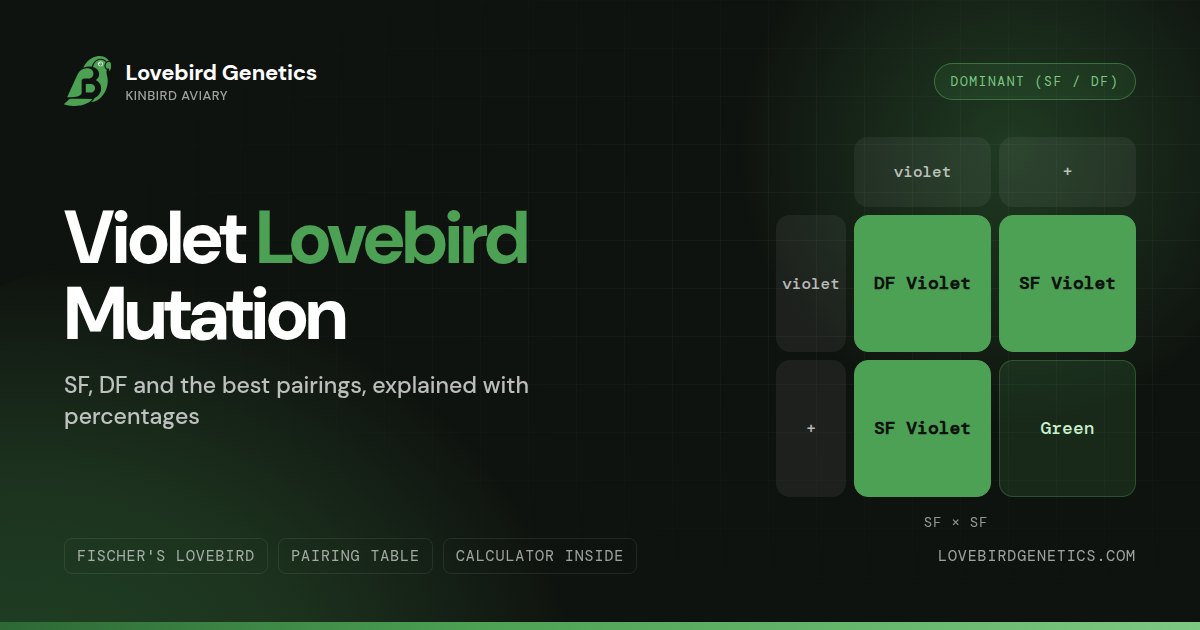
Violet in Fischer's lovebirds is an autosomal incomplete dominant mutation, the single factor (SF Violet) deepens body colour with a violet shift; the double factor (DF Violet) deepens it further. Violet is best expressed as "SF Violet Dark Blue" (Cobalt Violet), the most visually striking Fischer's combination in the blue series. On a green base, Violet produces only a subtle colour change.
Inheritance: Autosomal dominant incomplete (AD incomplete) in Agapornis fischeri
SF Violet: One copy of the Violet gene, bird shows violet phenotype, subtler expression
DF Violet: Two copies of the Violet gene, bird shows deeper, more saturated violet
No splits: Every bird that carries Violet, shows Violet. No exceptions.
Reference: Lovebird Compendium, Dirk Van den Abeele (2016)
Violet is an autosomal incomplete-dominant mutation that reshapes the spongy zone to throw violet interference instead of blue. It shows clearly only on a dark-factor blue bird: single-factor Violet on dark blue is the prime show colour, and double-factor Violet on dark blue is the richest. On green, or on double-dark blue, the violet is barely visible, which is why breeders target Violet dark-blue combinations. First recorded around 1982 (Lovebird Compendium, pp. 568 to 577).
What Is the Violet Mutation?
The Violet mutation in lovebirds is an autosomal incomplete-dominant structural mutation that adds a violet sheen. It shows clearly only on a dark-factor blue bird, single-factor Violet on dark blue is the prize show colour, while on green or double-dark blue it is barely visible.
The Violet mutation in Agapornis fischeri modifies the way light interacts with the structural colour system of the feather. Lovebird feather colour is produced by two systems working together: pigment-based colour (psittacofulvins for yellow-red, eumelanin for dark tones) and structural colour (produced by the physical nanostructure of the feather barbules scattering light). Violet affects the structural colour component, shifting the perceived hue toward the violet-purple end of the spectrum.
On a green bird, Violet produces only a subtle shift, the underlying yellow-green psittacofulvin pigment partially masks the structural violet effect. The bird may look slightly more yellowish-olive or show a faint lavender tinge in certain lighting, but the effect is easy to miss. On a Blue bird, where all psittacofulvin has been removed, the Violet modification works directly on the clean blue structural colour with nothing masking it. The result is a vivid, unmistakable violet-purple body colour that makes this one of the most striking mutations in the hobby.
Normal (no Violet)
Zero copies of the Violet gene. No violet expression. On Blue background: standard cobalt or sky blue body. Cannot produce Violet offspring when paired with another Normal.
Genotype: +/+SF Violet SF
Single Factor, one copy of Violet. Shows violet phenotype. On Blue background: a clear violet hue. Produces 50% Violet chicks when paired with Normal.
Genotype: V/+DF Violet DF
Double Factor, two copies of Violet. Deeper, more saturated violet than SF. All chicks receive at least one Violet gene regardless of partner.
Genotype: V/VHow Violet works, in plain terms
Violet is not a pigment, it is a structural change. It reshapes the spongy layer inside the feather so it throws back a violet interference colour instead of the normal blue. That is why Violet only shows clearly on a dark-factor blue bird: single-factor Violet on dark blue is the prize show colour and double-factor is the richest, but on green or on double-dark blue the violet is barely visible. It is autosomal incomplete dominant, so a single factor already shows (Van den Abeele, Lovebird Compendium, pp. 568 to 577).
Inheritance: AD Incomplete, SF vs DF Explained
Violet is autosomal incomplete dominant. One copy (SF) already shows the violet shift; two copies (DF) deepen it further. Because a single copy is always visible, there is no hidden "split Violet" carrier. A bird that looks normal carries zero Violet genes (Van den Abeele, Lovebird Compendium, 2016).
The label "autosomal dominant incomplete" tells you three important things about how Violet behaves:
- Autosomal, the gene is not on a sex chromosome. Males and females are equally affected and equally able to pass it on. Unlike sex-linked mutations such as Opaline or Cinnamon, there is no difference between male and female Violet inheritance.
- Dominant, one copy is enough to show the trait visually. This is why there is no such thing as a "split for Violet." A bird is either Violet (V/+ or V/V) or it is not (it has zero V alleles). Any bird with even one V allele expresses it in the phenotype.
- Incomplete, having two copies (DF, V/V) produces a noticeably stronger expression than one copy (SF, V/+). This is what separates "incomplete dominant" from a simple dominant where SF and DF look identical. With Violet, the difference is real and visible, DF Violet birds show a deeper, richer, more saturated violet compared to SF Violet birds.
Because many breeders learn genetics through recessive mutations first, the concept of "split Violet" gets repeated in aviculture communities. It is incorrect. A bird cannot carry the Violet gene silently. If it has the gene, it shows it. A visually normal green or blue bird has zero copies of the Violet gene, it cannot be "hiding" Violet. The only way to get Violet offspring is to pair with a bird that visually shows Violet.
Key Concept: Violet Needs Blue to Shine
This is the most practically important concept for any breeder working with Violet. The visual impact of Violet is entirely dependent on the base colour of the bird.
Violet on Green
On a green Fischer's lovebird, the Violet gene produces a very subtle effect. The psittacofulvin (yellow-green pigment) that creates the green body colour partially overrides and masks the structural violet shift. The result is a bird that may appear slightly different, a faint violet or lilac edge to some feathers in certain angles of light, but is often indistinguishable from a normal green bird to an inexperienced eye. Breeding Violet birds on a green background is unlikely to impress judges or win exhibitions.
Violet on Blue
On a Blue Fischer's lovebird, the Violet gene is fully revealed. Because there is no yellow-green psittacofulvin to interfere, the structural violet modification acts directly on the blue feather architecture. The body colour shifts from blue to a clear, saturated violet-purple. The effect is dramatic and unmistakable. This is why serious breeders specifically work to combine Violet with Blue, you are not just adding two mutations, you are unlocking the full visual potential of Violet.
Violet + Dark Factor
Adding a Dark Factor deepens the base blue, which in turn enriches the violet expression further. A Dark Blue (single Dark Factor on a Blue bird, also called Cobalt) combined with SF Violet, commonly called "SF Violet Dark Blue" or "Cobalt Violet", is considered the exhibition standard for Violet Fischer's lovebirds. The deeper cobalt background makes the violet hue appear richer, more jewel-like, and more distinct from ordinary blue birds. Double Dark Factor (Olive on green, or the equivalent deepest blue on a blue bird) is less commonly targeted because the very dark base can suppress the violet into a near-black or muddy tone.
Best expression: SF Violet Dark Blue (Cobalt-Violet), the exhibition ideal
Very good: SF Violet Blue, DF Violet Blue, DF Violet Dark Blue
Subtle / underwhelming: Violet on Green, the violet effect is largely masked by psittacofulvin
Core Violet Pairings
| 1.0 DF Violet (V/V)0.1 Normal (+/+) | ||
|---|---|---|
| Offspring | Chance | Note |
| SF Violet (V/+) | 100% | Every chick gets one V from the DF parent, all chicks are guaranteed Violet |
| 1.0 SF Violet (V/+)0.1 SF Violet (V/+) | ||
|---|---|---|
| Offspring | Chance | Note |
| DF Violet (V/V) | 25% | Deepest violet, both copies inherited |
| SF Violet (V/+) | 50% | Single factor, shows violet phenotype |
| Normal (+/+) | 25% | No Violet gene, normal base colour |
| 1.0 SF Violet (V/+)0.1 Normal (+/+) | ||
|---|---|---|
| Offspring | Chance | Note |
| SF Violet (V/+) | 50% | Show Violet, can be used to continue the line |
| Normal (+/+) | 50% | No Violet gene, cannot produce Violet without a Violet partner |
Calculate the rest of your pairing
Violet is tracked on paper; the calculator handles Blue, Opaline and moreBest Combinations for Exhibition Birds
Because Violet's visual quality depends heavily on the base colour, serious breeders work toward specific multi-mutation combinations. Here is how to think about building exhibition-quality Violet birds:
| Combination | Violet expression | Notes |
|---|---|---|
| SF Violet Dark Blue (Cobalt-Violet) | Exceptional, exhibition standard | One Dark Factor deepens the blue base, maximising the violet hue |
| DF Violet Blue | Very strong, deeper than SF Violet Blue | DF intensifies saturation on a standard blue background |
| SF Violet Blue | Clear and vivid | Good starting point, clean violet on standard blue |
| DF Violet Dark Blue | Very rich violet | Darker, more jewel-like than SF on the same base |
| SF/DF Violet Green | Subtle / minimal | Psittacofulvin masks the violet effect, not recommended for show |
| SF Violet Dark Green | Faint, slightly different from normal | One Dark Factor on green; Violet barely visible |
The classic exhibition target is SF Violet Dark Blue, also called Cobalt-Violet in some circles. The single Dark Factor shifts the blue from sky-blue toward cobalt, which provides a richer base for the violet structural modification to work against. DF Violet on the same background is arguably even deeper, but the visual difference between SF and DF on a Dark Blue base is subtle enough that SF Violet Dark Blue has become the consensus show standard.
To breed toward this target from scratch, you would typically: first establish Blue and Violet separately in your flock, then cross Violet Blue × Blue with one Dark Factor, selecting chicks that show both Violet and Dark Blue phenotype, and refine over successive seasons.
Why Violet Looks Best on Blue, The Base Colour Interaction
Violet works by shifting the feather's structural interference colour. On green, the yellow psittacofulvin overlays that shift and the violet barely shows. Remove the yellow with a blue-series base and the violet reads clearly. The prime show bird is SF Violet on a Dark Blue (Cobalt) base, where the deepened blue carries the violet most vividly (Van den Abeele, Lovebird Compendium, 2016).
Violet is an incomplete dominant modifier. Like Dark Factor, it has three phenotypes depending on how many copies are present (zero, one, or two). But unlike Dark Factor which affects all base colours with broadly similar intensity, Violet's visual expression is strongly base-colour-dependent.
Violet on Green, The Masked Effect
On a green Fischer's lovebird, Single Factor Violet (SF Vi) produces a very subtle violet-blue sheen on the wings and rump that is difficult to detect in normal lighting. Double Factor Violet (DF Vi) is slightly more visible, experienced breeders can spot the faint lavender tinge in ideal lighting conditions, but the effect remains widely underwhelming. Most casual observers cannot distinguish an SF Violet green from a normal green without expert examination in bright natural light. Few breeders pursue Violet on a green base as a result.
The reason for this masking is pigment competition. Green plumage in Fischer's lovebirds is produced by two systems working simultaneously: the psittacofulvin pigment (which creates the yellow-green colouration) and the structural feather nanostructure (which scatters light as blue). Violet modifies the structural colour component, shifting the reflected wavelength toward violet-purple. But the yellow psittacofulvin overlays this structural shift, effectively neutralising the violet modification visually. The result: a bird that is genetically Violet but looks almost Normal.
Violet on Blue, Full Expression Unlocked
On a Blue Fischer's lovebird, the calculation changes entirely. Blue birds have lost the ability to produce psittacofulvin, no yellow pigment is present to mask the structural colour system. Violet's modification of the feather nanostructure therefore acts directly on the clean structural blue colour with nothing opposing it. The result is a vivid, unmistakable violet-purple body colour that is immediately apparent even to inexperienced observers.
This is why serious Fischer's breeders work specifically toward Violet-on-Blue combinations. You are not simply adding two mutations together; you are unlocking the full visual potential of the Violet gene by removing the masking pigment that was suppressing it on a green background.
Cobalt Violet, The Definitive Fischer's Violet
The ultimate Violet expression is "Cobalt Violet", formally described as SF Violet combined with a single Dark Factor (SF DF) on a Blue base. This triple combination (Blue B1 or B2 + SF DF + SF Violet) creates the classic violet Fischer's lovebird that breeders refer to when using the word "Violet" without further qualification.
Why does adding Dark Factor improve Violet further? Dark Factor works by narrowing the spongy zone of the feather barbule, the nanostructural layer that scatters light as blue. A narrower spongy zone shifts the reflected wavelength toward shorter wavelengths (more violet, less sky-blue). Violet already nudges the reflected wavelength toward violet-purple. The two modifications stack, Dark Factor deepens the base colour to a richer cobalt, and Violet then shifts that cobalt further toward purple. Together they produce the deepest, most saturated violet-blue achievable in Fischer's lovebirds: the Cobalt Violet. See the detailed mechanism in the Dark Factor genetics guide.
DF Violet (two copies) on a Blue base produces an over-dark, almost purple-grey bird that most breeders consider less widely attractive than SF Violet Cobalt. The "sweet spot" is always SF Violet, one copy on a Dark Blue base. This has become the consensus exhibition standard in South Asian and Middle Eastern Fischer's collections.
Violet Inheritance, Predicting Offspring
Because Violet is incomplete dominant with three phenotypes (no Violet / SF Violet / DF Violet), it is easier to manage than autosomal recessive mutations. There are no hidden carriers, every bird that has the gene shows it. This simplifies pairing planning considerably.
Normal × SF Violet
Pairing a Normal bird (no Violet gene) with an SF Violet produces 50% Normal and 50% SF Violet offspring. This is the introduction pairing, useful for adding Violet into an existing Blue or Cobalt line without knowing the exact genotype of the Normal partner. Half the clutch will show Violet; half will not. The Violet offspring can be immediately identified visually on a Blue background.
SF Violet × SF Violet
The classic pairing for producing DF Violet birds. Offspring ratios: 25% Normal, 50% SF Violet, 25% DF Violet. The DF Violet offspring (25%) are the darkest and most heavily saturated, but as noted, they are widely less desirable than SF Violet on a Cobalt background. Most serious breeders use SF × SF pairings primarily to maintain their SF Violet Cobalt stock, accepting the 25% Normal and 25% DF as byproducts.
SF Violet × DF Violet
Produces 50% SF Violet and 50% DF Violet offspring. No Normals appear in this pairing. Useful when a breeder wants to increase the proportion of DF Violet birds in a flock, though as noted above, the appetite for DF Violet is limited in most collections.
DF Violet × DF Violet
Produces 100% DF Violet offspring. Every chick from this pairing will carry two Violet gene copies. This is rarely the target pairing for popular breeders because DF Violet birds are the over-dark, less visually appealing form, but it may be used in specialised lines where DF Violet birds are the specific product.
Normal × DF Violet
Produces 100% SF Violet offspring. This is the most efficient pairing for guaranteed Violet chicks, every single offspring will show the Violet phenotype on the appropriate base colour. The DF parent guarantees that every chick receives one Violet gene, and with a Normal partner, every chick gets exactly one copy (SF).
An important practical note: you can roughly confirm SF vs DF visually on a Blue base. DF birds are darker and the difference is real, though subtle. On a Cobalt background, an experienced eye can distinguish SF Violet Cobalt from DF Violet Cobalt side by side. Breeding two SF Violet Cobalts together consistently produces the widely desirable SF Violet Cobalt form in 50% of offspring, making this the standard maintenance pairing for most serious breeders.
Building a Violet Cobalt Line
Producing consistent Cobalt Violet birds requires managing three independent genetic systems simultaneously: the Blue mutation (AR), the Dark Factor (AD incomplete), and the Violet gene (AD incomplete). Here is the season-by-season pathway.
Step 1, Establish a Blue Foundation
Blue is an autosomal recessive mutation. Both parents must contribute one Blue allele for offspring to be visual Blue. The simplest approach is to acquire a pair of Visual Blue birds (both homozygous for Blue). Once you have Visual Blue birds, all offspring are Visual Blue, no splits to track for the base colour. See the full guide to Blue lovebird genetics for detail on Blue 1 vs Blue 2 distinctions. Cobalt = Blue + SF Dark Factor. If you are working from Visual Blue birds, introduce Dark Factor through a Cobalt bird crossed into your Blue line.
Step 2, Introduce Violet
Once you have a Cobalt (Blue + SF DF) foundation, cross an SF Violet bird on any base into your Cobalt line. Generation 1 offspring will include SF Violet Cobalts, the popular target, alongside non-Violet Cobalts. Select the SF Violet Cobalt offspring (identifiable visually by their violet-purple body on a cobalt background) and retain them as your next generation breeders.
Step 3, Stabilise SF Violet Cobalt Production
Pair two SF Violet Cobalt birds together. From this pairing, expect per clutch: 25% DF Violet Cobalt (over-dark, less popular), 50% SF Violet Cobalt (the target), 25% Non-Violet Cobalt. The 50% SF Violet Cobalt yield per clutch is widely efficient, half of every nest is your primary product. The 25% Non-Violet Cobalt can be recorded and kept on as Blue/Cobalt stock. The 25% DF Violet Cobalt can be used to produce guaranteed SF Violet offspring when crossed back to Normal Cobalt birds.
Adding Opaline to the Line
Opaline Violet Cobalt female is a prestige combination. The Opaline plumage redistribution on a Violet Cobalt base produces a bird with violet-purple highlights across the redistributed feather areas, the result is dramatic and is in strong demand among collectors. Because Opaline is sex-linked recessive, Opaline Violet Cobalt females require an Opaline male carrying Violet and Cobalt genes crossed with an appropriate female. Multi-system pairings of this complexity are best planned on paper. The calculator handles the Opaline and Blue components.
Violet Combination Rankings
Not all Violet combinations are equally sought-after widely. Below is an honest ranking by visual quality and how consistently breeders pursue each form.
SF Violet Cobalt (Blue + SF DF + SF Violet), The Reference Bird
This is the definitive Violet. When breeders say "Violet Fischer's," this is invariably what they mean. Rich purple-blue body, clear violet iridescence in optimal lighting, well established, and it is the form most breeders work toward.
DF Violet (Any Base), Specialist Niche
Double Factor on any base colour is over-dark. The purple-grey body is a niche form with a much smaller following than SF Violet. Breeders who specifically want to guarantee SF Violet offspring from every pairing do seek DF birds as one parent, but as a pet or exhibition bird it is far less widely kept than SF.
SF Violet Aqua, The Sought-after Surprise
Violet on an Aqua Homo base produces a purple-turquoise shift that is genuinely unusual, the turquoise of Aqua and the violet modifier combine to create a colour that reads as teal-violet in natural light. Demand for Violet Aqua from South Asian breeders is growing.
Violet Opaline Cobalt Female, Prestige
The most sought-after Violet combination. Opaline plumage redistribution on a Violet Cobalt base is a rare multi-mutation bird that is in strong demand from dedicated collectors. Rare in established lines.
Violet on Green Base, Limited Popular Appeal
As explained above, the psittacofulvin mask suppresses the Violet expression on green. These birds have limited appeal outside of specialist breeders who specifically want the Violet gene in a green line for future colour work.
What makes Violet birds so sought-after to breed?
Violet appeal comes down to one combination: SF Violet Cobalt. It is the bird breeders picture when they hear "Violet Fischer's," and producing it reliably means juggling three independent genetic systems at once, which is exactly why well-bred examples stay scarce.
The breeding difficulty is real. A good Cobalt Violet needs Blue (autosomal recessive) fixed as a visual base, one Dark Factor stacked on top, and the Violet gene layered over that. None of these can be left to chance: Blue must be confirmed visual, Dark Factor must be the single-factor cobalt rather than the over-dark double, and Violet must be present in single factor for the cleanest expression. Getting all three to land in one chick takes several seasons of selective pairing and careful record-keeping. Breeders who chase Violet on a green base, or who over-stack to double-factor Violet, end up with birds that look almost normal or muddy and grey respectively, so the genuinely vivid Cobalt Violets remain comparatively scarce.
When I select Violet stock, the base colour is everything. I will not keep a Violet bird for breeding unless it sits on a clean Blue or Cobalt background where the violet hue reads clearly in daylight. I favour single-factor Violet over double, because SF on a cobalt base gives the jewel-like tone breeders actually want, and pairing two SF Violet Cobalts together reliably returns half the nest as that same target bird. The Compendium (Van den Abeele, 2016) classes Violet as autosomal incomplete dominant, which is a real working advantage: there are no hidden splits to test for, so every Violet bird in your flock is visible at a glance and your selection decisions are never blind.
Common Mistakes with Violet
Violet is simpler to breed than AR mutations because there are no hidden carriers, but several consistent errors appear across South Asian Fischer's breeding communities.
- Breeding Violet on green expecting dramatic visual results. The green-base Violet is widely underwhelming. Breeders who acquire an SF Violet green bird expecting to immediately produce impressive Violet offspring are disappointed when their Blue-base chicks show the mutation vividly but their Green-base chicks look nearly identical to Normal. Establish a Blue foundation before introducing Violet, or cross a Green Violet bird to a Blue partner specifically to produce Violet Blue offspring in Generation 1.
- Confusing DF Violet with "better" SF Violet. DF Violet is not simply a stronger SF Violet, it is a darker, less widely attractive phenotype to most breeders. Breeding specifically for DF Violet at the expense of SF Violet Cobalt production is a popular mistake. The SF × SF pairing already produces 25% DF Violet, there is no need to chase DF specifically.
- Calling any dark blue bird "Violet." Not all dark blue Fischer's lovebirds carry the Violet gene. Dark Blue (Cobalt) = Blue + SF Dark Factor, with no Violet at all. A Cobalt bird without Violet can look superficially similar to an SF Violet Blue to an inexperienced eye, especially in indoor lighting. Violet must be confirmed by pedigree or by test pairing, pairing the suspected Violet bird with a Normal bird and observing whether Violet offspring appear in the next generation.
- Attempting to find "split Violet" birds. Because Violet is dominant, no hidden splits exist. If someone offers you a "split for Violet" that looks Normal, they are either mistaken or misdescribing the bird. Every bird with the Violet gene shows it. Take birds only from breeders who can show the bird's visual phenotype or confirmed pedigree.
History and Origin of Violet in Fischer's Lovebirds
Violet in Agapornis fischeri is documented in Van den Abeele's Lovebird Compendium (2016) as an autosomal incomplete dominant mutation. The mutation was first observed and established in European aviculture before spreading through global export networks. European breeders in the Netherlands and Belgium were among the first to systematically document the SF vs DF phenotype difference and to establish the SF Violet Dark Blue (Cobalt Violet) as the exhibition standard.
The mutation reached South Asian Fischer's collections through import networks via the Middle East, primarily UAE, in the 2000s and early 2010s. Bangladesh and Pakistan breeders initially encountered Violet as a hard-to-source import bird; by the mid-2010s, established Violet Cobalt lines existed in several major breeding operations in Dhaka, Karachi, and Lahore.
Today, in Bangladesh and Pakistan, "SF Violet DF Blue" (Cobalt Violet) is consistently one of the top three most widely desirable blue-series Fischer's mutations, alongside Aqua Homo and Pale Fallow. The Fischer's lovebird (Agapornis fischeri), native to the interior of Tanzania and documented by BirdLife International, has accumulated a remarkable array of established mutations in aviculture over the past century. Violet represents one of the mutations that dramatically demonstrates how structural colour modification, not pigment chemistry, can produce some of the most visually striking plumage variants in the species.
References
- Van den Abeele, D. (2016). Lovebird Compendium. Ornitho-Media. ISBN 978-90-822990-0-3.
- Wikipedia contributors. Lovebird. Wikipedia, The Free Encyclopedia. Accessed 2026.
- BirdLife International. Agapornis fischeri, Fischer's Lovebird. BirdLife Species Factsheet. Accessed 2026.
Violet pairing outcomes, cock × hen
Breeders usually describe a pairing as cock × hen. Below is every common Violet pairing written that way, with the exact percentages Mendelian incomplete dominance produces.
What do you get from a single factor Violet cock x normal hen?
Half the chicks show Violet as single factor and half are completely normal. Violet is dominant, so there is no split form: a bird either shows it or does not carry it.
| Chicks | Outcome |
|---|---|
| All chicks | 50% SF Violet, 50% normal |
What do you get from a single factor Violet cock x single factor Violet hen?
One quarter of the chicks are double factor Violet, half are single factor and one quarter are normal. Double factor birds show the effect more strongly.
| Chicks | Outcome |
|---|---|
| All chicks | 25% DF Violet, 50% SF Violet, 25% normal |
What do you get from a double factor Violet cock x normal hen?
Every chick is a single factor Violet. A double factor parent passes one copy to every chick, so no normal chicks are possible.
| Chicks | Outcome |
|---|---|
| All chicks | 100% SF Violet |
Violet is not currently modelled in the lovebird genetics calculator, so the Violet dose (SF or DF) has to be tracked on paper using the tables above. The calculator handles the base colour and any other mutations carried by the same pair.