
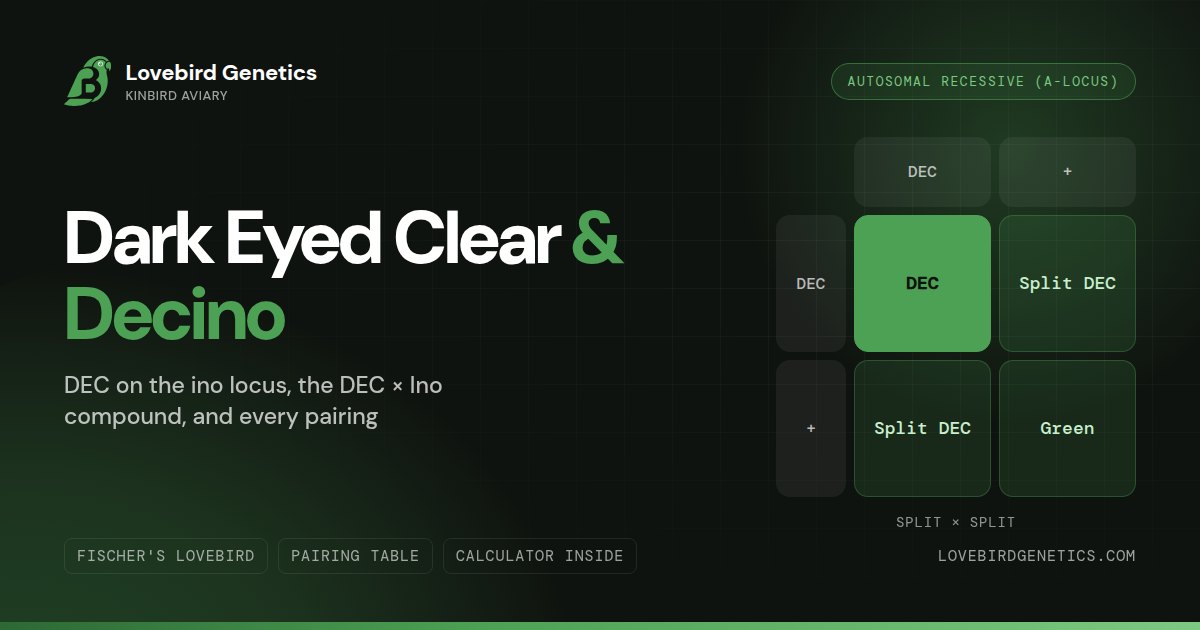
Dark Eyed Clear (DEC) is one of the oldest and most misunderstood mutations in Fischer's lovebirds, records go back to the 1930s, and it is still confused with Lutino, mislabelled, and faked in the market. This guide gives you the accurate genetics from Van den Abeele's Lovebird Compendium, the one tell that separates DEC from Lutino, what Decino really is, and every pairing verified against the book and our calculator.
DEC removes ~95% of the dark melanin, giving a mostly yellow bird with a light blue rump and dark eyes (Lutino has red eyes, that is the difference). DEC is autosomal recessive and an allele of the Ino gene. Its compound with Ino is DEC / Ino (white rump), which is not a separate mutation. DEC / Ino × Lutino gives 50% DEC / Ino + 50% Lutino.
What is the Dark Eyed Clear (DEC) mutation?
The Dark Eyed Clear (DEC) mutation in lovebirds removes about 95 percent of the dark melanin, leaving a mostly yellow bird with a light blue rump and, crucially, dark eyes, not the red eyes of a Lutino. It is autosomal recessive and is an allele of the Ino gene, so its combination with Ino is called DEC / Ino.
✓ Every pairing, description and form on this page is verified against Dirk Van den Abeele's Lovebird Compendium (2016), pp. 374 to 385. Breeders write the DEC plus Ino bird as DEC / Ino, where the double slash marks two alleles of one gene rather than a split; the Compendium calls this same bird a DEC / Ino.
Van den Abeele records the first dark eyed clear Agapornis fischeri as far back as the 1930s, which makes it likely one of the very first Fischer's mutations. The bird is primarily yellow, sometimes with a faint green hue or a few green spots that mostly fade after the first moult, and it keeps a light blue rump. The feet, nails and eyes stay dark. Genetic symbol: adec.
Dirk Van den Abeele documents Dark Eyed Clear as an autosomal recessive mutation removing roughly 95 percent of the eumelanin, giving a yellow bird with a light blue rump and dark eyes. It is an allele of the non-sex-linked (NSL) ino gene, the a-locus, so DEC, Ino and Pastel are all versions of the same gene (Lovebird Compendium, pp. 374 to 385).
DEC vs Lutino: it is all in the eyes
This is the mistake that costs breeders whole seasons. A DEC and a Lutino can look almost identical at a glance, both are yellow, but they are genetically different birds. The instant tell is the eye:
Dark eyes plus a hint of blue on the rump means DEC. Red eyes mean Lutino. Because both sit on the same gene, they interact directly, which is where Decino comes in.
How DEC works, in plain terms
DEC strips out almost all of the dark melanin pigment, so the bird's underlying yellow shows through. It leaves just enough structure for a light blue rump. Because it is an allele of the Ino gene, DEC and Ino are not two separate genes, they are two versions of one gene. That single fact controls everything about how DEC combines with Ino, and it is why the calculator treats them as one locus rather than two independent traits (Van den Abeele, Lovebird Compendium, pp. 374 to 385).
Decino: the DEC + Ino compound (and why it is not a mutation)
Here is the part most sellers get wrong. Decino is not a mutation. Because DEC and Ino are alleles of the same gene, a bird can carry one DEC allele and one Ino allele. That bird is a DEC / Ino: an intermediate colour with a white rump (a pure DEC has a light blue rump, that is how you tell them apart). Van den Abeele writes these combinations must be described as DEC / Ino, not as a bird "split for both", because a bird cannot be split for two alleles of the same gene.
In the calculator, you build a DEC / Ino by adding both DEC and Ino to the same bird. One alone stays pure DEC or pure Lutino.
A DEC or DEC / Ino always carries its base colour, and it changes appearance completely depending on that base. This is where breeders get fooled, a DEC or DEC / Ino can look almost exactly like a Lutino, Albino or Creamino, and only the dark eyes give it away.
Van den Abeele documents that DEC combined with the blue factor gives "a practically entirely white bird with dark eyes... called dark eyed clear blue" (Lovebird Compendium, p. 381). So a Blue DEC / Ino reads like an Albino and a Parblue DEC / Ino like a Creamino, but the eyes are dark, never red.
The DEC vs DEC / Ino tell: a pure DEC has a light blue rump, while a DEC / Ino has a white rump. That rump is how Van den Abeele separates the two in the nest. The calculator labels each bird by its base (Green DEC / Ino, Blue 1 DEC / Ino, Parblue DEC / Ino) so you always know exactly which one you produced.
If a bird you bought as DEC produces Lutinos, it was never a pure DEC, it is a DEC / Ino (it carries one Ino allele). Because DEC and Ino are two versions of the same gene, a bird that "carries Ino" has one DEC allele and one Ino allele, which makes it a visible DEC / Ino, not a hidden split. A pure DEC (dec/dec) paired to green never produces a Lutino; a DEC / Ino paired to Ino does. The visual tell: a pure DEC has a light blue rump, a DEC / Ino has a white rump (Van den Abeele, Lovebird Compendium, pp. 377 to 380).
DEC and Decino pairings (verified against the book)
Every pairing below matches Van den Abeele's own tables in the Lovebird Compendium. Buttons open in the calculator with Opaline on by default.
DEC, the recessive basics
| 1.0 Green0.1 DEC | |
|---|---|
| Offspring | Chance |
| Green / DEC | 100% |
| 1.0 DEC0.1 DEC | |
|---|---|
| Offspring | Chance |
| DEC | 100% |
| 1.0 Green / DEC0.1 Green / DEC | |
|---|---|
| Offspring | Chance |
| Green / DEC | 50% |
| Green | 25% |
| DEC | 25% |
Decino, the a-locus crosses
| 1.0 Green DEC / Ino0.1 Lutino | |
|---|---|
| Offspring | Chance |
| Green DEC / Ino | 50% |
| Lutino | 50% |
| 1.0 Green DEC / Ino0.1 Green | |
|---|---|
| Offspring | Chance |
| Green / DEC | 50% |
| Green / Ino | 50% |
| 1.0 Green DEC / Ino0.1 Green DEC / Ino | |
|---|---|
| Offspring | Chance |
| Green DEC (light blue rump) | 25% |
| Green DEC / Ino (white rump) | 50% |
| Lutino (red eyes) | 25% |
A DEC / Ino (white rump) and a pure DEC (light blue rump) look almost identical, but the white-rump combination is undesirable at most shows. For exhibition, breed toward a pure DEC with a light blue rump (Lovebird Compendium, pp. 376 to 377).
The buyer's trap: "bastard DEC" and Black Eyed Clear
Not every yellow bird sold as "DEC" is the real mutation. Van den Abeele warns that many clear yellow birds are actually pied combinations (double-factor dominant pied plus homozygous recessive pied). These are correctly called Black Eyed Clear (bec) and have no genetic relationship to true Dark Eyed Clear. They look similar but breed completely differently, so a "DEC" bought without records can wreck a breeding plan. Ask to see the parents and the pairing that produced the bird before you commit to it.
References
- Van den Abeele, D. (2016). Lovebird Compendium. Ornitho-Media. ISBN 978-90-822990-0-3 (Dark Eyed Clear, pp. 374 to 385).
- Wikipedia contributors. Lovebird. Wikipedia, The Free Encyclopedia. Accessed 2026.
- BirdLife International. Agapornis fischeri, Fischer's Lovebird. BirdLife Species Factsheet. Accessed 2026.
Dark Eyed Clear pairing outcomes, cock × hen
Breeders usually describe a pairing as cock × hen. Below is every common Dark Eyed Clear pairing written that way, with the exact percentages this calculator produces.
What do you get from a Dark Eyed Clear cock x Dark Eyed Clear hen?
Every chick is a visual Dark Eyed Clear, cocks and hens alike. Because Dark Eyed Clear is autosomal recessive, sex plays no part in the outcome.
| Chicks | Outcome |
|---|---|
| All chicks | 100% visual Dark Eyed Clear |
What do you get from a Dark Eyed Clear cock x normal hen?
No visual chicks appear in this generation. Every chick is a normal-looking bird carrying one hidden copy, written as normal / Dark Eyed Clear.
| Chicks | Outcome |
|---|---|
| All chicks | 100% split (normal / Dark Eyed Clear) |
What do you get from a split Dark Eyed Clear cock x split Dark Eyed Clear hen?
One quarter of the chicks are visual Dark Eyed Clear. Half are splits and one quarter carry nothing, and the splits and pure normals look identical.
| Chicks | Outcome |
|---|---|
| All chicks | 25% visual Dark Eyed Clear, 50% split, 25% pure normal |
What do you get from a Dark Eyed Clear cock x split Dark Eyed Clear hen?
Half the chicks are visual Dark Eyed Clear and half are splits, with the same result whichever parent carries the visible mutation.
| Chicks | Outcome |
|---|---|
| All chicks | 50% visual Dark Eyed Clear, 50% split |
Run any of these in the lovebird genetics calculator to see the full offspring list for your own birds.
Frequently asked questions
What is the Dark Eyed Clear (DEC) mutation in lovebirds?
DEC is an autosomal recessive mutation that removes about 95 percent of the dark melanin, leaving a mostly yellow bird with a light blue rump and dark eyes. The dark eyes are the key: a Lutino looks similar but has red eyes. DEC is an allele of the Ino gene.
What is the difference between DEC and Lutino?
Both look yellow, but DEC has dark eyes and a light blue rump, while Lutino (Ino) has red eyes and no blue. The eye colour is the instant tell: dark eyes mean DEC, red eyes mean Lutino.
Is Decino a separate mutation?
No. Decino is the compound of two mutations, DEC and Ino, which are alleles of the same gene. A DEC / Ino carries one DEC allele and one Ino allele and shows an intermediate colour with a white rump. It comes in different base forms: Green DEC / Ino, Blue 1 or Blue 2 DEC / Ino (which look like an Albino but with dark eyes) and Parblue DEC / Ino (which looks like a Creamino but with dark eyes).
What does DEC pair to produce?
DEC is autosomal recessive: DEC by DEC gives 100 percent DEC, DEC by green gives 100 percent green split DEC, and split DEC by split DEC gives 25 percent DEC. A DEC / Ino paired to a Lutino gives 50 percent DEC / Ino and 50 percent Lutino, matching the Compendium.
Why does my DEC lovebird throw Lutinos?
Because it is not a pure DEC, it is a DEC / Ino (it carries one Ino allele). DEC and Ino are alleles of the same gene, so a DEC that "carries Ino" is actually the visible DEC / Ino, not a hidden split. A pure DEC (light blue rump) paired to green never produces a Lutino; a DEC / Ino (white rump) does.
Why do some yellow lovebirds look like DEC but are not?
Many yellow birds sold as DEC are actually pied combinations (double-factor dominant pied plus recessive pied), correctly called black eyed clear (bec), not the true Dark Eyed Clear mutation. Ask to see the parents and breeding records.
Why is a DEC / Ino lovebird less desirable on the show bench?
A DEC / Ino shows a white rump, while a pure DEC shows a light blue rump. Van den Abeele records that the white-rump phenotype is undesirable at most shows, so for exhibition a pure DEC with a light blue rump is preferred.
What do you get from a Dark Eyed Clear cock x Dark Eyed Clear hen?
Every chick is a visual Dark Eyed Clear, cocks and hens alike. Because Dark Eyed Clear is autosomal recessive, sex plays no part in the outcome. All chicks: 100% visual Dark Eyed Clear.
What do you get from a Dark Eyed Clear cock x normal hen?
No visual chicks appear in this generation. Every chick is a normal-looking bird carrying one hidden copy, written as normal / Dark Eyed Clear. All chicks: 100% split (normal / Dark Eyed Clear).
What do you get from a split Dark Eyed Clear cock x split Dark Eyed Clear hen?
One quarter of the chicks are visual Dark Eyed Clear. Half are splits and one quarter carry nothing, and the splits and pure normals look identical. All chicks: 25% visual Dark Eyed Clear, 50% split, 25% pure normal.