
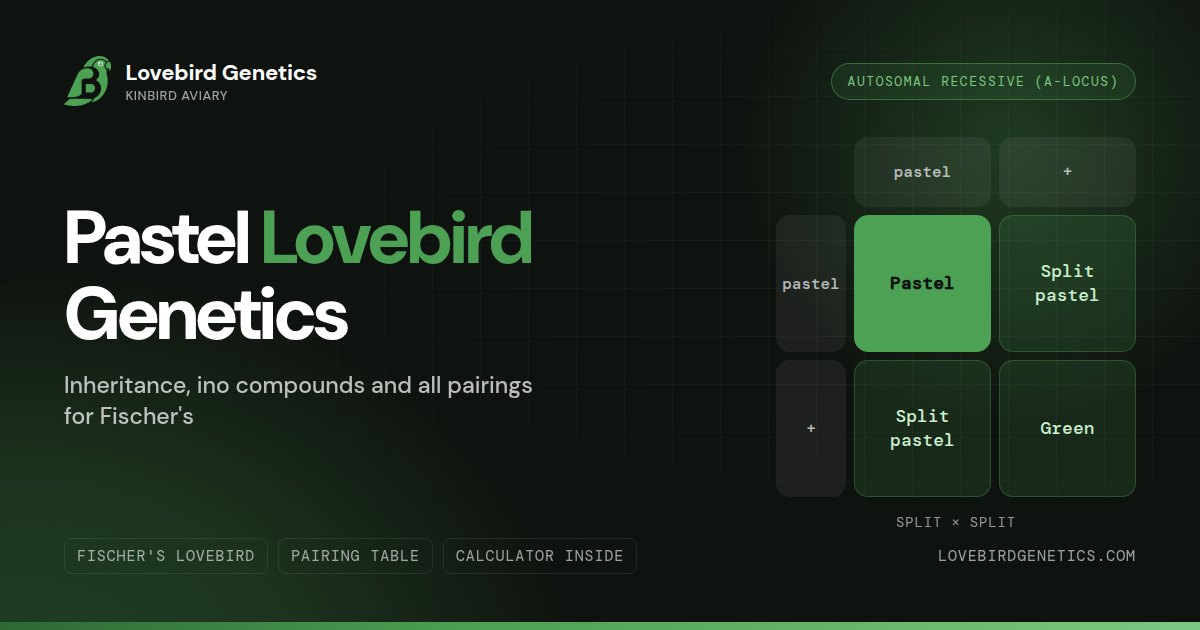
Pastel in Fischer's lovebirds is an autosomal recessive mutation that reduces eumelanin by roughly fifty percent, softening the body colour while leaving the eyes normal and dark. Because it is autosomal, both sexes are affected equally, both can carry it as an invisible split, and reversing a pairing changes nothing. The detail that matters most is the locus: Ornitho-Genetics VZW places Pastel on the NSL ino locus, the same gene as NSL Ino (Lutino and Albino) and Dark Eyed Clear. Pastel, Ino and DEC are alleles of one gene, not three independent genes, and a bird can only ever hold two of them. That is why a Pastel paired to a Lutino produces visual Pastel / Ino chicks rather than splits, and a Pastel paired to a DEC produces visual Pastel / DEC chicks. Our calculator models Pastel and both compounds.
A locus is a fixed position on a chromosome, and the alternative versions of the gene that can sit at that position are called alleles. Every bird carries a chromosome pair, so it holds exactly two alleles at any autosomal locus, one from the father and one from the mother. When several named mutations turn out to be alleles of one locus, they stop being independent traits that stack and become competing occupants of the same two slots. That is the situation at the NSL ino locus in Agapornis fischeri, and it is the reason this article spends as much time on the locus as on the mutation (Van den Abeele, Lovebird Compendium, 2016).
What is a Pastel lovebird?
A Pastel lovebird carries an autosomal recessive mutation that reduces eumelanin in the feather by roughly fifty percent. The body colour looks softened and washed rather than changed to a new colour, and the eyes stay normal and dark at every age.
Eumelanin is the dark pigment that provides the structural depth in a lovebird's plumage, and it is what makes a wild-type green bird look saturated rather than pale. Cut it roughly in half and you do not get a different colour, you get the same colour with the volume turned down. In practice the effect depends on the base the Pastel sits on:
- Pastel Green reads as a lighter, softer green with reduced depth in the wings and back. Side by side with a normal green the difference is obvious. Alone in a cage, a Pastel Green is frequently mistaken for a slightly off-colour normal.
- Pastel Blue 1 and Pastel Blue 2 read as milky, pale blues. The reduction is easier to see on a blue base than on green, because there is no psittacine yellow layered over the top to distract the eye.
- Pastel Aqua B1, Pastel Aqua B2 and Pastel Aqua Homo give notably lighter versions of each aqua grade. Pastel Aqua B2 in particular is a soft, muted sea tone clearly lighter than a standard Aqua B2.
- Pastel Parblue keeps the parblue yellow expression but lifts the whole bird, which can make the yellow read as cleaner than it is.
Two features stay constant across all of those bases and they are the ones to check on a bird in front of you. First, the eyes are normal and dark, at hatch and as an adult. Pastel is not an ino-type mutation in its effect even though it sits at the ino locus, so there is no red, plum or ruby reflection under a torch. Second, the beak and feet are unchanged. Nothing about a Pastel bird should look weak, small or fragile, and Pastel carries none of the viability problems that attach to some other pale-looking mutations.
Pastel does not add a colour, remove a colour or convert one pigment into another. It reduces how much eumelanin the feather lays down, by roughly half. Everything else about the bird's colour system continues to work normally, which is why a Pastel bird still shows its base colour, still shows its psittacine yellow or orange where that base has it, and still has completely normal dark eyes.
How does Pastel inherit in lovebirds?
Pastel is autosomal recessive. A bird needs two copies to show it visually and one copy to be split for it. Both cocks and hens can be split, and reversing the pairing never changes the outcome, which is the opposite of how sex-linked mutations behave.
Autosomal means the gene sits on an ordinary chromosome rather than on a sex chromosome. In birds, sex is determined by the Z and W chromosomes: cocks are ZZ and hens are ZW. A sex-linked mutation such as Opaline, Cinnamon or Pallid lives on the Z chromosome, which is why hens can never be split for those: a hen only has one Z, so whatever is on it, she shows. Pastel is not on the Z. It is on an autosome, and both sexes carry two copies of every autosome.
That gives Pastel three possible states in any bird:
- Visual Pastel. Two Pastel alleles. The bird shows the reduced eumelanin. It can only pass a Pastel allele to its chicks.
- Split for Pastel. One Pastel allele and one normal allele. The bird looks completely normal, and passes Pastel to half its chicks on average.
- Pure normal. No Pastel allele at all. Cannot produce a Pastel chick with any partner except by inheriting one from that partner.
The second state is the one that catches breeders out. A split Pastel is invisible: no faint wash, no lighter flight feather, no subtle hint an experienced eye can pick up. If a bird is described as split for Pastel, that claim rests entirely on its parentage or on a test pairing, never on how it looks.
The other practical consequence is a useful one: because Pastel is autosomal, reversing the pairing changes nothing. A Pastel cock over a normal hen gives exactly the same result as a normal cock over a Pastel hen. Every table in this article is therefore direction-independent, and that alone tells you Pastel is not sex-linked, since with Opaline or Cinnamon the reversal would produce a completely different clutch. If you are new to that distinction, the guides on sex-linked mutations and on what a split lovebird is cover it in detail.
Why is Pastel an allele of the NSL ino locus?
Because breeding results place it there. Ornitho-Genetics VZW classifies Pastel in Agapornis fischeri as an allele of the NSL ino locus, the a locus, alongside NSL Ino and Dark Eyed Clear. Pairing Pastel to Ino or to DEC yields visual compounds rather than normal-looking splits, which is the signature of allelism.
This is the section that changes how you plan, so it is worth being precise. Three named mutations in Fischer's lovebirds sit at the same position on the same chromosome:
- NSL Ino, the non sex-linked ino, which in Agapornis fischeri gives the Lutino on a green base and the Albino on a blue base. Covered in full in the Lutino and Albino genetics guide.
- Dark Eyed Clear (DEC), which clears the bird of eumelanin almost entirely while leaving the eyes dark. Covered in the Dark Eyed Clear and DEC / Ino guide.
- Pastel, the subject of this article, which reduces eumelanin partially rather than removing it.
Side by side, a pattern appears immediately. All three act on eumelanin and differ mainly in how far they go: Pastel takes roughly half of it away, DEC takes nearly all of it, and NSL Ino removes it while also affecting the eye. That is what you expect from a series of alleles of one gene, where different versions of the same instruction produce different degrees of the same effect.
The confirmation is not the appearance, though, it is the breeding behaviour. Two independent genes paired together produce chicks that are split for both and look normal. Two alleles of one gene produce chicks carrying one of each at the same position, and because neither is a normal allele, there is nothing left to mask them. The chick is visual. That is what happens when a Pastel is paired to a Lutino or to a DEC, and it is why the classification is not a matter of opinion.
Pastel, NSL Ino, DEC and Bronze Fallow compete for the same two slots. A bird can be Pastel and Pastel, Ino and Ino, DEC and DEC, Pastel and Ino, Pastel and DEC, or DEC and Ino. It cannot be Pastel and Ino and DEC all at once, because there is no third position for a third allele to occupy. Any bird advertised as a Pastel Lutino split DEC, or as a DEC Pastel split Ino, is being described in a way the chromosome cannot support. Check the pedigree, not the label.
This restriction applies to the ino locus only. A Pastel bird can also be Opaline, Cinnamon, Blue 1, Aqua or dark-factored, because those are different genes at different positions with their own two slots. Pastel Aqua Homo and Pastel Opaline Blue 2 are perfectly ordinary combinations.
| Allele | Effect on eumelanin | Eye colour | Combination with the others |
|---|---|---|---|
| Pastel | Reduced by roughly 50 percent, colour softened but present | Normal and dark | Forms Pastel / Ino and Pastel / DEC as visual compounds |
| NSL Ino | Removed, giving Lutino on green and Albino on blue | Red | Forms Pastel / Ino and DEC / Ino as visual compounds |
| Dark Eyed Clear | Removed almost entirely, bird reads as clear | Normal and dark | Forms DEC / Ino and Pastel / DEC as visual compounds |
| Bronze Fallow | Partially reduced, warm bronze cast with greyish-brown flights | Dark burgundy | Allelic with all of the above, so it can never be a double visual with them. Carries a serious viability warning, see the Bronze Fallow guide |
| Normal (wild type) | Full eumelanin expression | Normal and dark | Masks any single mutated allele, producing an invisible split |
Allelic status per Van den Abeele's gene-symbol table and Ornitho-Genetics VZW. Each bird carries exactly two of the five entries above, one inherited from each parent.
What are Pastel / Ino and Pastel / DEC?
They are visual compound birds, not splits. A Pastel / Ino carries one Pastel allele and one NSL Ino allele at the ino locus. A Pastel / DEC carries one Pastel and one DEC allele. Both are visible birds in their own right, and neither is split for anything at that locus. The Lovebird Compendium names them Pastel / Ino and Pastel / DEC, and the calculator uses the same spelling.
A compound heterozygote is a bird carrying two different mutated alleles of the same gene, one on each chromosome of the pair. There is no normal allele present to mask either of them, so both contribute to what you see, and the result is usually intermediate between the two pure forms. Breeders already meet this idea elsewhere: Parblue is a compound of Blue 1 and Blue 2 at the blue locus, and DEC / Ino is a compound of DEC and NSL Ino at this very locus.
- Pastel / Ino. One Pastel allele, one NSL Ino allele. The Ino allele contributes strong eumelanin removal, the Pastel allele contributes partial reduction, and the bird lands between a Pastel and a full Ino. Our calculator labels these by base, so a green-based bird returns as Green Pastel / Ino, a blue-based one as Blue 1 Pastel / Ino, and so on through the aqua and parblue bases.
- Pastel / DEC. One Pastel allele, one DEC allele. Both alleles keep the eye dark, so this bird has normal dark eyes with a heavily reduced body colour. The calculator returns these as Green Pastel / DEC, Aqua Homo Pastel / DEC and so on.
Van den Abeele is explicit about all of this. A bird carrying two mutated alleles of one gene "is not a wild type split for both mutations... We are dealing with an intermediate type", and for NSL ino combined with pastel green the eumelanin is reduced by about 75 percent, against roughly 50 percent in a pure Pastel. He names these birds "Pastel / Ino green (note the use of capitals)" (Lovebird Compendium, p.224). Two further points matter for anyone showing birds: Pastel / Ino "is not a separate mutation but a combination type of alleles" and such birds are "therefore not accepted as competition birds" (p.371), and combining pastel with other alleles of this locus is discouraged because it blurs the recognisability of each mutation (pp.361, 370).
The most useful thing to understand about compounds is what they can pass on. A Pastel / Ino bird has no normal allele at the ino locus at all, so every gamete it produces carries either Pastel or Ino. Paired to an ordinary green bird it gives one hundred percent normal-looking chicks, half split Pastel and half split Ino, and none split for both. The two alleles cannot travel together in one gamete, because they occupy the same position.
The mistake I see most often with Pastel is a record card that reads "Pastel split Ino". It looks reasonable and it is impossible: if the bird carries a Pastel allele and an Ino allele it is a visual compound, and it will breed like one. We write ino-locus birds with both alleles spelled out, always: Pastel / Pastel, Pastel / Ino, Pastel / normal, DEC / Ino. It removes an entire class of planning error, because the notation itself will not let you write down a bird with three alleles.
Pastel pairing outcomes, cock × hen
Six pairings cover almost every Pastel decision. Because Pastel is autosomal, every outcome below applies equally to cocks and hens, and swapping the cock and the hen changes nothing at all. That is the opposite of a sex-linked mutation, where the direction of the cross decides the result.
Read these tables as percentages per chick, not guarantees per clutch. A twenty five percent outcome means each chick has a one in four chance, so a clutch of four can easily contain no visual Pastel at all, or four of them.
Pastel cock × Pastel hen
One hundred percent visual Pastel chicks, in both sexes. Each parent carries two Pastel alleles and can pass nothing else, so every chick receives Pastel from both sides. There are no splits and no normals in this nest, and nothing needs testing afterwards.
| Offspring | Percentage | Sex | Notes |
|---|---|---|---|
| Visual Pastel | 100% | Cocks and hens | Two Pastel alleles. Breeds true, cannot produce a normal chick with another Pastel |
Verify in the calculator: Pastel Green × Pastel Green
Pastel cock × normal hen
One hundred percent normal-looking chicks, every one of them split for Pastel, in both sexes. The Pastel parent passes a Pastel allele, the normal parent passes a normal allele, and the normal allele masks the Pastel. No visual Pastel can appear in this nest.
| Offspring | Percentage | Sex | Notes |
|---|---|---|---|
| Normal / Pastel (split) | 100% | Cocks and hens | Looks completely normal. Carries one Pastel allele. Identical result if the pairing is reversed |
Verify in the calculator: Pastel Green × Green
Split Pastel cock × split Pastel hen
Twenty five percent visual Pastel, fifty percent split for Pastel, twenty five percent genetically pure normal, evenly across both sexes. This is the standard autosomal recessive ratio. The catch is that the split and pure normal chicks are visually identical, so three quarters of the clutch cannot be sorted by eye.
| Offspring | Percentage | Sex | Notes |
|---|---|---|---|
| Visual Pastel | 25% | Cocks and hens | The only chicks in this nest you can identify by looking at them |
| Normal / Pastel (split) | 50% | Cocks and hens | Indistinguishable from the pure normal chicks without a test pairing |
| Pure normal | 25% | Cocks and hens | No Pastel allele at all. Carries nothing forward |
Verify in the calculator: Green / Pastel × Green / Pastel
Pastel cock × split Pastel hen
Fifty percent visual Pastel and fifty percent split for Pastel, in both sexes. No pure normal chick is possible here, because the visual parent contributes a Pastel allele to every chick. Every bird from this nest carries Pastel whether it shows it or not.
| Offspring | Percentage | Sex | Notes |
|---|---|---|---|
| Visual Pastel | 50% | Cocks and hens | Two Pastel alleles |
| Normal / Pastel (split) | 50% | Cocks and hens | Guaranteed split, no test pairing needed, because the visual parent can only give Pastel |
Verify in the calculator: Pastel Green × Green / Pastel
Pastel cock × Lutino hen
One hundred percent Pastel / Ino compound visuals, in both sexes. This is the allelic outcome. Every chick receives a Pastel allele from one parent and an NSL Ino allele from the other, both land at the same locus, and with no normal allele present the chick is visual rather than split.
| Offspring | Percentage | Sex | Notes |
|---|---|---|---|
| Pastel / Ino (visual compound) | 100% | Cocks and hens | Shown by the calculator as Green Pastel / Ino on a green base. Not a Pastel split Ino, and not a Lutino split Pastel |
Verify in the calculator: Pastel Green × Lutino
Pastel cock × DEC hen
One hundred percent Pastel / DEC compound visuals, in both sexes, for exactly the same reason. Pastel and DEC are alleles of one locus, so each chick holds one of each and shows a combined phenotype. Both alleles keep the eye dark, so these chicks have normal dark eyes.
| Offspring | Percentage | Sex | Notes |
|---|---|---|---|
| Pastel / DEC (visual compound) | 100% | Cocks and hens | Shown by the calculator as Green Pastel / DEC on a green base. Dark eyes, heavily reduced body colour |
Verify in the calculator: Pastel Green × DEC
Every pairing above gives the identical result when you swap the cock and the hen. Pastel cock over Lutino hen and Lutino cock over Pastel hen both give one hundred percent Pastel / Ino. That is the practical signature of an autosomal gene, and it is worth testing deliberately if you are unsure whether an unfamiliar pale bird is Pastel or something sex-linked. With Opaline, Cinnamon or Pallid, reversing the pairing changes the answer completely.
Run your own Pastel pairing in seconds
Pastel, Pastel / Ino and Pastel / DEC modelled across every base colourHow do you tell Pastel from Dilute and Pallid?
By the pairing, not the photograph. All three pale the bird and keep the eyes dark. Pastel sits at the ino locus, so it makes visual compounds with Ino and DEC. Dilute sits at its own dil locus and stays independent. Pallid is sex-linked, so hens can never be split.
This is where most misidentification happens, because the three mutations really do overlap visually. A pale green Fischer's lovebird with normal dark eyes could be any of them, and no photograph settles it. What settles it is how the bird behaves in a pairing.
Pallid is the easiest to eliminate. Pallid is sex-linked, sitting on the Z chromosome, so a hen cannot be split for it: she either shows it or she does not carry it. Pallid pairings also auto-sex in one direction, since a Pallid cock over a normal hen gives split cocks and visual Pallid hens. No autosomal mutation, Pastel included, can do that.
Dilute is the harder one, because Dilute is also autosomal recessive, also keeps normal dark eyes, and also pales the bird. Direction does not matter for either, both sexes can be split for either, and the split by split ratios are identical. There is no inheritance-pattern shortcut. The separation comes from the locus.
Pair the bird in question to a Lutino and the answer arrives in one clutch:
- If the chicks are visual compounds, pale and clearly not normal green, the bird was Pastel. Its allele went to the same locus as the Ino allele and there was no normal allele to mask either.
- If the chicks are all normal-looking green, split for both, the bird was Dilute. The dil locus and the ino locus are different genes, so each chick got a normal allele at each locus and both mutations were masked.
That single test pairing separates two mutations that photographs cannot. It is the most useful practical fact on this page and it follows directly from the allelism.
| Pastel | Dilute | Pallid | |
|---|---|---|---|
| Inheritance | Autosomal recessive | Autosomal recessive | Sex-linked recessive |
| Locus | NSL ino locus (a locus) | Separate dil locus | Z chromosome, ino-related series |
| Eye colour | Normal and dark | Normal and dark | Normal and dark |
| Can hens be split? | Yes | Yes | No, never |
| Does reversing the pairing matter? | No | No | Yes, completely |
| Paired to a Lutino gives | Visual Pastel / Ino compounds | Normal-looking chicks split for both | Depends on direction, see the Pallid guide |
| Full guide | This page | Dilute lovebird genetics | Pallid lovebird genetics |
Three mutations that pale the bird and keep the eyes dark. Only the pairing behaviour tells them apart reliably. Pallid is recorded by OGVZW as an original mutation in both Agapornis roseicollis and Agapornis fischeri.
One more distinction that comes up constantly: Pastel is not the same thing as the word "pastel" used loosely for any soft-coloured bird. Breeders call parblue tones pastel, call a lightly marked aqua pastel, and call a poorly photographed normal pastel. The mutation named Pastel is a specific allele at a specific locus with specific breeding behaviour, so treat the word on a leg-ring card as a claim to be checked against the parents.
How do you breed Pastel into a line?
Start with a visual Pastel, not a claimed split. Pair it into your line to produce guaranteed splits, then pair those splits back to a visual Pastel rather than to each other. That route gives fifty percent visuals per nest and removes the guesswork entirely.
Bringing an autosomal recessive into an existing line is a two-generation job at minimum, and the route you choose decides how much of your third generation you can actually identify.
Generation one: source a visual, never a split. A visual Pastel is self-certifying, and every chick it produces is guaranteed to carry a Pastel allele. A bird sold as split for Pastel is a claim about its parents, and if that claim is wrong you find out two seasons later with nothing to show for it.
Generation two: pair the visual into the line you want to improve. A visual Pastel over any normal bird gives one hundred percent guaranteed splits, so nothing in that nest needs testing. Hold them back and select among them on type, size and condition, since they are genetically identical for Pastel.
Generation three: choose your route deliberately. You now have two options, and they are not equally good.
- Split × visual (recommended). Fifty percent visual Pastel, fifty percent guaranteed split. Nothing in the nest is ambiguous. Every chick either shows Pastel or is certain to carry it, so you can keep or move any bird with an accurate record card.
- Split × split (avoid where possible). Twenty five percent visual, fifty percent split, twenty five percent pure normal. The problem is that seventy five percent of the nest looks normal and you cannot tell which of those carry Pastel. Every one of them needs a test pairing before it can be described honestly.
Split by split is not wrong, it simply burns seasons. If your only available Pastel-line birds are splits, use it and record the uncertainty properly. If you have a visual available, use the visual.
Combining Pastel with other mutations. Because Pastel is autosomal and lives at its own locus, it stacks freely with anything that is not an ino-locus allele. Pastel with a blue base gives Pastel Blue 1 and Pastel Blue 2. Pastel with the aqua series gives Pastel Aqua B1, Pastel Aqua B2 and Pastel Aqua Homo, each visibly lighter than the aqua grade underneath it. Pastel with Opaline combines an autosomal recessive with a sex-linked recessive, so the Opaline component still auto-sexes exactly as it normally would while the Pastel component follows the tables above. The pairing outcomes hub works through how multi-mutation crosses read once two inheritance modes are running in the same nest.
When we bring in any autosomal recessive, we write the certainty level on the card next to the status, not just the status. "Split Pastel, confirmed by parentage" and "Split Pastel, claimed by seller" are two completely different birds even though the first three words match. A year later nobody remembers which was which, and a card recording only the word "split" quietly turns a guess into a fact.
Does the calculator model Pastel?
Yes, with both compounds. Pastel is modelled as an autosomal recessive allele of the ino locus, with visual and split statuses, and results display as Pastel Green, Green Pastel / Ino and Green Pastel / DEC across every base colour the engine supports.
Most lovebird calculators handle Pastel as if it were an independent recessive gene. That gets the simple pairings right and the interesting ones badly wrong: pair a Pastel to a Lutino in such a tool and it confidently returns normal chicks split for both, which is not what happens in the nest. Our Lovebird Genetics Calculator models the locus itself, so the compounds come out correctly.
What that means in use:
- Pastel appears as a selectable trait with visual and split statuses for either parent, exactly like the other autosomal recessives.
- Pure Pastel results are named by base: Pastel Green, Pastel Blue 1, Pastel Blue 2, Pastel Parblue, Pastel Aqua B1, Pastel Aqua B2 and Pastel Aqua Homo.
- Compound results are named with the double slash: Green Pastel / Ino, Blue 2 Pastel / Ino, Green Pastel / DEC, Aqua Homo Pastel / DEC, and so on across the supported bases.
- Impossible combinations are blocked by the model. Because the engine treats Pastel, Ino and DEC as occupants of two slots at one locus, it will not produce a bird holding three of them. You cannot accidentally plan around a genotype that does not exist.
If you are new to the interface, the step-by-step walkthrough covers entering each parent and reading the results panel. For the wider map, the Fischer's lovebird mutations hub lists every documented mutation with its inheritance mode, and the complete genetics guide covers the inheritance modes from the ground up.
The reference material behind all of this is public. Ornitho-Genetics VZW maintains MutaBase, the database that records the current status and locus classification of each named mutation across parrot species, and publishes its research through ogvzw.org. The base reference for everything on this page is Dirk Van den Abeele's Lovebird Compendium (2016), which sets out the loci, the allele series and the inheritance modes this article follows.
References
- Van den Abeele, D. (2016). Lovebird Compendium. Ornitho-Media. ISBN 978-90-822990-0-3. (Base reference: loci, allele series, eumelanin reduction and inheritance modes in Agapornis.)
- Ornitho-Genetics VZW. MutaBase mutation database. Accessed 2026. (Allelic status of Pastel, NSL Ino and Dark Eyed Clear at the NSL ino locus.)
- Ornitho-Genetics VZW. Research and publications of the MUTAVI Research & Advice Group.
- KinBird Aviary engine notes (2026). Pastel, Pastel / Ino and Pastel / DEC implementation in the Lovebird Genetics Calculator, verified against the Compendium's locus model.
Frequently asked questions
What is a Pastel lovebird?
A Pastel lovebird is a Fischer's lovebird carrying an autosomal recessive mutation that reduces the amount of eumelanin in the feather by roughly fifty percent. The result is a softened, washed body colour: a Pastel Green looks like a lighter, gentler green rather than a different colour, and a Pastel Blue 1 or Pastel Blue 2 reads as a pale, milky blue. The eyes stay normal and dark at every age, the feet and beak are unchanged, and there is no red or plum reflection under a torch. Because it is autosomal, cocks and hens are affected equally and both sexes can carry it invisibly as a split.
Is Pastel in lovebirds sex-linked or autosomal recessive?
Pastel is autosomal recessive. It sits on an ordinary chromosome, not on the Z sex chromosome, so a bird needs two copies of the Pastel allele to show it visually and one copy to be split for it. Cocks and hens can both be split, and swapping the cock and the hen in any Pastel pairing changes nothing about the outcome. That is the fastest practical way to separate Pastel from sex-linked mutations such as Opaline and Cinnamon, where hens can never be split and where reversing the pairing changes the result completely.
What do you get from a Pastel cock x normal hen?
One hundred percent normal-looking chicks, all of them split for Pastel, in both sexes. The Pastel parent can only pass a Pastel allele, and the normal parent can only pass a normal allele, so every chick receives exactly one of each and is heterozygous. No visual Pastel chick can appear in this nest. The same result applies if you reverse the pairing to a normal cock over a Pastel hen, because Pastel is autosomal and the direction of the cross makes no difference.
What do you get from a split Pastel cock x split Pastel hen?
Twenty five percent visual Pastel, fifty percent split for Pastel, and twenty five percent genetically pure normal, spread evenly across both sexes. This is the classic autosomal recessive ratio. The practical problem is that the fifty percent split and the twenty five percent pure normal chicks look identical in the nest, so three quarters of the clutch cannot be told apart by eye. Only a test pairing back to a visual Pastel, or DNA work, will separate a split chick from a pure normal one.
What do you get from a Pastel cock x Lutino hen?
One hundred percent Pastel / Ino compound chicks, in both sexes. This is the outcome that surprises breeders who assume Pastel and Ino are separate genes. They are not. In Fischer's lovebirds Pastel is an allele of the NSL ino locus, the same gene that carries NSL Ino and Dark Eyed Clear, so the chick receives a Pastel allele from one parent and an Ino allele from the other and both sit at the same position. The chick is a visual compound bird, not a Pastel split for Ino and not a Lutino split for Pastel.
What is the difference between Pastel and Dilute in lovebirds?
They are two different genes that both pale the bird. Pastel sits at the NSL ino locus, so it forms visual compounds with NSL Ino and with Dark Eyed Clear, and a Pastel bird paired to a Lutino produces visual Pastel / Ino chicks. Dilute sits at its own separate dil locus and is inherited completely independently, so a Dilute bird paired to a Lutino produces normal-looking chicks split for both. Both mutations are autosomal recessive and both keep normal dark eyes, so a single bird in isolation can be hard to call. The pairing behaviour, not the photograph, is what separates them.
Can a lovebird be Pastel and Ino and DEC at the same time?
No. Pastel, NSL Ino and Dark Eyed Clear are three alleles of one and the same locus, and a bird carries only two alleles at any locus, one inherited from the father and one from the mother. That leaves room for exactly two of the four. A bird can be Pastel and Pastel, Ino and Ino, DEC and DEC, Pastel and Ino, Pastel and DEC, or DEC and Ino, but never three of them together. Any pedigree or advertisement describing a bird as Pastel Lutino split DEC is describing something genetically impossible.