
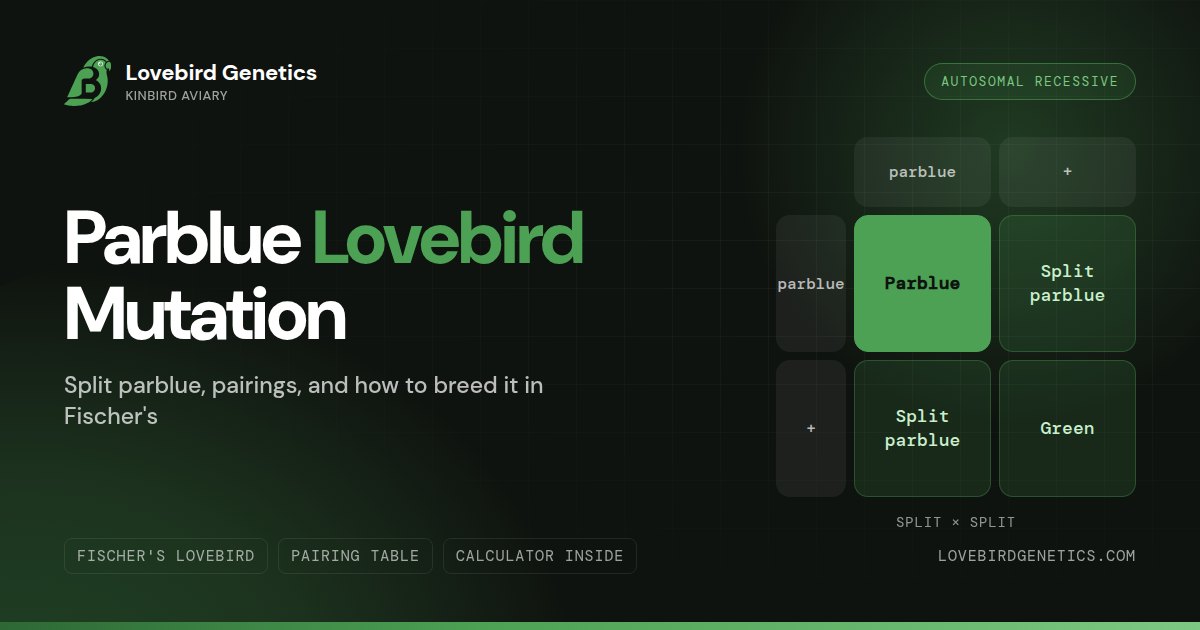
Parblue in Fischer's lovebirds (Agapornis fischeri) is the compound of the two blue-locus alleles, Blue 1 and Blue 2 (bl1 // bl2). The blue factor only partially reduces the yellow psittacofulvin, so a parblue looks like a soft sea-green to yellowish bird sitting between green and full blue. The fastest way to make it is Blue 1 × Blue 2, which gives 100% Parblue. Because parblue is a compound of two alleles, a true "split parblue" is really a green bird carrying one blue allele (Blue 1 or Blue 2).
Van den Abeele documents the blue factor as a series of alleles at one locus rather than a single on/off gene. Blue 1 and Blue 2 are two of these alleles, and the blue factor reduces psittacofulvin (the yellow/red pigment) by different degrees. The bl1 // bl2 heterozygote, the parblue, keeps part of that psittacofulvin, which is why it reads as a partial blue rather than a pure blue (Lovebird Compendium, pp. 298 to 315).
What is the Parblue mutation in lovebirds?
Parblue is the Blue 1 + Blue 2 compound in Fischer's lovebirds. The blue factor partially removes the yellow psittacofulvin pigment instead of removing it fully, so a parblue looks like a soft sea-green or yellow-tinged bird sitting between a normal green and a full blue. It is not a separate gene, it is what appears when one Blue 1 allele and one Blue 2 allele land in the same bird.
Body colour in lovebirds comes from two pigment systems: eumelanin (the dark structural pigment) and psittacofulvin (the yellow-to-red pigment). The blue factor works on psittacofulvin. A full blue removes almost all of it, leaving a white-and-blue bird. Blue 1 and Blue 2 are two alleles of that blue locus, and each reduces psittacofulvin to a slightly different degree. When a bird inherits one of each, the two alleles express together and only part of the psittacofulvin is removed. The result, parblue, keeps a soft yellow to sea-green cast that neither a pure Blue 1 nor a pure Blue 2 shows.
This is why parblue is best understood as a partial blue, which is exactly what the name shortens from. On a green base it reads as a soft sea-green to yellow bird. Combined with Yellow Face, which is the orange face gene (symbol of), an autosomal recessive on its own locus separate from the blue locus, the yellow deepens. Combined with Ino it becomes the cream-bodied Creamino.
What is a "split parblue"?
A split parblue is a green-looking bird carrying one blue-locus allele (Blue 1 or Blue 2) hidden as a split. Because parblue itself needs two blue alleles, a bird with only one still looks green but passes that allele to about half of its chicks. It is written Green / Blue 1, a single slash, because that is a split.
This trips up a lot of breeders. There is no single "parblue gene" to be split for. When a bird is described as "split parblue," what that really means is that the bird is a normal green carrying one blue allele. Pair two such splits carrying different blue alleles (one carrying Blue 1, one carrying Blue 2) and a portion of the chicks can inherit both, appearing as visual parblue.
A single slash means a split: one allele is hidden behind a dominant partner, as in Green / Blue 1 or Green / Aqua. A double slash means an allelic compound: two different alleles of the same gene sitting opposite each other and both expressing, as in bl1 // bl2 (Parblue), bl aq // bl1 (Aqua B1) or DEC / Ino. A homozygote is written with a single slash between two copies of the same allele, as in bl1 / bl1 (Blue 1).
How do you breed a Parblue lovebird?
Pair Blue 1 × Blue 2 and you get 100% Parblue. Every chick inherits one Blue 1 allele from one parent and one Blue 2 allele from the other, which is the exact bl1 // bl2 compound that defines parblue. This is the single most reliable route and the reason many breeders keep both a Blue 1 and a Blue 2 bird in the aviary.
If you already own a parblue, pairing it back to a pure Blue 1 gives 50% Parblue and 50% Blue 1, and to a pure Blue 2 gives 50% Parblue and 50% Blue 2. Parblue × Parblue gives 50% Parblue plus Blue 1 and Blue 2 birds. Pairing a parblue to a pure Green produces no visual parblue at all, only green chicks each carrying one blue allele (green split blue), because green is dominant to the blue factor.
Keep one good Blue 1 and one good Blue 2 in your program. Blue 1 × Blue 2 gives you a full clutch of parblue in a single pairing, no splits to chase and no waiting seasons.
All Parblue pairing outcomes (engine-verified)
Every percentage below is generated directly by the Lovebird Genetics calculator engine, base colour to base colour, with no extra mutations added. Tap any row to open it live.
| 1.0 Blue 1 × 0.1 Blue 2 | |
|---|---|
| Offspring | Chance |
| Parblue (B1B2) | 100% |
| 1.0 Parblue × 0.1 Parblue | |
|---|---|
| Offspring | Chance |
| Parblue (B1B2) | 50% |
| Blue 1 | 25% |
| Blue 2 | 25% |
| 1.0 Parblue × 0.1 Blue 1 | |
|---|---|
| Offspring | Chance |
| Parblue (B1B2) | 50% |
| Blue 1 | 50% |
| 1.0 Parblue × 0.1 Green | |
|---|---|
| Offspring | Chance |
| Green / Blue 1 or Blue 2 | 100% |
| 1.0 Parblue × 0.1 Aqua B1 | |
|---|---|
| Offspring | Chance |
| Parblue (B1B2) | 25% |
| Aqua B1 | 25% |
| Aqua B2 | 25% |
| Blue 1 | 25% |
Parblue vs Blue vs Aqua: how they differ
All three live at the same blue locus, and that locus carries four alleles: bl1 (Blue 1), bl2 (Blue 2), bl aq (Aqua) and bl tq (Turquoise). All of them reduce psittacofulvin, which is why they are so often confused. The difference is how much psittacofulvin each removes and which alleles are paired.
Practically: if you want a full clutch of the partial-blue look, pair Blue 1 × Blue 2 for parblue. If you want the clean sea-green aqua look, work the bl aq allele instead. The calculator keeps them separate, select the exact base (Blue 1, Blue 2, Parblue, Aqua B1, Aqua B2, Aqua Homo) so the outcome is correct for the bird you actually hold. See the full blue series guide and the aqua mutation guide for each in depth.
Parblue combined with other mutations
Parblue is a base colour, so it stacks with every other mutation. The three combinations breeders ask about most:
Parblue Yellow Face: Yellow Face deepens the retained psittacofulvin, giving a richer yellow mask and body wash on the parblue base. A popular, high-visibility combination.
Parblue Opaline: Opaline (sex-linked) redistributes the psittacofulvin, brightening the body and clearing the wing markings, so a Parblue Opaline reads as an unusually clean, soft-coloured bird. Remember Opaline follows sex-linked rules, so plan the pairing direction, see how to breed Opaline.
Creamino (Parblue Ino): add visual Ino to a parblue base and the melanin disappears while the cream psittacofulvin remains, producing a pale cream bird with red eyes. It is the parblue equivalent of a Lutino (green Ino) or Albino (blue Ino), covered in the Ino genetics guide.
Common mistakes with Parblue
Thinking "split parblue" means split for one gene. There is no parblue gene. A split parblue is a green bird carrying one blue allele. To breed visual parblue you need both a Blue 1 line and a Blue 2 line in play.
Pairing Parblue to Green and expecting parblue chicks. Green is dominant to blue, so Parblue × Green gives 100% green split birds and zero visual parblue. Always verify the cross in the calculator before setting the pair.
Confusing parblue with aqua. They are different allele combinations at the same blue locus, with a different look. Label your stock accurately and select the correct base in the calculator, or your predicted outcomes will be wrong.
References
- Van den Abeele, D. (2016). Lovebird Compendium. Ornitho-Media. ISBN 978-90-822990-0-3.
- Ornitho-Genetics VZW. Blue, aqua and turquoise mutations in Lovebirds. Accessed 2026.
- BirdLife International. Agapornis fischeri, Fischer's Lovebird. BirdLife Species Factsheet. Accessed 2026.
Parblue pairing outcomes, cock × hen
Breeders usually describe a pairing as cock × hen. The blue locus is autosomal, so sex plays no part in any of these outcomes, the same percentages apply whichever parent carries what. Note also that Parblue cannot breed true: it is the allelic compound bl1 // bl2, not a mutation a bird can be homozygous for, so there is no parblue allele to be split for.
What do you get from a Parblue cock x Parblue hen?
Each parent passes either bl1 or bl2, so the nest splits three ways and only half of it is Parblue.
| Chicks | Outcome |
|---|---|
| All chicks | 25% Blue 1 (bl1 / bl1), 50% Parblue (bl1 // bl2), 25% Blue 2 (bl2 / bl2) |
What do you get from a Parblue cock x Blue 1 hen?
The Blue 1 parent can only pass bl1, so half the chicks pick up bl2 from the Parblue parent and read as Parblue. Swap in a Blue 2 hen and the result mirrors it.
| Chicks | Outcome |
|---|---|
| All chicks | 50% Parblue (bl1 // bl2), 50% Blue 1 (bl1 / bl1) |
What do you get from a Blue 1 cock x Blue 2 hen?
The cleanest route to a full clutch of Parblue. Every chick takes bl1 from one parent and bl2 from the other.
| Chicks | Outcome |
|---|---|
| All chicks | 100% Parblue (bl1 // bl2) |
What do you get from a Parblue cock x normal green hen?
Wild-type green is dominant over every blue-locus allele, so no visual chicks appear in this generation. Every chick is a green-looking split.
| Chicks | Outcome |
|---|---|
| All chicks | 100% green-looking splits, half Green / Blue 1 and half Green / Blue 2 |
Run any of these in the lovebird genetics calculator to see the full offspring list for your own birds.
Frequently asked questions
What is a parblue lovebird?
A parblue Fischer's lovebird is the blue-locus compound of two alleles, Blue 1 and Blue 2, written bl1 // bl2. The blue factor removes only part of the yellow psittacofulvin, so the bird sits between a normal green and a full blue. It is not a mutation.
How do you make a parblue lovebird?
Pair Blue 1 x Blue 2 for 100% Parblue, since every chick inherits one of each blue allele. Parblue x Blue 1, Parblue x Blue 2 and Parblue x Parblue each give 50%. Parblue x Green gives none, only green chicks split for a blue allele.
What is split parblue?
Parblue is a compound of two alleles, so a split parblue is really a green bird carrying one blue-locus allele, Blue 1 or Blue 2, hidden as a split. It is written Green / Blue 1: a single slash means a split, a double slash means an allelic compound.
Is parblue dominant or recessive in lovebirds?
The blue factor is autosomal recessive to green, so a bird needs two blue-locus alleles to show any blue. Blue 1 and Blue 2 are co-dominant to each other, so a bl1 // bl2 bird shows the intermediate parblue rather than one masking the other.
What is the difference between parblue and aqua?
Both sit at the blue locus, which carries four alleles: bl1, bl2, bl aq (Aqua) and bl tq (Turquoise). Parblue is bl1 // bl2. Aqua uses bl aq, as in bl aq // bl1 (Aqua B1). Aqua reads cleaner, parblue keeps a softer yellow cast.
What is a Creamino lovebird?
A Creamino is a parblue bird that also carries visual Ino. The Ino removes the melanin while the parblue base leaves a soft cream body, giving a pale cream bird with red eyes. It is the parblue equivalent of a Lutino (green Ino) or Albino (blue Ino).
What do you get from a Parblue cock x Parblue hen?
Each parent passes either bl1 or bl2, so the nest splits three ways: 25% Blue 1 (bl1 / bl1), 50% Parblue (bl1 // bl2), 25% Blue 2 (bl2 / bl2). Parblue cannot breed true. The blue locus is autosomal, so sex plays no part.
What do you get from a Parblue cock x Blue 1 hen?
The Blue 1 parent can only pass bl1, so half the chicks pick up bl2 and read as Parblue: 50% Parblue (bl1 // bl2), 50% Blue 1 (bl1 / bl1). Swap in a Blue 2 hen and the result mirrors it.
What do you get from a Blue 1 cock x Blue 2 hen?
The cleanest route to a full clutch of Parblue. Every chick takes bl1 from one parent and bl2 from the other, so all chicks are 100% Parblue (bl1 // bl2). The blue locus is autosomal, so sex plays no part.
What do you get from a Parblue cock x normal green hen?
No visual chicks appear in this generation, because wild-type green is dominant over every blue-locus allele. Every chick is a green-looking bird carrying one blue allele, written Green / Blue 1 or Green / Blue 2. All chicks: 100% green-looking splits, half carrying bl1 and half carrying bl2.