
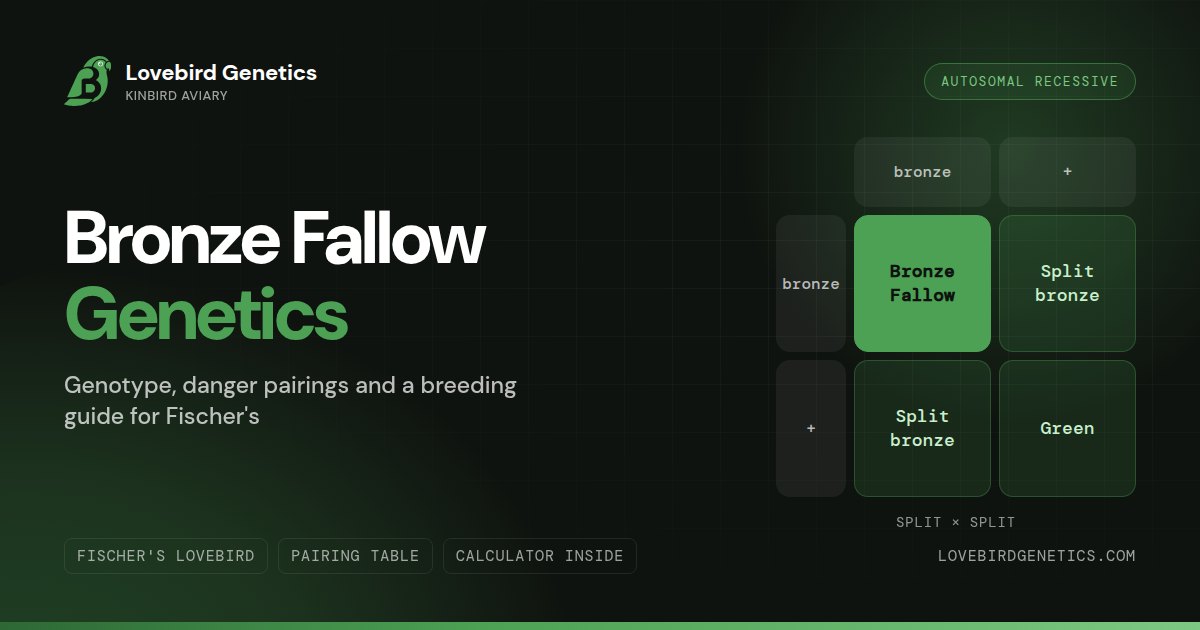
Bronze fallow × bronze fallow = approximately 100% chick mortality. This is the most dangerous pairing in lovebird genetics. If you own a bronze fallow bird, read the breeding safety section before pairing it with anything.
Bronze Fallow chicks are weak, and pairing two visual Bronze Fallows together gives roughly 100 percent chick mortality, so you must breed through split carriers, never visual to visual. Bronze Fallow is autosomal recessive with distinctive dark burgundy-red eyes, first recorded in 1978 in West Germany (Karlheinz Grau). It is not a mutation for novice breeders (Lovebird Compendium, pp. 476 to 483).
What Is Bronze Fallow?
Bronze Fallow in lovebirds is an autosomal recessive mutation with a laurel-green body, greyish-brown flights and dark burgundy-red eyes. It carries a serious warning: two visual Bronze Fallows paired together give roughly 100 percent chick mortality, so it must be bred through split carriers only.
Bronze fallow is one of three fallow mutations documented in Agapornis roseicollis, the peach-faced lovebird. The term "fallow" describes a class of mutations that reduce eumelanin, the dark pigment responsible for black and dark brown colouration in feathers, eyes, feet, and nails. What makes bronze fallow distinct from its fallow relatives is the degree of that reduction: it is the most limited of the three, affecting feathers and eyes only moderately.
The result is a bird that looks superficially similar to a normal green lovebird, but with a set of tell-tale differences visible on close inspection: greyish-brown flight feathers instead of the usual near-black, pale pink feet instead of grey, and, most importantly, burgundy or wine-red eyes instead of the near-black eyes of a normal bird.
Bronze fallow was first documented in 1978 in West Germany by breeder Karlheinz Grau working with Agapornis roseicollis. It has since been confirmed in two other species: Agapornis taranta (black-winged lovebird, Netherlands, approximately 1995) and Agapornis fischeri. All three species show the same characteristic limited eumelanin reduction and burgundy eye colour.
Body: Laurel green (not yellowed). Flight feathers: Greyish-brown (not black). Eyes: Dark burgundy / wine-red, the defining marker. Feet: Pale pink. Nails: Horn coloured. Mask: Normal red-orange, unchanged from wild type.
Genotype: Autosomal Recessive and Partial TYR Albinism
Bronze fallow is an autosomal recessive (AR) mutation. This means it is not sex-linked (both males and females are equally affected and equally capable of being carriers), and a bird must carry two copies of the mutant allele, one inherited from each parent, to express the visual bronze fallow phenotype. A bird carrying only one copy is a "split" or carrier: it looks entirely normal but can pass the bronze fallow gene to its offspring.
At the molecular level, bronze fallow is believed to be a partial TYR-negative albinism. Bronze fallow is inherited as a simple autosomal recessive, so a bird must carry two copies to show it and one copy to pass it on unseen. It can be a compound such as bronze fallow // Ino. In TYR-negative albinism, the tyrosinase enzyme, the key enzyme in eumelanin production, is partially disrupted. With bronze fallow, the disruption is partial rather than complete: enough eumelanin is still produced to give the bird its greenish body colour, but the reduction is enough to shift eye colour toward burgundy and lighten the flight feathers to brown.
This contrasts with pale fallow, which achieves 90-95% eumelanin reduction in both feathers and eyes (bright clear red eyes, strongly yellowed body), and dun fallow, which shows limited feather reduction but nearly complete eye reduction (bright red eyes). Bronze fallow sits at the mildest end of the fallow spectrum in terms of visible eumelanin reduction, but it carries the most severe breeding risk.
Visual bronze fallow: bz / bz (two copies of the bronze fallow gene)
Split (carrier): bz / + (one bronze fallow copy, one wild type, visually normal)
Pure normal: + / + (no bronze fallow copies)
The Burgundy Eye: Your Most Reliable Field Identifier
The single most reliable way to confirm a bronze fallow in the hand is the eye: a deep burgundy or wine-red, distinctly darker than the bright clear red of pale fallow or dun fallow. Body and feather reduction in bronze fallow are mild and easily mistaken for an off-colour normal, so the eye carries the identification. Always read it under natural daylight (Van den Abeele, Lovebird Compendium, 2016).
Of all the physical characteristics of bronze fallow, the eye colour is the single most reliable identifier, and the key to distinguishing it from both pale fallow and dun fallow in the field.
| Fallow Type | Eye Colour | Body Colour | Feather Reduction |
|---|---|---|---|
| Bronze Fallow | Dark burgundy / wine-red | Laurel green (mild reduction) | Limited, greyish-brown flight feathers |
| Pale Fallow | Bright clear / crystal red | Yellow-green to yellow (strong reduction) | 90-95% reduction, strongly yellowed body |
| Dun Fallow | Bright red (like pale fallow) | Laurel green (like bronze fallow) | Limited feathers, near-complete eyes |
The rule of thumb: if the eyes are the darkest reddish-brown you can imagine, sometimes described as burgundy wine, you are looking at bronze fallow. Pale fallow and dun fallow both produce much brighter, more vivid red eyes. Dun fallow is the most commonly confused with bronze fallow because both have a similarly limited body colour reduction, but dun fallow's eyes are noticeably brighter red. When in doubt under good lighting, bright red = not bronze fallow; dark burgundy = bronze fallow.
The Most Dangerous Pairing in Lovebird Genetics
This is the section every bronze fallow owner must read before making any breeding decisions.
When two visually bronze fallow birds are paired, bronze fallow × bronze fallow, the offspring suffer from extremely high mortality, approaching 100%. Almost no chicks survive. This has been documented consistently by breeders across multiple countries and is recorded in the Lovebird Compendium (Dirk Van den Abeele, 2016, pp. 476-483) as a known characteristic of this mutation.
The biological mechanism behind this outcome is not documented. What is recorded is the effect at the pairing level, not at the level of the gene: bronze fallow × bronze fallow produces near-total chick mortality, reliably and repeatably, wherever it has been tried. Homozygosity on its own is not the explanation, because the visual bronze fallows produced by the safe pairings below are homozygous too and they live perfectly normal lives. Only the visual × visual pairing carries the mortality.
This is not a theoretical risk. Breeders worldwide report near-total chick mortality when two visually bronze fallow birds are paired. There is no benefit to this pairing that justifies the loss of the offspring. Always breed bronze fallow using split (heterozygous) birds paired with normals or carefully structured three-generation programs.
Bronze fallow is explicitly listed in the Lovebird Compendium as not recommended for novice breeders, specifically because of this mortality risk.
Dun fallow, the third member of the fallow group, shares a similar high-mortality pattern when homozygously expressed. Pale fallow birds, by contrast, are described as "rather weak but less so than bronze fallow", they can survive in reasonable numbers. This makes bronze fallow the most extreme case in the fallow category.
Safe Pairings: The Split Strategy
Because bronze × bronze kills, all productive bronze fallow breeding relies on using split (heterozygous carrier) birds. A split bird, written green / bronze fallow or a^brf / a+, looks completely normal but carries one copy of the bronze fallow gene. It is safe to breed and will pass the gene on to approximately 50% of its offspring when paired with another split or with a visual bronze fallow.
| 1.0 Green / Bronze Fallow (split)0.1 Green / Bronze Fallow (split) | ||
|---|---|---|
| Offspring | Chance | Note |
| Visual Bronze Fallow | 25% | Homozygous, shows full phenotype. Safe offspring (not a bronze × bronze pairing). |
| Green / Bronze Fallow (split) | 50% | Visually normal carriers. Must be test-paired to confirm split status. |
| Pure Green (no bronze fallow) | 25% | Visually identical to splits. DNA test or test pairing needed to distinguish. |
| 1.0 Visual Bronze Fallow0.1 Pure Green Normal | ||
|---|---|---|
| Offspring | Chance | Note |
| Green / Bronze Fallow (split) | 100% | All offspring are visually normal but carry one bronze fallow allele. No visual bronze fallow chicks from this pairing. |
| 1.0 Visual Bronze Fallow0.1 Green / Bronze Fallow (split) | ||
|---|---|---|
| Offspring | Chance | Note |
| Visual Bronze Fallow | 50% | Homozygous. Visually bronze fallow. Safe, this is not a bronze × bronze outcome. |
| Green / Bronze Fallow (split) | 50% | Visually normal carriers. Build your split stock from these. |
Visual Bronze Fallow × Visual Bronze Fallow → approximately 100% chick mortality. Do not pair two visual bronze fallows together under any circumstances.
Calculate your bronze fallow pairings instantly
Enter parent genotypes, get exact offspring percentages, visual ratios, and split probabilitiesThe Three Fallows: Why They Cannot Be Combined
Bronze Fallow, Pale Fallow and Dun Fallow are three independent autosomal recessive mutations and they are not alleles of one another, so they do not stack or combine into a stronger fallow. Pale Fallow has its own pf locus and Dun Fallow its own df locus. Bronze Fallow is inherited as a straightforward autosomal recessive, exactly like the other two fallows. Crossing two different fallow types produces only normal-looking green birds that are double-split for both, never a blended fallow (Van den Abeele, Lovebird Compendium, 2016).
A common question among breeders encountering the fallow group for the first time is: "Can I combine bronze fallow and pale fallow to get a stronger fallow?" The answer is no, and the genetics explain why.
Bronze fallow, pale fallow, and dun fallow sit at three different genetic loci, a, pf and df respectively, so they are not alleles of each other. Bronze fallow is not allelic with the other two fallows, which is why a bronze fallow crossed with a pale fallow gives normal-looking double splits. When you cross a visual bronze fallow with a visual pale fallow, the offspring are not combined fallows, they are all normal-looking green birds that carry one allele for each fallow type (double splits).
To produce a bird that expresses both mutations, you would need to breed those double splits together and select the offspring that are homozygous for both. But here is the critical problem: any bird that is homozygous bronze fallow AND homozygous pale fallow would need to be the result of a bronze fallow lineage, which carries the near-100% mortality risk at the bronze fallow locus. The theoretical combined bird is essentially unobtainable through standard aviculture.
Bronze Fallow
Partial TYR negative. Autosomal recessive, one locus of its own. Limited reduction in body and eyes.
bz / bzPale Fallow
90-95% eumelanin reduction. Separate pf-locus. Bright clear red eyes.
pf / pfDun Fallow
Limited feather reduction, near-complete eye reduction. Separate df-locus.
df / dfWhat Can Bronze Fallow Be Combined With?
Within the constraints of the split-breeding strategy, bronze fallow can be combined with a range of other mutations to produce interesting and sought-after birds. The key rule is that bronze fallow is an eumelanin mutation and should not be combined with other eumelanin mutations, the interactions are unpredictable and the resulting birds are typically undesirable for exhibition.
Recommended Combinations
- Dark Factor (SF or DF): Adding one or two dark factors deepens the overall tone of the bronze fallow bird. The burgundy eye colour remains as the identifying marker. SF dark bronze fallow is more common and easier to work with; DF (double dark) is rarely recommended as plumage quality suffers.
- Aqua: Bronze fallow combined with aqua produces a pale, warm-toned bird with the characteristic burgundy eyes and reduced psittacine expression. This is one of the most popular combinations among specialist breeders because the aqua's partial psittacine reduction interacts attractively with the limited eumelanin reduction of bronze fallow.
- Turquoise: Similar to aqua in terms of the visual combination effect. The reduced psittacine of the turquoise mutation creates a lighter overall palette, with bronze fallow's greyish-brown feather reduction visible against the cooler background.
- Orange Face: The orange face mutation (affecting mask colour in specific lovebird species) can be combined with bronze fallow without eumelanin-related complications. The bronze fallow's unchanged mask colour means orange face adds its normal effect.
- Pale Headed: A valid combination in species where pale headed is confirmed. Does not interact with the bronze fallow eumelanin pathway.
- Opaline: Bronze fallow combined with opaline (sex-linked recessive) is a well-documented and attractive combination. The opaline's psittacine rearrangement interacts with the bronze fallow's reduced eumelanin to produce a distinctly different colour pattern, with the burgundy eye still present as confirmation of the bronze fallow genotype.
Avoid These Combinations
- Pale Fallow or Dun Fallow: Different loci, crossing produces double splits, not a combined fallow. The bronze × pale attempt also risks mortality concerns in long-term selection programs.
- Cinnamon: Both are eumelanin mutations (bronze fallow autosomal recessive, cinnamon at the Z chromosome TRP1 pathway). Combining eumelanin mutations is discouraged as the outputs are inconsistent and generally not accepted at shows.
- Dilute: Also an eumelanin mutation (macromelanosomes). Same reasoning applies, avoid eumelanin + eumelanin combinations.
- NSL Ino: NSL ino removes melanin almost completely. A bronze fallow paired with Ino leaves no burgundy eye and no bronze tone to judge, so the bronze fallow becomes impossible to identify. Pairing a visual bronze fallow to a visual Ino gives bronze fallow // Ino compound chicks, not double visuals, and the compound phenotype is unpredictable enough that the combination is not recommended.
Origin and Species Distribution
Bronze fallow was first documented in 1978 in West Germany. The breeder credited with the first confirmed bronze fallow birds is Karlheinz Grau, working with Agapornis roseicollis (peach-faced lovebird). From West Germany the mutation spread through European aviculture over the following decade.
The mutation was subsequently confirmed in Agapornis taranta (black-winged lovebird) in the Netherlands around 1995, making it one of the few lovebird mutations confirmed in A. taranta, which is less commonly kept in captivity. The A. taranta bronze fallow shows the same characteristic burgundy eyes and limited eumelanin reduction as the A. roseicollis form.
Bronze fallow has also been documented in Agapornis fischeri (Fischer's lovebird), though it is considerably rarer in Fischer's than in roseicollis. In Fischer's, the bronze fallow phenotype interacts with the different base colouration and mask design of the species, but the burgundy eye marker remains consistent and reliable for identification.
The mutation has remained relatively rare in worldwide aviculture, partly because of the breeding difficulty (the mortality risk discourages casual breeders) and partly because the visual phenotype is subtle enough that novice breeders may not recognise the birds as bronze fallow at all, dismissing them as "off-colour normals." This rarity keeps bronze fallow in strong demand within specialist circles.
Practical Breeding Advice
Bronze Fallow is autosomal recessive, and pairing two visual bronze fallows together causes near-100% chick mortality. The rule is absolute: never pair visual to visual. Always breed split to visual, or split to split, so that no clutch is ever produced from two homozygous bronze fallow parents. There is no husbandry workaround for this lethality (Van den Abeele, Lovebird Compendium, 2016).
Bronze fallow is not a mutation for beginners. If you are new to lovebird genetics, gain experience with simpler AR mutations such as blue, dilute, or pale fallow before working with bronze fallow. The mortality risk of the bronze × bronze pairing is not something that can be avoided through better husbandry, it is a genetic certainty, not a management problem.
When you do work with bronze fallow, keep meticulous records. Because splits look completely normal, it is easy to lose track of which birds in your collection carry the gene. A bird passed on or traded without the new keeper knowing it is a bronze fallow split can become part of a future pairing that accidentally produces a bronze × bronze cross. Label your splits clearly, and communicate the bronze fallow status of carrier birds to anyone you pass them on or trade them to.
Eye colour in fallow chicks is visible from hatching: bronze fallow chicks are born with burgundy-red eyes that remain that colour. This means you can identify visual bronze fallow birds from the nest without waiting for adult plumage. Use this early identification window to separate visual bronze fallows from their sibling normals and splits as soon as possible.
Why Is Bronze Fallow So Rare, and How Do You Build a Healthy Line?
Bronze fallow stays scarce for two reasons working together: the breeding is genuinely difficult, and the visual phenotype is subtle enough that many birds go unrecognised. The mortality risk discourages casual breeders, and the rest dismiss the birds as plain "off-colour normals." Both effects keep numbers low and demand steady in specialist circles.
The defining difficulty is welfare, not genetics on paper. Because bronze fallow x bronze fallow produces approximately one hundred percent chick mortality, no responsible programme can take the fast route of pairing two visuals together. Every line must instead be built through splits, which look completely normal and therefore have to be tracked on paper rather than recognised by eye. That single constraint is what makes bronze fallow a multi-generation project: you build split stock first, then pair split to split or visual to split, and you only ever see roughly a quarter to a half of a clutch come through as visuals even in the best safe pairings. There is no husbandry shortcut around the lethal pairing, so patience and record-keeping carry the whole line.
When selecting bronze fallow stock, eye colour is your first and most reliable filter. Look for the deep, true burgundy or wine-red eye under natural daylight rather than the brighter clear red of pale fallow or dun fallow, because mislabelled fallows are the single most common sourcing error. Beyond eye colour, prioritise robust, well-grown birds with clean greyish-brown flight feathers and good frame size, since the fallow group already trends toward lower vigour and you do not want to compound that by selecting weak founders. Above all, insist on documented split status: a green bird offered as "split bronze fallow" is only useful to you if its parentage is recorded, because there is no way to confirm a split visually. The strongest founders are well-documented splits from a line with a known survival history, paired into your programme alongside unrelated normals to keep genetic diversity wide and reduce the inbreeding pressure that worsens an already fragile mutation.
Frequently Asked Questions
Bronze Fallow pairing outcomes, cock × hen
Breeders usually describe a pairing as cock × hen. Below is every common Bronze Fallow pairing written that way, with the exact percentages this calculator produces.
What do you get from a Bronze Fallow cock x Bronze Fallow hen?
This pairing is strongly advised against and should never be set up. The Lovebird Compendium records near-total chick mortality from bronze × bronze. Genetically, every chick would be a visual Bronze Fallow, cocks and hens alike, because Bronze Fallow is autosomal recessive and sex plays no part in the outcome, but almost none of those chicks survive. The safe route is to breed through splits: visual Bronze Fallow × Green / Bronze Fallow split, or split × split.
| Chicks | Outcome |
|---|---|
| All chicks | Not recommended, near-total chick mortality. Genetically 100% visual Bronze Fallow, but almost no chicks survive. |
What do you get from a Bronze Fallow cock x normal hen?
No visual chicks appear in this generation. Every chick is a normal-looking bird carrying one hidden copy, written as normal / Bronze Fallow.
| Chicks | Outcome |
|---|---|
| All chicks | 100% split (normal / Bronze Fallow) |
What do you get from a split Bronze Fallow cock x split Bronze Fallow hen?
One quarter of the chicks are visual Bronze Fallow. Half are splits and one quarter carry nothing, and the splits and pure normals look identical.
| Chicks | Outcome |
|---|---|
| All chicks | 25% visual Bronze Fallow, 50% split, 25% pure normal |
What do you get from a Bronze Fallow cock x split Bronze Fallow hen?
Half the chicks are visual Bronze Fallow and half are splits, with the same result whichever parent carries the visible mutation.
| Chicks | Outcome |
|---|---|
| All chicks | 50% visual Bronze Fallow, 50% split |
Run any of these in the lovebird genetics calculator to see the full offspring list for your own birds.