
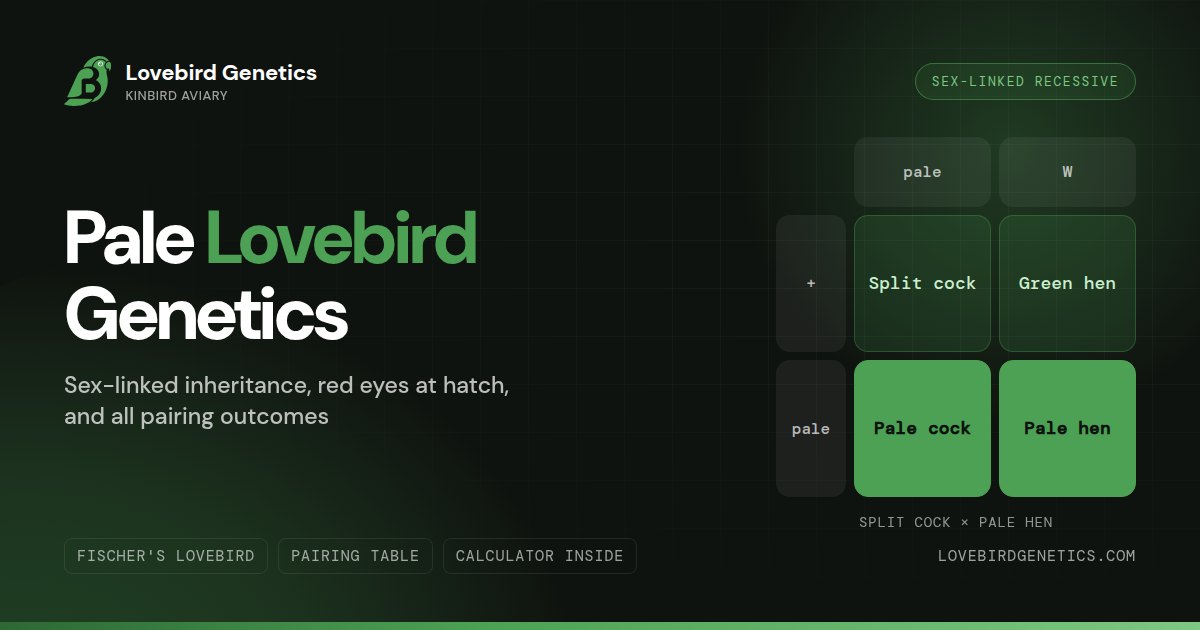
Pale in Fischer's lovebirds is sex-linked recessive and it is an allele of the sex-linked ino locus, gene symbol inope, allelic with SL ino and pallid. It is a proven mutation in Agapornis fischeri according to Ornitho-Genetics VZW. It removes roughly 15 percent of the eumelanin, which is the main identification point, because pallid removes roughly 50 percent and looks clearly lighter. Visual pale chicks are born with dark red eyes that darken as the bird grows. Because cocks are ZZ and hens are ZW, hens can never be split for pale. Pale, pallid and sex-linked ino are three alleles of the same ino locus, so they compete for one slot and a hen can carry only one of them. Pallid itself has never been formally confirmed in this species, so a fair number of birds sold as pallid Fischer's are probably pale, or pale combined with another eumelanin reducer. Our calculator models the mutation as trait Pale, sex-linked recessive. The engine currently blocks selecting Pale and Pallid together on one bird; that restriction dates from an earlier reading of the locus and is under review.
The mutations that sit on the ino gene do not add a pigment or rearrange the pattern. They interfere, to different degrees, with the production of eumelanin, the dark pigment that supplies depth and contrast in the feather. A full ino removes essentially all of it. The other alleles on the same gene remove only part of it, and how much they remove is what tells them apart in the hand (Van den Abeele, Lovebird Compendium, 2016).
What is a Pale lovebird?
A pale lovebird is a Fischer's lovebird carrying the sex-linked pale mutation, which reduces visible eumelanin by roughly 15 percent. The pattern and the base colour stay exactly where they were, but every dark area reads softer. Visual chicks hatch with dark red eyes that darken with age.
Start with what a normal Fischer's lovebird is doing. Two pigment systems produce almost everything you see. Eumelanin supplies the dark component, the depth in the wing, the definition in the mask and the structural contribution that turns a yellow feather green. Psittacine pigment supplies the yellow, orange and red. Take eumelanin away entirely and you get a Lutino or Albino, a bird with nothing dark left anywhere. Take away only part of it and you get one of the softer mutations, of which pale is the mildest of the sex-linked group.
Pale removes roughly one fifth of the visible eumelanin. In practice that means:
- Pale Green looks like a green bird photographed in slightly kinder light. A shade lighter, marginally warmer, wing markings still clearly present.
- Pale Blue 1 and Pale Blue 2 lighten in the same proportion, and the reduction is easier to see on a blue series bird because there is no psittacine yellow layered over the top.
- Pale combined with Aqua or Parblue gives the least obvious result of all, because those birds are already light in tone.
- The mask, the beak and the feet are unaffected in any way that helps identification. Pale is a feather pigment story, not a soft-part story.
The word that matters here is roughly. Twenty percent is a working figure, not something you can measure by eye, and the difference between a pale bird and a normal bird of the same base is genuinely subtle when the two are not side by side. This is why almost every reliable pale identification comes from the nest rather than from the flight cage. A chick that hatches with dark red eyes has told you something no adult photograph can.
"There is a proven pale mutant in Agapornis fischeri." He also notes that you do not need an SL ino mutant in the line to have a pale mutant. The 2016 Compendium listed pale with the provisional symbol pe and stated on printed page 420 that should we later discover that pale is indeed an allele of the SL ino-locus the symbol must be adapted to inope
. Ornitho-Genetics VZW confirmed exactly that, so pale sits on the ino locus alongside SL ino (ino) and pallid (inopd). Pale is therefore established in the species, it lives on the Z chromosome at the ino locus as the allele inope, and a line does not need a visual SL ino bird for pale to appear.
That last point is worth pausing on, because it heads off a common assumption. Breeders who hear pale and sex-linked ino discussed in the same breath sometimes conclude that a pale bird must have come out of an ino line somewhere. It does not. Pale is a separate gene, and it arises independently of any ino mutation. Sex-linked ino is not currently established in Agapornis fischeri, though it could arise in the species, so at present a pale Fischer's lovebird is normally just a pale. Nor is pale a health problem: there is no viability concern attached to it, unlike a recessive such as Bronze Fallow.
How does Pale inherit in lovebirds?
Pale is sex-linked recessive. It sits on the Z chromosome at the ino locus, gene symbol inope, allelic with pallid and sex-linked ino, and follows the ordinary sex-linked recessive rules. Cocks are ZZ and can be visual, split or normal. Hens are ZW, so a hen is either visual pale or she carries nothing.
Birds do not use the mammalian XY system. In Agapornis fischeri, as in every parrot, the cock carries two Z chromosomes and the hen carries one Z and one W. The W carries none of the colour genes we care about, so everything on the Z behaves asymmetrically between the sexes, and pale sits on the Z. That gives exactly three possible states in a cock and exactly two in a hen:
- Visual pale cock. A pale allele on both Z chromosomes. He shows the mutation and can only pass a pale allele to every one of his chicks.
- Split pale cock. A pale allele on one Z and a normal allele on the other. He looks completely normal and passes pale to half his chicks on average.
- Normal cock. No pale allele on either Z.
- Visual pale hen. A pale allele on her single Z. She shows the mutation. There is no second Z to mask it, so a hen with the allele always shows it.
- Normal hen. No pale allele. She carries nothing and can contribute nothing.
The consequence is the one rule breeders need burned in. A hen can never be split for pale. If somebody offers you a hen described as split pale, the description is not genetically possible, and the same applies to every other sex-linked mutation in the species. Our guide to sex-linked mutations in lovebirds covers the chromosome mechanics, and what is a split lovebird covers the split concept generally.
A hen has one Z chromosome and one W, and the pale allele lives on the Z. She either has it, in which case she shows it, or she does not have it at all. There is no hidden middle state for a hen, no matter what her parents were. Every genuine split pale bird in existence is a cock. If a hen in your records is marked "split pale", the record is wrong, and correcting it before you plan a season saves a great deal of confusion later.
The second consequence is that direction matters enormously. With an autosomal mutation such as Dilute or Pastel, putting the mutation on the cock or on the hen gives the identical clutch. With pale, the two directions give completely different results, and one of them auto-sexes the chicks in the nest. That is covered in full in the pairing section below, and it is the single most useful practical property the mutation has.
Why are Pale chicks born with red eyes?
Because reduced eye eumelanin at hatch is typical of the sex-linked eumelanin mutations as a group. Dirk Van den Abeele records that homozygote pale birds are born with dark red eyes, and that this is typical for most sex-linked mutations. The eyes then darken as the bird grows.
This is the most useful identification tool the mutation gives you, and it is available for a window of days rather than for the life of the bird. Van den Abeele's observation is direct: "Homozygote pale birds are born with dark red eyes. This is typical for most SL mutations." Homozygote there refers to a cock carrying pale on both Z chromosomes. A visual pale hen carries the allele on her single Z and is a visual bird for the same functional reason.
What is happening physically follows from the pigment rather than from any one gene. Eumelanin is deposited in the eye as well as in the feather, and pale reduces eumelanin production. A mutation that reduces eumelanin in the plumage also reduces it in the developing eye, and at hatch the reduction is enough that the blood supply behind the iris shows through as a dark red. As the chick grows, eumelanin accumulates in the eye, the red recedes, and the adult ends up looking dark-eyed under normal light. That is why this is a hatch-time observation rather than a permanent field mark.
| Mutation | Eye at hatch | Eye as adult | What it tells you |
|---|---|---|---|
| Pale | Dark red | Darkens with age, looks dark in ordinary light | Best single window for identifying a visual pale chick |
| Pallid | Reddish | Darkens with age | Same family behaviour, deeper plumage reduction |
| Ino (NSL) | Red | Stays red or plum for life | Full ino, not a partial reduction |
| Cinnamon | Plum, visible through the closed lid | Darkens, often plum under a torch | A different sex-linked gene entirely |
| Bronze Fallow | Red | Burgundy for life | Autosomal recessive, permanent eye mark |
| Normal wild-type | Dark | Dark | No eumelanin reduction present |
The pale entry is the important one. A red eye at hatch that darkens is compatible with pale. A red eye that stays red for life is not pale.
Two practical cautions come with this. First, the observation only identifies visual birds. A split pale cock hatches with ordinary dark eyes, because his normal Z is producing eumelanin as usual, so the red eye tells you nothing about a chick's normal-looking nest mates. Second, a red eye at hatch is not exclusive to pale. Several eumelanin-reducing mutations do it, as the table above shows, and what separates them is what the eye does afterwards. If a chick hatches red-eyed and is still plainly red-eyed as a fledged adult under a torch, you are not looking at a pale.
We check eye colour on day one and again around day ten on every chick in a nest where a sex-linked mutation is possible, and we write it down even when it is boring. The entry costs nothing and it is the only chance you get. By the time the chick is out of the box, the window has closed and you are back to guessing from plumage tone, which for a 15 percent reduction is close to unusable.
Pale vs Pallid, what is actually confirmed?
Pale is proven in Fischer's lovebirds. Pallid is not. Pale reduces eumelanin by roughly 15 percent and pallid by roughly 50 percent. Ornitho-Genetics VZW has never examined a pure-bred pallid green Fischer's, and holds that the phenotype is sex-linked and either allelic with pale or created in combination with it.
This is the section that decides what most breeders should write on a leg-ring card, so it is worth being precise and it is worth being fair. Nobody here is being accused of anything. Breeders have been reporting a lighter sex-linked phenotype in Fischer's lovebirds since 2016, those reports are taken seriously by Ornitho-Genetics VZW, and the organisation has published on the question more than once. What has not happened is the confirming examination.
The visual difference. Pale gives roughly a 15 percent reduction in visible eumelanin. Pallid gives roughly 50 percent. That gap is the main identification point between the two, and it is a large one when the birds are side by side. A pallid bird looks meaningfully lightened. A pale bird looks like a normal bird in flattering light. If a bird is clearly, obviously lighter than its nest mates in a way nobody argues about, you are not looking at a 15 percent reduction.
The status difference. Pale is proven in Agapornis fischeri. Pallid is confirmed in Agapornis roseicollis, the peach-faced lovebird, where it is long established. In Fischer's lovebirds OGVZW records it as an original mutation on its list dated 17 August 2025. An earlier OGVZW update noted that a pure-bred pallid green Fischer's lovebird had not been examined, and Ornitho-Genetics VZW's stated position is that the Fischer's phenotype being called pallid is certainly sex-linked, and is either allelic with pale or a phenotype created in combination with pale.
| Pale | Pallid | |
|---|---|---|
| Status in Agapornis fischeri | Proven mutation per OGVZW | Original mutation per OGVZW, list of 17 August 2025 |
| Status in Agapornis roseicollis | Described in the genus | Confirmed and long established |
| Approximate eumelanin reduction | Roughly 15 percent | Roughly 50 percent |
| Inheritance | Sex-linked recessive, ino locus, allelic with pallid and sex-linked ino | Sex-linked recessive, on the ino locus, allelic with sex-linked ino |
| Eye at hatch | Dark red, darkens with age | Reddish, darkens with age |
| Can a hen be split for it? | No | No |
| Calculator trait id | Pale | Pallid |
| Full guide | This page | Pallid lovebird genetics |
The 15 percent versus 50 percent difference is the main identification point. Everything else about the two is shared behaviour, because both are sex-linked recessives, not because they share a locus.
The honest consequence is that some birds currently sold as pallid Fischer's lovebirds are very likely pale. Others are probably pale combined with a second eumelanin reducer, most often Opaline or Pastel, which together can produce a lighter bird than pale alone and can therefore look like the deeper reduction people expect from a pallid. None of that makes the bird less good and none of it makes the breeder wrong. It makes the label uncertain, and an uncertain label is worth writing down as uncertain.
If a Fischer's lovebird shows a clear sex-linked lightening, the possibilities include plain pale, pale combined with Opaline, pale combined with Pastel, and the phenotype people call pallid, which Ornitho-Genetics VZW has not confirmed as a separate mutation in this species. Appearance alone does not separate those. The correct card entry is what you can see plus what you can prove, not a confident single word.
There is something constructive breeders can do here, and it is exactly what Dirk has asked for. If you believe you hold a pallid Fischer's lovebird, pair it to a pure green bird with no other eumelanin-reducing mutation in the line, raise the clutch, record the results with sexes noted, and report them to Ornitho-Genetics VZW. Pure-bred results from a clean green pairing are precisely the evidence that has been missing since 2016. This is one of the few open questions in Agapornis fischeri where an ordinary breeder with a good record book can genuinely move the science forward.
Ornitho-Genetics VZW has published its position on both the original question and the follow-up: FAQ: what about pallid Agapornis fischeri and Update on pallid Agapornis fischeri. Both are short and both are worth reading in full before you label a bird. Our own pallid lovebird genetics guide covers the pallid side of the question in the same detail this page gives to pale.
Pale pairing outcomes, cock × hen
Five pairings cover every pale decision. Because pale is sex-linked, the direction of the cross changes the answer completely, and sons and daughters must be read separately. One of the five auto-sexes the entire clutch in the nest with no DNA test needed.
Read every table as a percentage per chick within its sex, not as a guarantee per clutch. Fifty percent of the daughters means each individual daughter has a one in two chance, so a nest with two hens in it can easily contain two visuals or none. Over a season the numbers settle. A single nest never has to obey them. The cock is written first in every heading, because with a sex-linked mutation the order is not decorative: reversing a pale pairing produces a genuinely different clutch.
Pale cock × normal hen
All sons are normal-looking and split pale. All daughters are visual pale. This is the classic sex-linked auto-sexing pairing: any pale-looking chick in the nest is a hen, any normal-looking chick is a cock, and no DNA test is needed for the whole clutch.
| Offspring | Percentage | Sex | Notes |
|---|---|---|---|
| Normal / Pale (split) | 100% | Cocks | Pale Z from the father, normal Z from the mother. Looks normal. Guaranteed split, no test breeding needed |
| Visual Pale | 100% | Hens | Pale Z from the father and a W from the mother. Nothing to mask it. Red eyes at hatch, darkening with age |
Fully auto-sexing. Every visual chick is a hen and every normal chick is a cock, decided at the moment you can see the plumage or the eye.
→ Run this pairing in the calculatorNormal cock × Pale hen
All sons are normal-looking and split pale. All daughters are completely normal with no pale allele at all. This is the reverse of the auto-sexing cross and it produces no visual pale chicks whatsoever, but every son is a guaranteed split that never needs testing.
| Offspring | Percentage | Sex | Notes |
|---|---|---|---|
| Normal / Pale (split) | 100% | Cocks | Receives his mother's pale Z and his father's normal Z. Guaranteed split. The most useful bird this pairing produces |
| Normal | 100% | Hens | Receives her father's normal Z and her mother's W. Carries no pale allele and cannot pass one on |
No visual chicks, but no ambiguity either. Every son is a confirmed split and every daughter is confirmed clear, which is a clean result to record.
→ Run this pairing in the calculatorSplit Pale cock × normal hen
Fifty percent of the sons are split pale and fifty percent are normal. Fifty percent of the daughters are visual pale and fifty percent are normal. The daughters resolve themselves visually. The sons do not, and cannot be sorted by eye at all.
| Offspring | Percentage | Sex | Notes |
|---|---|---|---|
| Normal / Pale (split) | 50% | Cocks | Received the father's pale Z. Looks identical to his normal brothers, so only a test pairing separates them |
| Normal | 50% | Cocks | Received the father's normal Z. Carries nothing |
| Visual Pale | 50% | Hens | Received the father's pale Z. Shows the mutation, red eyes at hatch |
| Normal | 50% | Hens | Received the father's normal Z. Carries nothing and can never be a split |
Half the daughters declare themselves. Every son is a coin toss, and a normal-looking son from this nest is a possible split with a one in two probability, not a split.
→ Run this pairing in the calculatorSplit Pale cock × Pale hen
Fifty percent of the sons are visual pale and fifty percent are split. Fifty percent of the daughters are visual pale and fifty percent are normal. This is the only common pairing that can produce a visual pale cock, because a cock needs a pale allele on both of his Z chromosomes.
| Offspring | Percentage | Sex | Notes |
|---|---|---|---|
| Visual Pale | 50% | Cocks | Pale Z from each parent. The only route to a visual cock apart from pale × pale |
| Normal / Pale (split) | 50% | Cocks | Father's normal Z and mother's pale Z. Guaranteed split, no test breeding needed |
| Visual Pale | 50% | Hens | Father's pale Z plus her mother's W |
| Normal | 50% | Hens | Father's normal Z plus her mother's W. Carries nothing |
Nothing in this nest is ambiguous once the chicks are sexed. Every son is either a visual or a certain split, and every daughter is either a visual or certainly clear.
→ Run this pairing in the calculatorPale cock × Pale hen
One hundred percent visual pale, in both sexes. Each parent can only contribute a pale allele, so every chick receives one and every chick shows the mutation. There are no splits and no normals in this nest, and nothing needs testing afterwards.
| Offspring | Percentage | Sex | Notes |
|---|---|---|---|
| Visual Pale | 100% | Cocks and hens | Breeds true. Every chick hatches with dark red eyes that darken as it grows |
The pairing breeds true, so it loses the auto-sexing benefit entirely. Every chick looks the same and every chick needs DNA sexing if the sex matters to you.
→ Run this pairing in the calculatorLook back through the five pairings and you will not find a single row producing a split hen. That is not an omission. A hen has one Z, so the pale allele is either present and visible or absent entirely. Every split pale bird produced by any pairing on this page is a cock. Write the sex next to the status every time you copy these results into a record book, because "split pale" without a sex will eventually be applied to the wrong bird.
Run your own Pale pairing in seconds
Sex-linked logic handled automatically, sons and daughters reported separatelyIf you want the same five-pairing treatment across the other sex-linked mutations in the species, the lovebird pairing outcomes hub collects the engine-verified crosses in one place, and how to breed Opaline lovebirds works through the same logic on a mutation most breeders already own.
Which sex-linked combinations are cock-only, and which are not?
Only same-locus compounds are cock-only. PallidIno is one example: pallid and sex-linked ino are alleles of one locus, and two different alleles there need two Z chromosomes, which only a ZZ cock has. Pale is a third allele of that same ino locus, gene symbol inope, so PalePallid and PaleIno are cock-only for exactly the same reason. A hen has one Z, so she carries one ino-locus allele and nothing more. What a hen can never be is split for any of them.
A gene occupies a fixed position on a chromosome, called a locus, and alleles are the alternative versions of that gene that can sit in that position. Pallid and sex-linked ino are alleles of one gene, the ino locus, so they compete for the same position on the Z and only one of them can be there on any given Z. Pale is a third allele at that same position, symbol inope, so it competes with both of them for the single slot.
Now count the chromosomes:
- A cock is ZZ. He has two copies of every Z locus. Pallid on one Z and ino on the other makes him a PallidIno, a genuine one-locus compound. The same allele twice makes him a plain visual of that mutation. He can also carry pale on both Z chromosomes at the same time, because pale is at a separate position entirely.
- A hen is ZW. She has one copy of every Z locus, on her single Z, and the W contributes nothing at those positions. At the ino locus she carries exactly one allele: pale, pallid, sex-linked ino or the wild type. So a hen showing both pale and pallid is impossible, and a PallidIno hen is impossible for the same reason.
The Compendium gene-symbol table lists pale as pe+ / pe and pallid as ino+ / inopd, alongside sex-linked ino as ino+ / ino. Pallid and sex-linked ino therefore share one locus and pale has its own. The cock-only rule is structural rather than a biological preference: two different alleles of a single locus require two Z chromosomes, which only a cock has. It applies to PallidIno, and it does not apply to pale combined with either of them.
What does a bird carrying both actually look like? It sits between the two mutations, which is why these birds are so easy to mislabel. A cock carrying pale and pallid has one gene taking roughly 15 percent of the eumelanin and another taking roughly 50 percent, so the bird is lighter than a plain pale and not as light as a full pallid. On its own, with no siblings to compare against, it looks like a somewhat lightened bird of uncertain identity, which is one of the reasons the pallid question in Fischer's lovebirds has stayed open for so long.
| Genotype | Possible in a cock? | Possible in a hen? | Why |
|---|---|---|---|
| Visual Pale | Yes | Yes | Pale on both Z in a cock, on her single Z in a hen |
| Split Pale | Yes | No | A split needs a second Z carrying the normal allele. A hen has no second Z |
| Pale plus sex-linked ino | Yes | No | Same ino locus. The compound needs two Z chromosomes, so it is cock-only |
| Pale plus pallid | Yes | No | Same ino locus. The compound needs two Z chromosomes, so it is cock-only |
| PallidIno | Yes | No | Two different alleles of one locus need two Z chromosomes |
| Pale plus Opaline | Yes | Yes | Opaline is a third sex-linked gene at its own locus, so it competes with nothing here |
Only alleles of one and the same locus are restricted to cocks. Pale, pallid and sex-linked ino are three alleles of the ino locus, so a hen carries exactly one of them. Opaline and cinnamon are different Z-linked genes, so either can sit alongside whichever ino-locus allele she carries.
One footnote. Because sex-linked ino is not currently established in Agapornis fischeri, a Fischer's lovebird carrying both pale and sex-linked ino is a theoretical possibility rather than something you are likely to meet. The same-locus logic that does produce true compounds is easiest to see at the parallel autosomal a-locus, which is where DEC and DEC / Ino compounds come from, and because that locus sits on an autosome both sexes can form them.
How do you confirm you really have Pale?
Check the eye at hatch, then breed the bird to a pure green. A visual pale hatches with dark red eyes that darken with age. Pairing to a pure green bird with no other eumelanin reducer, and reading the sons and daughters separately, is what turns a guess into a confirmed record.
Pale is a 15 percent reduction on a bird that varies naturally in tone, so eye colour and breeding behaviour carry the identification, not a photograph. Work through it in order.
Step one, the eye at hatch. Look at every chick on the day it hatches and again during the first ten days. A dark red eye that darkens as the chick grows is consistent with pale. A dark eye from the start means that chick is not a visual pale. A red eye that stays red into adulthood points at a full ino rather than a partial reduction, and the Lutino and Albino guide covers what that looks like.
Step two, sex the bird. The sex changes what the bird can possibly be: a normal-looking bird can only be a split if it is a cock. DNA sexing is the reliable route unless the bird came out of an auto-sexing nest, in which case the plumage already told you.
Step three, the test pairing to a pure green. This is the step that settles things, and it is also the step Ornitho-Genetics VZW has asked breeders to run and report. Pair the suspected pale to a bird of pure green ancestry, carrying no Opaline, no Pastel and no other eumelanin-reducing mutation anywhere in the line, and read the clutch against the tables above:
- Suspected pale cock to a pure green hen. If he is a visual pale, all daughters are visual and all sons are normal-looking splits, which is the unmistakable auto-sexing signature. If instead roughly half the daughters are visual, he was a split.
- Suspected pale hen to a pure green cock. If she is a visual pale, no chick shows the mutation and every son is a split. A visual chick from that nest means the cock was carrying something too, and the line was not as clean as you thought.
- Anything that does not fit either pattern means more than one mutation is in play, and the honest entry is that the identification is unresolved.
A 15 percent eumelanin reduction cannot be assessed reliably from an image. Lighting, camera white balance, feather condition, age and moult stage all shift apparent tone by more than the mutation does. Photographs record a bird you have already identified. They are not evidence of identification, and this is the most common way a mislabelled sex-linked bird enters an aviary.
Step four, report what you find. If your results bear on the open pallid question in this species, send them to Ornitho-Genetics VZW. Dirk Van den Abeele has explicitly asked breeders to pair to pure green and report results, and pure-bred data from clean pairings is the missing piece. Include the sexes, the eye colour at hatch, the base colours of both parents and the full mutation history of the line. Our pallid guide lays out what the organisation is looking for.
We keep three separate lines on every card for a bird like this: what the bird shows, what the seller claimed, and what we have confirmed ourselves from a pairing. For an imported bird described as pallid, the first two usually disagree and the third stays blank for a season. Leaving that third line honestly empty is not a failure. Filling it in from the second line is how a whole aviary's records quietly become fiction.
How does the calculator handle Pale?
As a sex-linked recessive, trait id Pale. Sons and daughters are reported separately and split status is offered on cocks only. The mutation picker currently prevents selecting Pale and Pallid on the same bird; that restriction is an engine constraint carried over from an earlier reading of the locus, not a rule that follows from the gene symbols.
Modelling a sex-linked mutation correctly requires the engine to know two things a naive calculator does not track: which parent is which, and which sex each offspring class is. Our Lovebird Genetics Calculator tracks both, which is why every pale result on this page separates the sons from the daughters instead of giving one blended percentage. What that means in practice:
- Pale appears under the sex-linked group, alongside Opaline, Cinnamon and Pallid, with the trait id Pale.
- Split status is available on the cock only. Selecting split on a hen is not offered, because it is not a genetically possible state and offering it would produce answers that cannot happen.
- Results are split by sex. A pale cock over a normal hen returns 100 percent split sons and 100 percent visual daughters, rather than an averaged 50 percent that would be true of neither sex.
- Pale and Pallid cannot both be selected on one bird at present. The picker blocks the combination. This is correct. Pale (inope) and pallid (inopd) are alleles of the same ino locus, so no bird can be visual for both. A PalePallid compound cock is possible in theory and is not currently modelled.
- Pale combines freely with mutations on other genes. Opaline, the base colour series, the fallows and the pied genes all sit at their own loci, so any of them can be selected alongside Pale on the same bird.
Where the engine deliberately stops is prediction of appearance. It will tell you that a chick is a visual pale. It will not tell you how obvious the 15 percent reduction will look on that individual, because that depends on the base colour, on background genetics and on the bird's condition, and no honest engine can put a number on it. The same restraint applies across the site, and the reasoning is set out in the complete lovebird genetics guide.
If the interface is new to you, the step-by-step walkthrough covers entering each parent and reading the results panel, and the Fischer's lovebird mutations hub lists every documented mutation in the species alongside its inheritance mode. For the underlying pigment biology, lovebird colour genetics explains eumelanin, psittacine pigment and the four inheritance modes from the ground up.
The reference material behind this page is public. Ornitho-Genetics VZW maintains MutaBase, the database recording the inheritance classification of each named mutation across parrot species, and publishes its research and its open questions at ogvzw.org. The base reference for everything here is Dirk Van den Abeele's Lovebird Compendium (2016).
References
- Van den Abeele, D. (2016). Lovebird Compendium. Ornitho-Media. ISBN 978-90-822990-0-3. (Base reference: eumelanin reduction, sex-linked inheritance in Agapornis, and the gene-symbol table that assigns pale the symbol pe and pallid the symbol inopd.)
- Ornitho-Genetics VZW. FAQ: what about pallid Agapornis fischeri? Accessed 2026. (Main source: pale proven in the species, pale allelic to SL ino, homozygote pale birds born with dark red eyes, only the male can be PaleIno or PalePallid, pallid not formally confirmed in Agapornis fischeri at the time of that FAQ, superseded by the OGVZW mutation list of 17 August 2025.)
- Ornitho-Genetics VZW. Update on pallid Agapornis fischeri. Accessed 2026. (Reports received since 2016, the request that breeders pair to pure green and report results, the sex-linked status of the phenotype.)
- Ornitho-Genetics VZW. MutaBase mutation database. Accessed 2026. (Inheritance classification of the mutations of the ino gene across Agapornis.)
- Ornitho-Genetics VZW. Research and publications of the MUTAVI Research & Advice Group.
- KinBird Aviary engine notes (2026). Pale implementation in the Lovebird Genetics Calculator as a sex-linked recessive with cock-only split status and an allelic lock against Pallid.
Frequently asked questions
What is a pale lovebird?
A pale lovebird is a Fischer's lovebird carrying the sex-linked pale mutation, which reduces the visible eumelanin in the plumage by roughly 15 percent. The bird keeps its normal pattern and its normal base colour, but every dark area reads slightly softer. Dirk Van den Abeele of Ornitho-Genetics VZW states plainly that there is a proven pale mutant in Agapornis fischeri. The 2016 Compendium gave pale the provisional symbol pe and stated on printed page 420 that if pale proved to be an allele of the SL ino locus the symbol must be adapted to ino-pe. Ornitho-Genetics VZW confirmed that, so pale sits on the ino locus. It still behaves as an ordinary sex-linked mutation, and visual pale chicks are born with dark red eyes that darken as the bird grows.
Is Pale in lovebirds sex-linked or autosomal recessive?
Pale is sex-linked recessive. It sits on the Z chromosome at the ino locus, gene symbol ino-pe, allelic with SL ino and pallid, but it follows the ordinary sex-linked recessive rules all the same. Cocks are ZZ and can be visual pale, split pale or normal. Hens are ZW and have only one Z, so a hen is either visual pale or she is not pale at all. A hen can never be split for pale. That single fact separates pale from every autosomal recessive mutation, where both sexes can hide the gene. Our guide to sex-linked mutations in lovebirds covers the chromosome mechanics.
What do you get from a Pale cock x normal hen?
All sons are normal-looking and split pale, and all daughters are visual pale. This is the classic sex-linked auto-sexing pairing. The cock gives a pale-carrying Z to every chick. Each son also receives a normal Z from his mother, which masks the pale, while each daughter receives a W from her mother and has nothing to mask it. Any pale-looking chick in that nest is a hen and any normal-looking chick is a cock, with no DNA test needed.
What do you get from a normal cock x Pale hen?
All sons are normal-looking and split pale, and all daughters are completely normal with no pale allele at all. This is the reverse of the auto-sexing cross and it produces no visual pale chicks whatsoever. The pale hen passes her single pale-carrying Z only to her sons, and her daughters receive her W instead. It is still a useful pairing, because every son out of it is a guaranteed split pale that needs no test breeding later.
What do you get from a split Pale cock x Pale hen?
Fifty percent visual pale and fifty percent split pale among the sons, and fifty percent visual pale and fifty percent normal among the daughters. This is the only common pairing that can produce a visual pale cock, because a cock needs a pale allele on both of his Z chromosomes and only this cross can supply one from each parent. Every normal-looking son from this nest is a guaranteed split, while a normal-looking daughter carries nothing.
What is the difference between Pale and Pallid in Fischer's lovebirds?
The main practical difference is the depth of the eumelanin reduction. Pale removes roughly 15 percent of the visible eumelanin and pallid removes roughly 50 percent, so a pallid bird looks noticeably lighter than a pale bird of the same base colour. The status of the two is also different. Pale is a proven mutation in Agapornis fischeri. OGVZW records pallid as an original mutation in the species on its mutation list dated 17 August 2025. An earlier OGVZW update noted that a pure-bred pallid green Fischer's lovebird had not been examined, and the organisation's position is that the phenotype being called pallid is certainly sex-linked and is either allelic with pale or a phenotype created in combination with pale. Pallid is confirmed in Agapornis roseicollis. The full picture is in our pallid lovebird genetics guide.
Why are Pale lovebird chicks born with red eyes?
Because reduced eumelanin in the eye at hatch is typical of the sex-linked eumelanin mutations as a group. Dirk Van den Abeele records that homozygote pale birds are born with dark red eyes, and notes that this is typical for most sex-linked mutations. The eyes then darken as the bird grows, so an adult pale bird usually looks dark-eyed in ordinary light. This makes hatch day and the first two weeks the single most reliable window for spotting a visual pale chick in the nest.
Can a hen be PaleIno or PalePallid?
No. Pale carries the gene symbol ino-pe, so it sits at the same Z-linked locus as pallid and sex-linked ino. A hen has a single Z, and that Z carries exactly one ino-locus allele, so she can be pale or pallid or sex-linked ino, never two of them at once. What she can never be is split for any of them, because a split needs a second Z. Another cock-only compound is PallidIno, because pallid and sex-linked ino do compete for the same locus. You do not need an SL ino bird in the line to have a pale, and SL ino is not currently established in Agapornis fischeri.