
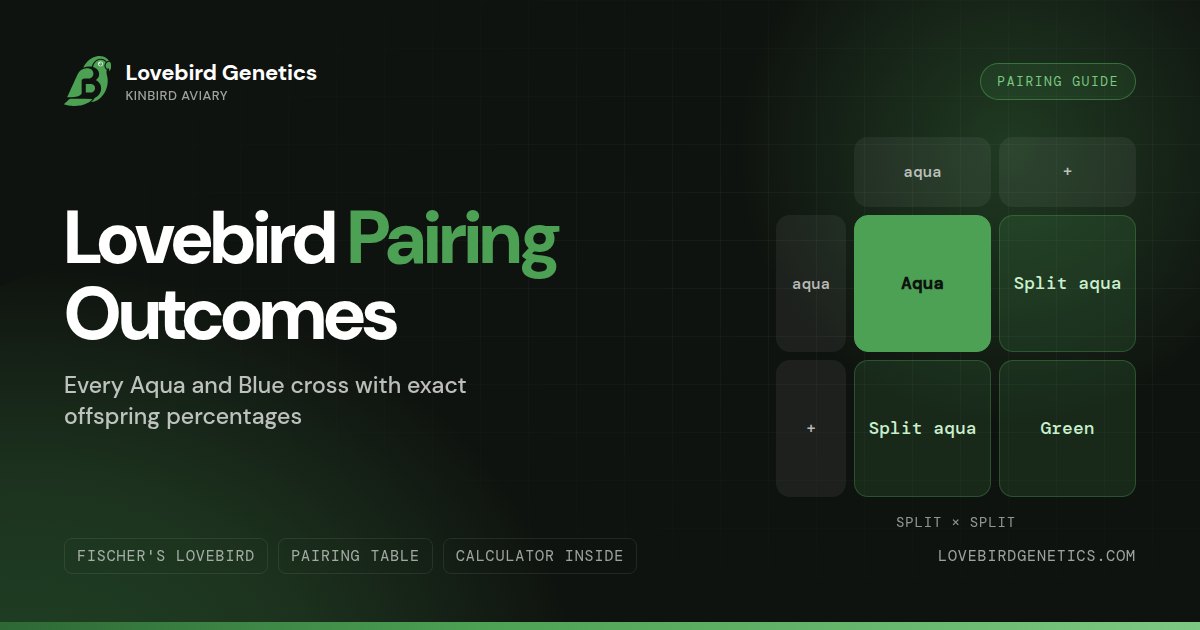
This is a verified reference of lovebird pairing outcomes for the Aqua and Blue (Parblue) series in Agapornis fischeri. Every result below was generated by the Lovebird Genetics Calculator engine, not estimated. Each pairing links straight into the calculator so you can adjust it for your own birds. For the Aqua mutation explained in full, see the Aqua breeder guide and the aqua mutation in lovebirds guide.
Aqua, Blue 1 and Blue 2 are alleles at the same blue locus, recessive to wild-type Green and co-dominant among themselves. Two visual blue-series parents carry no green allele, so they can never produce a pure Normal chick, a common mistake in older charts. The percentages here come directly from the calculator engine.
Every pairing in breeder syntax, cock × hen
Breeders write a pairing as cock × hen. What a pairing produces depends on the inheritance type of the mutation, not on the mutation name. Sex-linked mutations give different results depending on which parent carries them. Autosomal mutations do not.
Sex-linked recessive: Opaline cock × normal hen, and the reverse
Sex-linked mutations sit on the Z chromosome. A cock has two Z chromosomes so he can be split, a hen has only one Z so she can never be split. She either shows the mutation or does not carry it. This is why the direction of the pairing changes everything, and why these pairings can auto-sex the chicks.
| Pairing (cock × hen) | Sons | Daughters |
|---|---|---|
| Visual cock × normal hen | 100% split | 100% visual |
| Normal cock × visual hen | 100% split | 100% normal |
| Split cock × normal hen | 50% split, 50% normal | 50% visual, 50% normal |
| Split cock × visual hen | 50% visual, 50% split | 50% visual, 50% normal |
| Visual cock × visual hen | 100% visual | 100% visual |
Applies to Opaline, Cinnamon, Pallid and Pale. A visual cock paired to a normal hen is the classic auto-sexing pairing: every visual chick is a hen, every normal-looking chick is a split cock. Pallid is recorded by OGVZW as an original mutation in both Agapornis roseicollis and Agapornis fischeri. See the Pallid guide for the detail.
Autosomal recessive: Pale Fallow cock × Pale Fallow hen, and the split combinations
Autosomal mutations sit on ordinary chromosomes, so cocks and hens inherit them identically. Swapping the sexes in the pairing changes nothing.
| Pairing (cock × hen) | All chicks, both sexes |
|---|---|
| Visual cock × visual hen | 100% visual |
| Visual cock × normal hen | 100% split, no visuals |
| Split cock × split hen | 25% visual, 50% split, 25% pure normal |
| Visual cock × split hen | 50% visual, 50% split |
| Split cock × normal hen | 50% split, 50% pure normal, no visuals |
Applies to Yellow Face, Lutino and Albino, Dark Eyed Clear, Pastel, Dilute, Pale Fallow, Dun Fallow, Bronze Fallow and Recessive Pied. Splits and pure normals look identical, so pedigree records matter.
Aqua, Blue and Parblue are a special case. They are alleles at the same blue locus and Aqua B1 and Aqua B2 are co-dominant compounds rather than plain recessives, so a visual to visual pairing can still throw a different visual form. Their compound-specific tables are set out in full further down this page.
Bronze Fallow cock × Bronze Fallow hen gives roughly 100 percent chick mortality. Bronze Fallow must be bred through split carriers, never visual to visual.
Autosomal dominant: single factor and double factor pairings
Dominant mutations have no split form. One copy already shows as single factor (SF) and two copies make the bird double factor (DF). Where the mutation is an incomplete dominant, such as Euwing and Misty, the DF bird also looks visibly stronger than the SF bird. Where it is a plain dominant, such as Dominant Pied and Slaty, SF and DF are not reliably separable by eye and the pairing arithmetic below is what identifies a DF bird.
| Pairing (cock × hen) | All chicks, both sexes |
|---|---|
| SF cock × normal hen | 50% SF, 50% normal |
| SF cock × SF hen | 25% DF, 50% SF, 25% normal |
| DF cock × normal hen | 100% SF |
| DF cock × SF hen | 50% DF, 50% SF |
| DF cock × DF hen | 100% DF |
Euwing, Misty, Dominant Pied and Slaty follow this pattern and are modelled in the calculator. Violet and Dark Factor follow exactly the same rules but are not yet modelled in the calculator, so their SF or DF dose has to be tracked on paper.
Sex-linked dominant: Greywing
Greywing in Fischer's lovebirds is sex-linked incomplete dominant per Ornitho-Genetics VZW, so it combines both rules: one copy shows, and the direction of the pairing still matters.
| Pairing (cock × hen) | Sons | Daughters |
|---|---|---|
| Normal cock × Greywing hen | 100% SF Greywing | 100% normal |
| SF Greywing cock × normal hen | 50% SF, 50% normal | 50% Greywing, 50% normal |
| DF Greywing cock × normal hen | 100% SF | 100% Greywing |
Which rule applies to which mutation
| Mutation | Inheritance | Full cock × hen breakdown |
|---|---|---|
| Opaline | Sex-linked recessive | Opaline guide |
| Cinnamon | Sex-linked recessive | Cinnamon guide |
| Pallid | Sex-linked recessive, recorded by OGVZW as original in A. roseicollis and A. fischeri | Pallid guide |
| Pale | Sex-linked recessive | Pale guide |
| Greywing | Sex-linked dominant | Greywing guide |
| Aqua | Blue-locus allele. Aqua Homo (aqua / aqua) behaves autosomal recessive; Aqua B1 (aqua // bl1) and Aqua B2 (aqua // bl2) are co-dominant compounds | Aqua guide |
| Yellow Face | Autosomal recessive | Yellow Face guide |
| Lutino and Albino | Autosomal recessive | Lutino and Albino guide |
| Dark Eyed Clear | Autosomal recessive | Dark Eyed Clear guide |
| Pastel | Autosomal recessive | Pastel guide |
| Dilute | Autosomal recessive | Dilute guide |
| Pale Fallow | Autosomal recessive | Pale Fallow guide |
| Dun Fallow | Autosomal recessive | Dun Fallow guide |
| Bronze Fallow | Autosomal recessive | Bronze Fallow guide |
| Blue | Blue-locus allele. bl1 / bl1 and bl2 / bl2 breed true and behave autosomal recessive to wild-type | Blue guide |
| Parblue | Blue-locus compound (bl1 // bl2). Both alleles express, so Parblue cannot breed true | Parblue guide |
| Recessive Pied | Autosomal recessive | Recessive Pied guide |
| Euwing | Autosomal dominant, incomplete | Euwing guide |
| Misty | Autosomal dominant, incomplete | Misty guide |
| Dominant Pied | Autosomal dominant | Dominant Pied guide |
| Slaty | Autosomal dominant | Slaty guide |
| Violet | Autosomal dominant, incomplete | Violet guide |
| Dark Factor | Autosomal dominant, incomplete | Dark Factor guide |
Enter any of the modelled mutations above in the free lovebird genetics calculator to get the exact offspring percentages for your own birds, including splits and sex-specific results. Violet and Dark Factor are the two exceptions and are tracked on paper.
Aqua series pairings
What does Aqua B1 x Aqua B1 produce?
Aqua B1 x Aqua B1 produces 25% Aqua Homo, 50% Aqua B1, 25% Blue 1. Verified on the lovebirdgenetics.com calculator engine.
| 1.0 Aqua B10.1 Aqua B1 | ||
|---|---|---|
| Offspring | Chance | Note |
| Aqua Homo | 25% | |
| Aqua B1 | 50% | |
| Blue 1 | 25% | |
What does Aqua B2 x Aqua B2 produce?
Aqua B2 x Aqua B2 produces 25% Aqua Homo, 50% Aqua B2, 25% Blue 2. Verified on the lovebirdgenetics.com calculator engine.
| 1.0 Aqua B20.1 Aqua B2 | ||
|---|---|---|
| Offspring | Chance | Note |
| Aqua Homo | 25% | |
| Aqua B2 | 50% | |
| Blue 2 | 25% | |
What does Aqua B1 x Aqua B2 produce?
Aqua B1 x Aqua B2 produces 25% Aqua Homo, 25% Aqua B1, 25% Aqua B2, 25% Parblue (B1B2). Verified on the lovebirdgenetics.com calculator engine.
| 1.0 Aqua B10.1 Aqua B2 | ||
|---|---|---|
| Offspring | Chance | Note |
| Aqua Homo | 25% | |
| Aqua B1 | 25% | |
| Aqua B2 | 25% | |
| Parblue (B1B2) | 25% | |
What does Aqua Homo x Aqua B1 produce?
Aqua Homo x Aqua B1 produces 50% Aqua Homo, 50% Aqua B1. Verified on the lovebirdgenetics.com calculator engine.
| 1.0 Aqua Homo0.1 Aqua B1 | ||
|---|---|---|
| Offspring | Chance | Note |
| Aqua Homo | 50% | |
| Aqua B1 | 50% | |
What does Aqua Homo x Aqua B2 produce?
Aqua Homo x Aqua B2 produces 50% Aqua Homo, 50% Aqua B2. Verified on the lovebirdgenetics.com calculator engine.
| 1.0 Aqua Homo0.1 Aqua B2 | ||
|---|---|---|
| Offspring | Chance | Note |
| Aqua Homo | 50% | |
| Aqua B2 | 50% | |
What does Aqua Homo x Aqua Homo produce?
Aqua Homo x Aqua Homo produces 100% Aqua Homo. Verified on the lovebirdgenetics.com calculator engine.
| 1.0 Aqua Homo0.1 Aqua Homo | ||
|---|---|---|
| Offspring | Chance | Note |
| Aqua Homo | 100% | |
What does Aqua Homo x Green (Normal) produce?
Aqua Homo x Green (Normal) produces 100% Green / Aqua (split). Verified on the lovebirdgenetics.com calculator engine.
| 1.0 Aqua Homo0.1 Green (Normal) | ||
|---|---|---|
| Offspring | Chance | Note |
| Green / Aqua (split) | 100% | |
What does Aqua B1 x Green (Normal) produce?
Aqua B1 x Green (Normal) produces 50% Green / Aqua and 50% Green / Blue 1. The Aqua B1 parent carries one aqua allele and one bl1 allele, so each chick inherits one or the other, and every chick looks Green. Verified on the lovebirdgenetics.com calculator engine.
| 1.0 Aqua B10.1 Green (Normal) | ||
|---|---|---|
| Offspring | Chance | Note |
| Green / Aqua | 50% | Split for aqua, looks Green |
| Green / Blue 1 | 50% | Split for bl1, looks Green |
What does Aqua B1 x Blue 1 produce?
Aqua B1 x Blue 1 produces 50% Aqua B1, 50% Blue 1. Verified on the lovebirdgenetics.com calculator engine.
| 1.0 Aqua B10.1 Blue 1 | ||
|---|---|---|
| Offspring | Chance | Note |
| Aqua B1 | 50% | |
| Blue 1 | 50% | |
What does Aqua B2 x Blue 1 produce?
Aqua B2 x Blue 1 produces 50% Aqua B1, 50% Parblue (B1B2). Verified on the lovebirdgenetics.com calculator engine.
| 1.0 Aqua B20.1 Blue 1 | ||
|---|---|---|
| Offspring | Chance | Note |
| Aqua B1 | 50% | |
| Parblue (B1B2) | 50% | |
What does Aqua B2 x Parblue (B1B2) produce?
Aqua B2 x Parblue (B1B2) produces 25% Aqua B1, 25% Aqua B2, 25% Parblue (B1B2), 25% Blue 2. Verified on the lovebirdgenetics.com calculator engine.
| 1.0 Aqua B20.1 Parblue (B1B2) | ||
|---|---|---|
| Offspring | Chance | Note |
| Aqua B1 | 25% | |
| Aqua B2 | 25% | |
| Parblue (B1B2) | 25% | |
| Blue 2 | 25% | |
What does Normal / Aqua (split) x Normal / Aqua (split) produce?
Normal / Aqua (split) x Normal / Aqua (split) produces 25% Aqua Homo, 50% Green / Aqua (split) and 25% pure Green. The splits and the pure Greens look identical, so pedigree records or a test pairing are needed to tell them apart. Verified on the lovebirdgenetics.com calculator engine.
| 1.0 Normal / Aqua (split)0.1 Normal / Aqua (split) | ||
|---|---|---|
| Offspring | Chance | Note |
| Aqua Homo | 25% | Visual Aqua |
| Green / Aqua (split) | 50% | Carries one Aqua allele, looks Green |
| Green (pure) | 25% | Carries no Aqua allele, looks identical to the splits |
Blue and Parblue series pairings
What does Blue 1 x Blue 2 produce?
Blue 1 x Blue 2 produces 100% Parblue (B1B2). Verified on the lovebirdgenetics.com calculator engine.
| 1.0 Blue 10.1 Blue 2 | ||
|---|---|---|
| Offspring | Chance | Note |
| Parblue (B1B2) | 100% | |
What does Parblue (B1B2) x Parblue (B1B2) produce?
Parblue (B1B2) x Parblue (B1B2) produces 50% Parblue (B1B2), 25% Blue 1, 25% Blue 2. Each parent passes either a bl1 or a bl2 allele, so a quarter of the chicks are bl1/bl1 (Blue 1), a quarter are bl2/bl2 (Blue 2) and half are the bl1/bl2 compound, which is Parblue. Verified on the lovebirdgenetics.com calculator engine.
| 1.0 Parblue (B1B2)0.1 Parblue (B1B2) | ||
|---|---|---|
| Offspring | Chance | Note |
| Parblue (B1B2) | 50% | bl1/bl2 compound |
| Blue 1 | 25% | bl1/bl1 |
| Blue 2 | 25% | bl2/bl2 |
What does Blue 1 x Green (Normal) produce?
Blue 1 x Green (Normal) produces 100% Green / Blue 1 (split). Verified on the lovebirdgenetics.com calculator engine.
| 1.0 Blue 10.1 Green (Normal) | ||
|---|---|---|
| Offspring | Chance | Note |
| Green / Blue 1 (split) | 100% | |
Run your own pairing
These cover the most-asked Aqua and Blue crosses, but the calculator handles the full modelled set, including Opaline, Ino (Creamino), Pale Fallow and multi-trait pairings, with separate male and female outcomes for sex-linked mutations. Violet and Dark Factor are the two modifiers it does not yet model. Open the Lovebird Genetics Calculator →